


A CATI study by MKOR for Gociu Lawyers: 414 decision-makers interviewed, 322 firms that requested the free legal audit, and a public report cited by 18 publications.

IP Legal Readiness Review 2026, conducted by MKOR for Gociu Lawyers.
How well protected in law are the brands on which Romanian companies build their growth?
Why is the registration of trademarks and designs put off until the first conflict? And how wide is the gap between marketing budgets and the budgets set aside to protect the same assets?
To find out, Gociu Lawyers commissioned MKOR to run a nationwide quantitative study of business decision-makers in four sectors exposed to the risk of copying:
- fashion and footwear
- pharma and supplements
- food and beverages
- cosmetics and personal care
MKOR’s survey of 414 decision-makers was complemented by a legal maturity audit that Gociu Lawyers carried out on 322 firms. Together they make up the “IP Legal Readiness Review 2026”, a case study in how B2B market research can generate qualified demand for a client.
Contents
The study at a glance: challenge, MKOR’s solution and results
| Challenge | MKOR’s solution | Results |
|---|---|---|
| Gociu Lawyers needed primary, nationwide data on the gap between brand investment and its legal protection, so that it could speak to the market about risk. | MKOR designed and ran a CATI study of 414 decision-makers in 4 sectors and offered every respondent a free legal audit, so that taking part in the study generated leads, tracked in a real-time dashboard. | 322 of the 414 firms interviewed (77.8%) requested the free Gociu audit. The audit showed an average maturity score of 42.3 out of 100, and 59.3% of audited firms are in the critical or emerging zone. The study was cited by 18 publications. |
What the data shows: brands grow faster than their legal protection
The MKOR survey (CATI, N=414) shows that 78% of companies operate with no formal intellectual property protection, and only 22% hold registered IP assets.
At the same time, 64% of companies plan to invest in 2026, mainly in marketing and digitalisation, but only 13% intend to invest in protecting their intellectual property.
Delay costs time.
Among firms that hold a registered trademark (n=93), the average exposure window between product launch and trademark registration is 11.2 months. During that period, the brand can be copied or registered by someone else.
The main barrier is perceived risk. 67% of companies do not work with a lawyer (MKOR, N=414), and among the firms that do not use legal services, 40% believe they have nothing to protect.
The Gociu Lawyers audit of 322 firms confirms the picture.
The average maturity score is 42.3 out of 100, below the threshold for functional protection. By dimension, Brand scores 71% while Protection scores only 18%.
Digital stays below 40%, which means online exposure is often greater than offline exposure. By maturity level, 59.3% of audited firms sit in the critical or emerging zone, and only 21.4% reach the consolidated or strategic level.
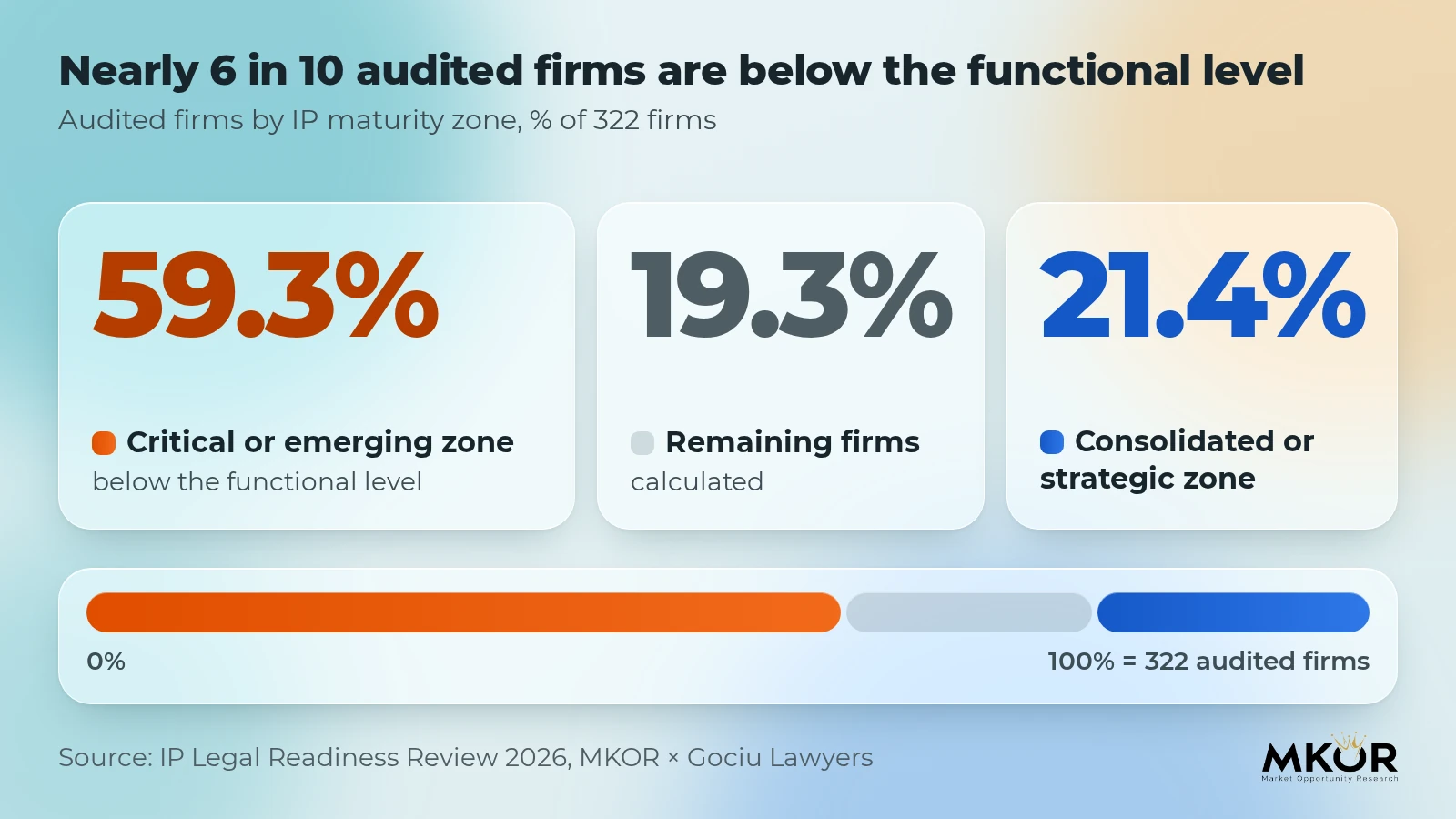
IP maturity zones, Gociu Lawyers audit of 322 firms.
The differences between sectors are clear. Fashion is the most mature sector, with a score of 48.2, followed by Cosmetics and personal care (43.1), Pharma and supplements (39.6) and Food and beverages (39.3).
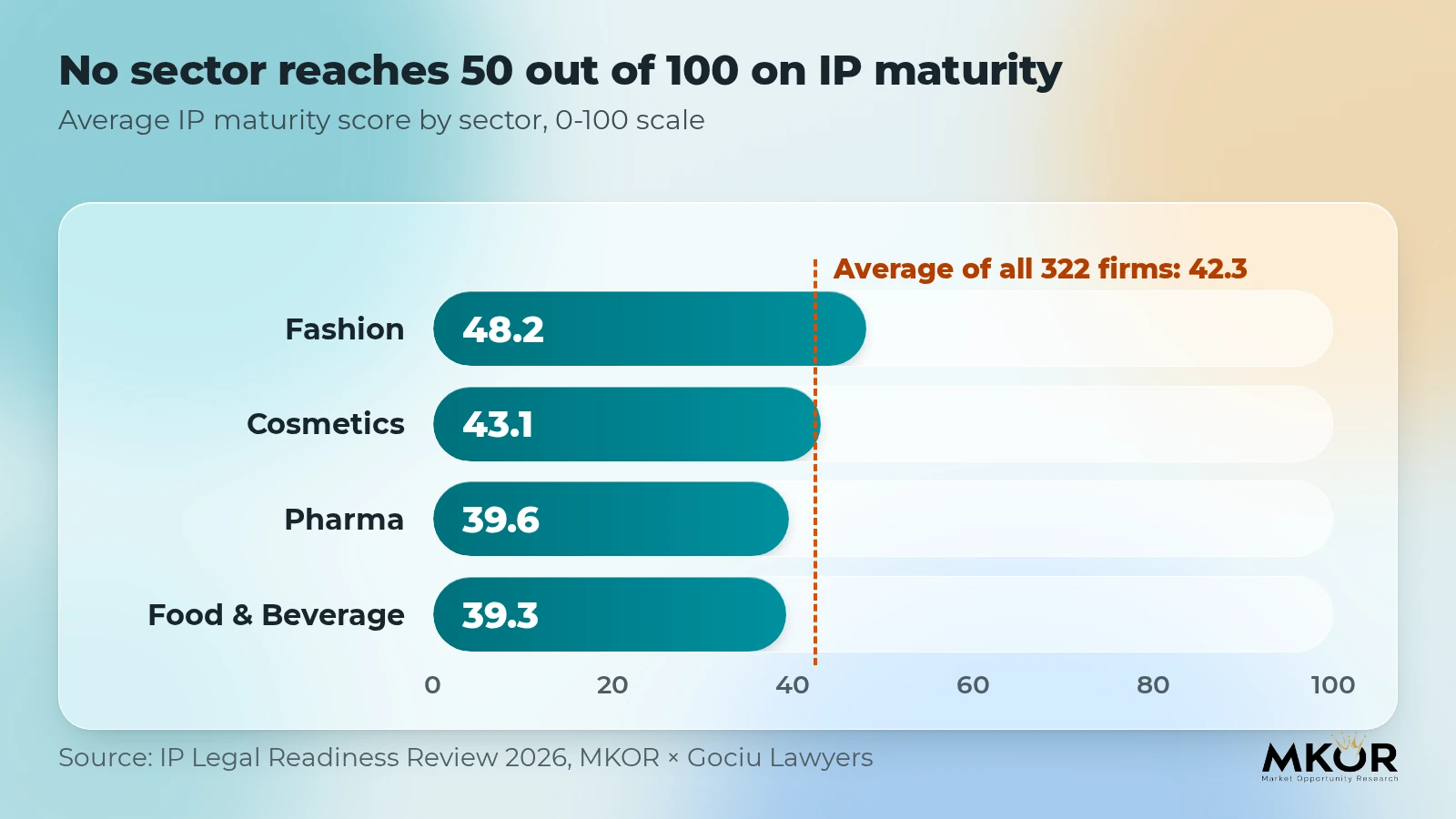
Average IP maturity score by sector, Gociu Lawyers audit of 322 firms.
Cosmetics illustrates the gap between marketing and protection best: 74% of firms in the sector are investing in marketing in 2026, but only 10% plan to invest in IP (MKOR, by sector).
- Fashion has a similar profile, with 61% intending to invest in marketing and 17% in IP.
- Food and beverages has the highest stated intention to invest in IP, at 19%, but on fragile legal foundations, especially for recipes and production processes.
- Pharma has the lowest intention, at 6%.
Download the Gociu Lawyers × MKOR report for free with the scores across the five dimensions, the sector analysis and the recommended courses of action.
How the study generated leads for Gociu Lawyers
A co-branded study can win clients as well as press coverage.
Every respondent was offered a free legal audit, and 322 of the 414 firms interviewed (77.8%) asked for it. For Gociu Lawyers, the survey worked as a lead generation channel: qualified contacts with a maturity score already calculated, delivered throughout fieldwork through a real-time dashboard.
The figures then supported a positioning built on real market risk, and the press picked up the results.
What are the benefits of a study on intellectual property protection for Romanian businesses?
A study of this kind gives an objective view of the gap between brand and protection and shows where the exposure risk is greatest. The main benefits are:
- Identifying points of exposure: shows where a company’s brand, design or production process remains legally unprotected.
- Grounding investment decisions: provides an objective reference for splitting budgets between marketing and legal protection.
- Sector benchmark: lets a company compare its maturity level with the average for its sector.
How was the market study on intellectual property protection carried out?
MKOR ran a quantitative B2B market research study using computer-assisted telephone interviewing (CATI), with a sample of 414 decision-makers in four sectors with a high risk of copying. Gociu Lawyers then assessed the legal maturity of the 322 companies that asked for the free audit:
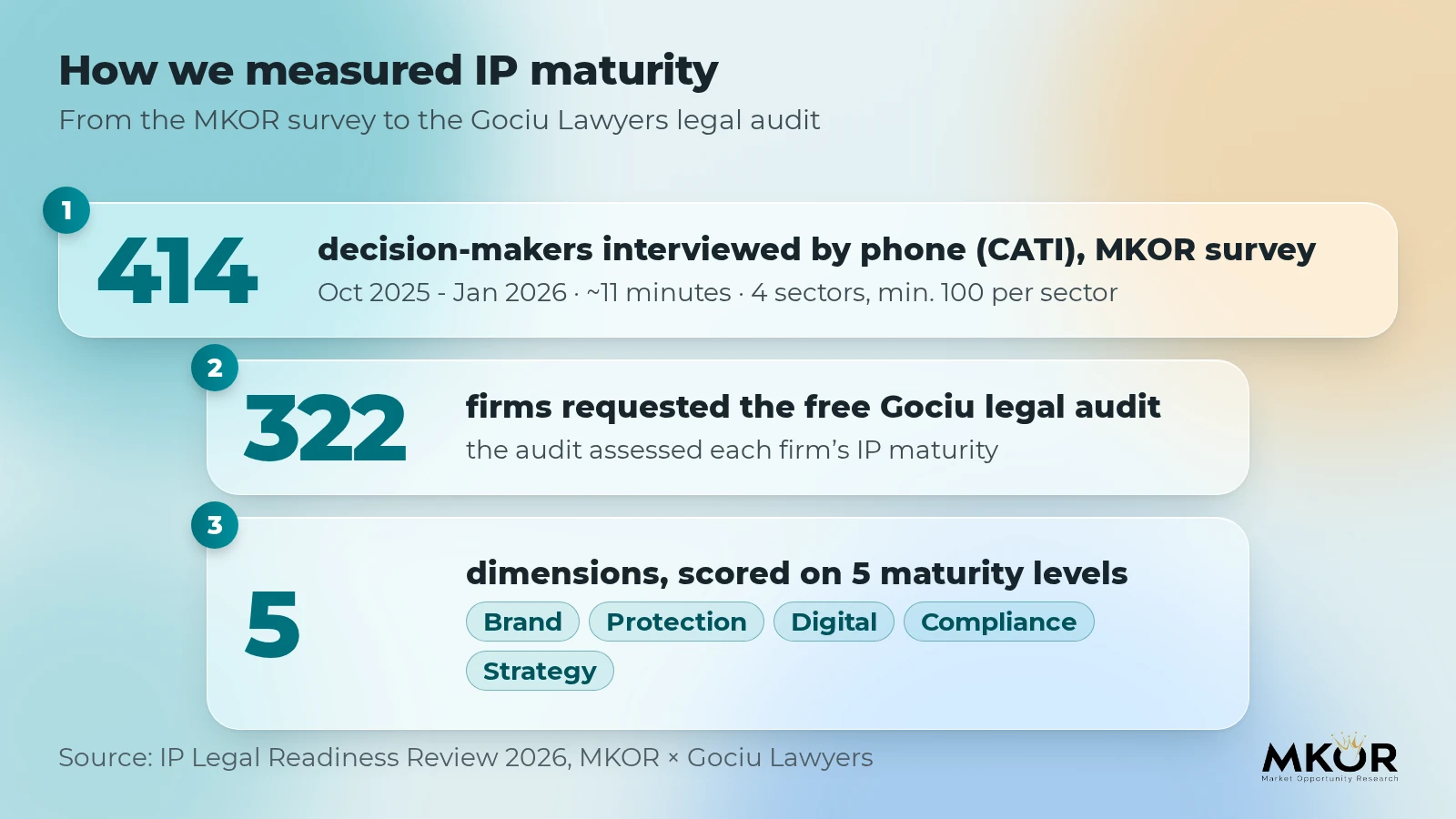
Study design: MKOR survey of 414 decision-makers and Gociu Lawyers legal audit of 322 firms, across 4 sectors.
- Target market: Romania
- Target group: business decision-makers in fashion and footwear, pharma and supplements, food and beverages, and cosmetics and personal care
- Research type: primary, quantitative
- Method: computer-assisted telephone interview (CATI) of about 11 minutes
- Sample: N=414, with a minimum of 100 interviews per sector
- Fieldwork period: October 2025 to January 2026
- Analysis framework: five maturity dimensions (Brand, Protection, Digital, Compliance, Strategy) and five levels, from critical to strategic
The public report produced by the project is available free of charge on the client’s website, on the dedicated study page.
Who is Gociu Lawyers, the client behind this study?
Gociu Lawyers (registered in Romania as Gociu și Asociații Societate Civilă de Avocați) is a law firm specialising in business law and intellectual property.
The firm advises entrepreneurial companies and brands on protecting, structuring and exploiting commercial assets, through advice on trademarks, designs and copyright, as well as on commercial contracts, distribution and e-commerce.
Gociu Lawyers is an authorised agent before OSIM (the Romanian trademarks office), EUIPO, WIPO and the EPO, and builds intellectual property assets into its clients’ legal and asset structures, in due diligence, financing, international expansion and exit scenarios.
The firm has offices and partnerships in Romania and Dubai.
Who a B2B market research study is right for
A B2B market research study measures how ready a market is for a solution, a service or a change of standard, directly among the people who take the decisions in companies. It suits situations such as:
- Professional service providers who want to understand how aware the market really is before launching a new offer or entering an unfamiliar segment.
- Companies investing in their own brands, products or packaging that need an objective benchmark of their exposure against the sector average.
- Professional associations and industry organisations that back a public position or a regulatory initiative and need data of their own to stand behind.
- Companies preparing a funding round, due diligence or an expansion who must demonstrate the strength of their assets and of the market they operate in.
An example from another regulated field is the legal tech platform study. You can find other projects MKOR has carried out on its own initiative on the public research page.
What the press said about the study
The results were announced in a joint MKOR and Gociu Lawyers press release in July 2026. The study was published or cited by 18 publications, including Forbes România, AmCham România, Economedia, Legal Marketing and Juridice.ro (16 October 2026).
What the client says
“The market study carried out by MKOR offered a thorough analysis and valuable data, allowing us to ground our action in accurate data. [...] Our experience with MKOR was exceptional and we recommend them without reservation for any market research and professional analysis needs.”

Excerpt from the recommendation letter signed in February 2024, for an earlier engagement with MKOR.
Frequently asked questions
How much does a B2B market research study cost, and how long does it take?
A CATI study of decision-makers in four sectors, with at least 100 interviews per sector, needed four months of fieldwork, from October 2025 to January 2026. After a briefing, MKOR sends a tailored quote setting out the sample, the timeline and the deliverables.
What is a CATI study?
A trained interviewer calls the respondent and enters the answers straight into the system, which reduces recording errors and allows sector quotas to be controlled in real time. The method suits B2B studies, where decision-makers are hard to reach online.
What sample size is enough for a B2B study?
Who owns the study data?
How does a co-branded study work?
MKOR designs the questionnaire and conducts the interviews, while the client brings subject expertise and, where relevant, a value offer for respondents, such as the free legal audit in the Gociu Lawyers project. The result is a public report that can be cited in the press and that brings in qualified leads as well as visibility.
Want a co-branded study for your law firm, consultancy or association?
MKOR designs, runs and analyses B2B market research studies that the client publishes under its own brand, following the model used for Gociu Lawyers:
- a CATI questionnaire aimed at your target group
- a value offer for every respondent
- leads delivered in real time
- a public report that can be cited in the press
We work with law firms, consultancies and professional associations that want primary data to build their position on.
Tell us what question the market should answer and we will propose the study design, the sample and the timeline. Contact the MKOR team for a no-obligation conversation, or see more projects in the market research portfolio.