



Steve Jobs once said: “It’s really hard to design products by focus groups. A lot of times, people don’t know what they want until you show it to them.” That may hold true when you’re Steve Jobs. For the rest of us, business is built on solid evidence — and there are real business opportunities through market research that a methodical approach can bring to light.

Why market research creates real business opportunities
Even if your business model is innovative, there are steps you must take to ensure customer satisfaction. You can measure it, grow it, and truly understand it — only through research.
Whether conducted scientifically by experienced professionals or developed in-house intuitively, research among your customers will help you discover new opportunities for your business — straight from the source.
Four types of research that open new doors
1. Market Sizing
Before you invest in a new product or expand a service line, you need to know whether the market is large enough. A market sizing study estimates the potential volume of customers, their purchasing power, and likely adoption rate. Without this analysis, investment decisions are made in the dark.
A practical example: a food industry manufacturer wants to launch a premium range. Market sizing research reveals that the target segment has 3–4x the spending capacity of the market average — but that distribution remains the main barrier. The result: the launch decision changes fundamentally. The priority becomes partnership with specialty retail networks, not mass advertising.
2. Customer Satisfaction Studies
Customer satisfaction is not a vague concept. It can be measured, tracked over time, and turned into concrete actions. A periodic satisfaction study (Customer Satisfaction Score) or NPS (Net Promoter Score) shows you exactly where and why you’re losing customers.
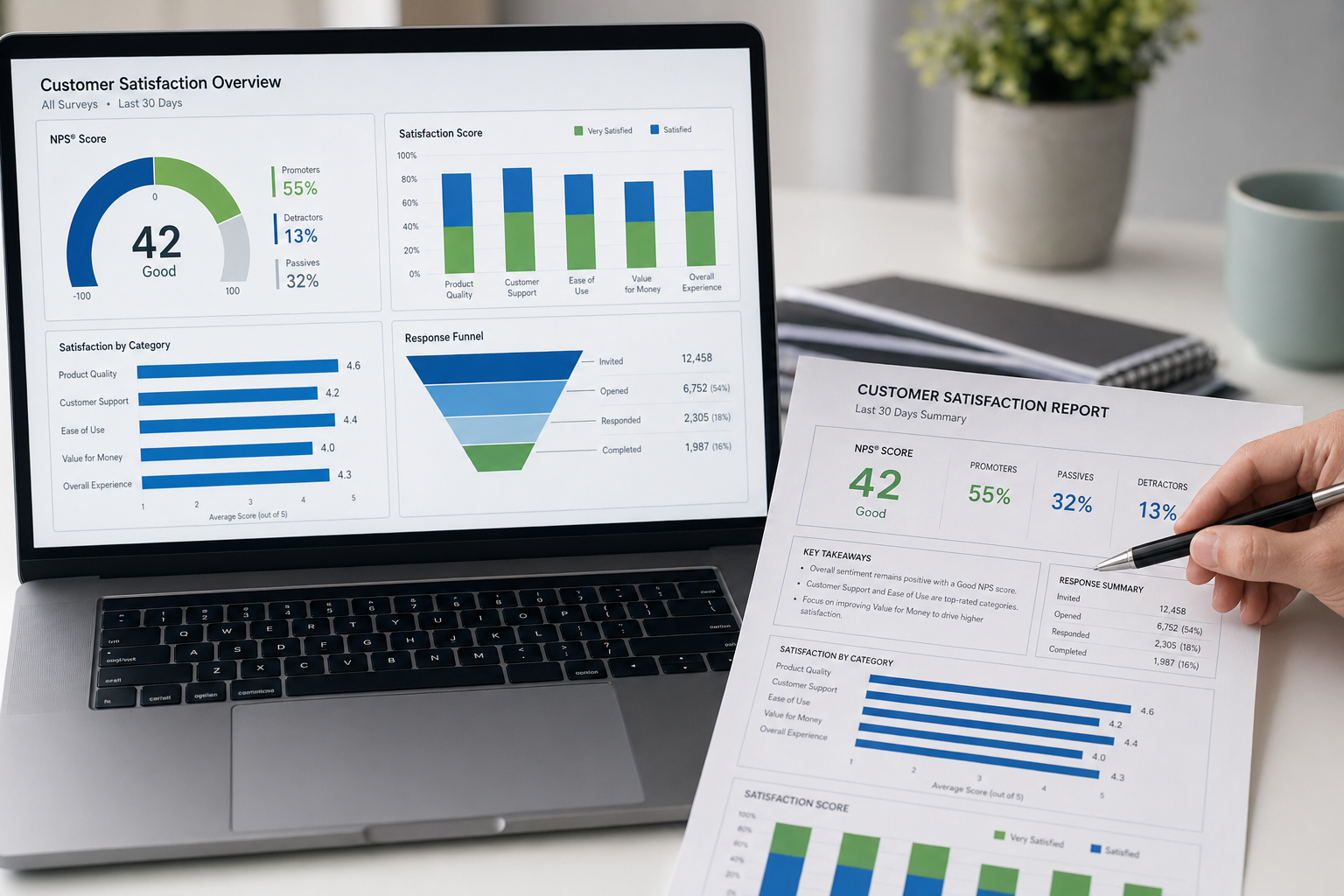
A retailer with 40 stores discovered through such a study that the satisfaction gap between high-scoring and low-scoring locations wasn’t price or product range — it was how staff handled complaints. A data-driven training intervention raised NPS by 18 points in 6 months.
3. Usage & Attitudes Studies
A U&A study maps how consumers use a product or service, what attitudes they hold toward the category and brands, and what the consumption occasions are. This data is directly actionable for marketing and product teams.
Say you sell management software for small businesses. A U&A study might reveal that 60% of users only use 3 of the 12 available features — not because they don’t need the others, but because they don’t know they exist. The business opportunity: a better onboarding programme can double retention without any new product development cost.
4. Brand Tracking
Your brand’s awareness, perception relative to competitors, and the spontaneous associations consumers make — all of these shift over time. A brand tracking study conducted quarterly or semi-annually lets you react quickly to market shifts, rather than discovering them too late.
A financial services company used brand tracking to detect a deterioration in perceived transparency — 6 months before this issue began affecting acquisition rates. The communication campaign that followed was built on data, not intuition, and reversed the trend.

How to turn data into decisions
Data gathered through research is only as valuable as the quality of decisions it supports. Well-conducted research doesn’t end with a report delivery — it concludes with a set of actionable recommendations, prioritised by impact and feasibility.
At MKOR, we recently completed such a project with one of our clients, who approached it with exactly this mindset. After two months of work, the results gave them a range of new tools they can use to innovate and be first to market with what comes next.

Research isn’t a cost — it’s a competitive advantage
Companies that invest systematically in research make better-informed decisions with lower risk. They know more than their competitors about their customers, market, and trends.
Sometimes the opportunity is hidden in an underserved segment, an unexpressed dissatisfaction, or a consumption behaviour nobody has measured yet. Research brings it to the surface.
How far do you look for business opportunities? And how often?
If the honest answer is “not very far” or “rarely,” then a market research study might be exactly the tool you need. Explore MKOR’s research services and let’s find together what opportunities your market is hiding.
Have you read everything? Comment / join our newsletter / read our other research posts!