



Net Promoter Score (NPS) is a management tool, a performance indicator that measures, among all customers who express an opinion, the difference between the promoters and detractors of a product, service, or company.
NPS = % Promoters – % Detractors
When calculating the Net Promoter Score, an essential question must be asked: “How likely is it that you would recommend product/service/company X to a friend or colleague?”. To collect responses and determine the score, a scale from 0 to 10 is used, where 0 means “not at all likely”, 5 is “neutral”, and 10 means “extremely likely”.
We recommend accessing the NPS in Romanian retail report, where you can track the NPS score across all industries monitored since the launch of ConsumerTrends.Live, find out What is NPS?, How to interpret the NPS score, as well as NPS Benchmarking in the global retail market.
Promoters (with a score of 9-10) are enthusiastic, loyal consumers who will repurchase and recommend the brand to others. Long-term relationships between a brand and its consumers reduce costs. The relationship with promoters can be improved through constant communication, offers, follow-ups, etc.
Passives (with a score of 7-8) are satisfied but unenthusiastic consumers who are vulnerable to competitive offerings. To achieve a higher score and avoid an increase in the number of detractors, efforts must be made to turn passives into promoters.
Detractors (with a score of 0-6) are unhappy consumers who can damage the brand by spreading negative word-of-mouth. To decrease the number of detractors, the reasons that led to their dissatisfaction must be researched, and then the appropriate solution must be found to resolve them.
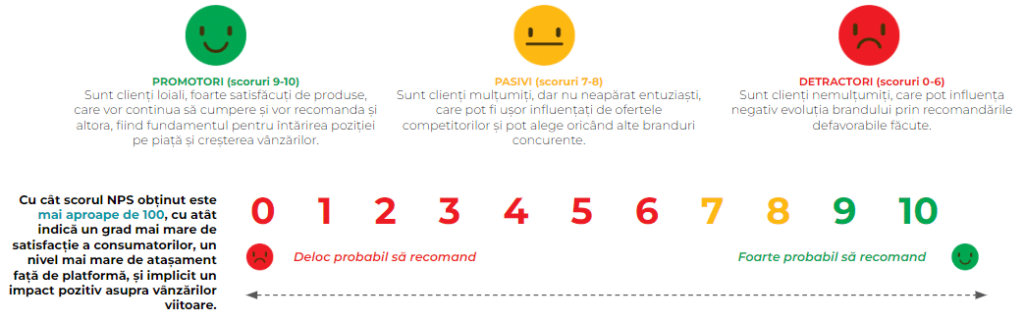 Net Promoter Score results can range between -100% and +100%. A higher figure means a better score, as the number of promoters is higher. If the result is negative, it means the number of detractors is greater than that of promoters, which can be the cause of problems related to revenue growth and the company’s market position.
Comparing NPS across different regions, industries, representatives, or consumer segments most often leads to discovering the causes of these differences and thus to appropriate solutions for implementation.
Does your company conduct studies to determine consumer loyalty?
What truly matters is how your company ranks against the competition. After calculating the score, you can determine how your company is perceived in the industry and whether the obtained NPS is a competitive advantage or not.
Always seek to improve your score!
Even though they are different performance indicators, the Net Promoter Score can be associated with the level of consumer satisfaction. Although NPS measures the likelihood of users recommending a product/service/company and the satisfaction level refers to the consumer experience, these are linked. A consumer who has had a good consumption experience is much more likely to recommend a product than one who is not satisfied with it. Thus, the net promoter score is a performance indicator aimed at determining consumer opinion about a certain product, company, etc., and establishing the probability of them recommending them.
What Net Promoter Score does your company have?
If you want to build or maintain your market position, it is essential to know how loyal your consumers are and how likely they are to recommend your company to others. MKOR Consulting offers you the opportunity to find these things out; all you have to do is let us know.
We help you make decisions based on real data through market research tailored to your objectives. The MKOR team uses verified working methods, specially designed for your business.
MKOR Methodology: precision and relevance
We combine quantitative research (CATI and our own online panel) with qualitative research, such as focus groups or interviews. We find out what consumers think through Usage & Attitude (U&A) studies, beyond simple numbers.
Case studies and expertise
We have worked on dozens of brand tracking projects and market analyses for large companies. Our studies show you exactly where you stand compared to the competition and what is changing in the market right now.
Frequently Asked Questions (FAQ)
How long does a market study take? It depends on what you need. A quick survey in the online panel is ready in a few days, while qualitative research can take several weeks.
What type of research suits me? Choose quantitative research if you want to measure the market. If you want to find out “why” people behave in a certain way, go for the qualitative option.
Have you read everything? Comment / join our newsletter / read our other research posts!