

A few years ago, workplace diversity was a rarely discussed concept – at least in the Romanian context.
Today, more and more companies are including aspects related to Diversity, Inclusion, and Gender Equality in their organizational policies.
We are debating this topic to find out what “diversity” actually means, why it is an asset for a business, and the importance of diversity of thought, inclusion, and equal opportunity.
What is diversity?
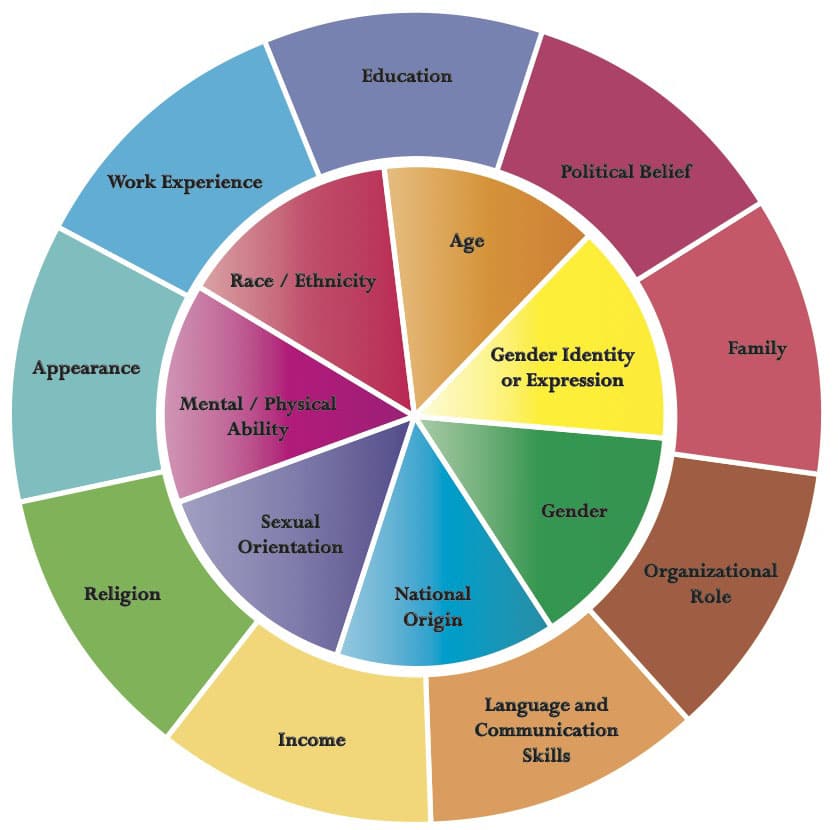
According to the definition provided by Business Dictionary, diversity refers to understanding, evaluating, and accepting differences between people related to age, gender identity, sexual orientation, physical and mental abilities, race, ethnicity, religion, and other attributes.
A study conducted by Macromex and Aon Romania shows that workplace diversity has a strong impact on employee engagement. Thus, according to the survey data, diversity is appreciated by the employees of Macromex, a company that achieved a high score for “diversity and inclusion” – 83%. At Selgros Romania, a company that also participated in the survey, the focus is on what unites people and their shared values.
A sensitive and important topic for some, while of no interest to others, opinions regarding diversity are divided.
Therefore, while some believe that organizations should have official policies and procedures aimed at supporting organizational diversity, for others, a simple verbal agreement, established by consensus across the entire company, is sufficient.
Diversity – a business asset?
A study conducted by Deloitte indicates that companies that support diversity and inclusion in all aspects of their business outperform their competitors in terms of performance. According to the 2017 “Deloitte Global Human Capital Trends” report, two-thirds of 10,000 surveyed leaders mentioned diversity and inclusion as “important” or “very important” for business.
Employee diversity improves performance when it comes to common creative tasks, such as product development or identifying new opportunities. Therefore, managers pay attention to this aspect to reap the benefits brought by innovation and new ideas.
Diversity of thought
Research shows that diversity of thought is important for creativity, increasing innovation by approximately 20%. It also allows groups to identify risks more easily, reducing them by up to 30%.
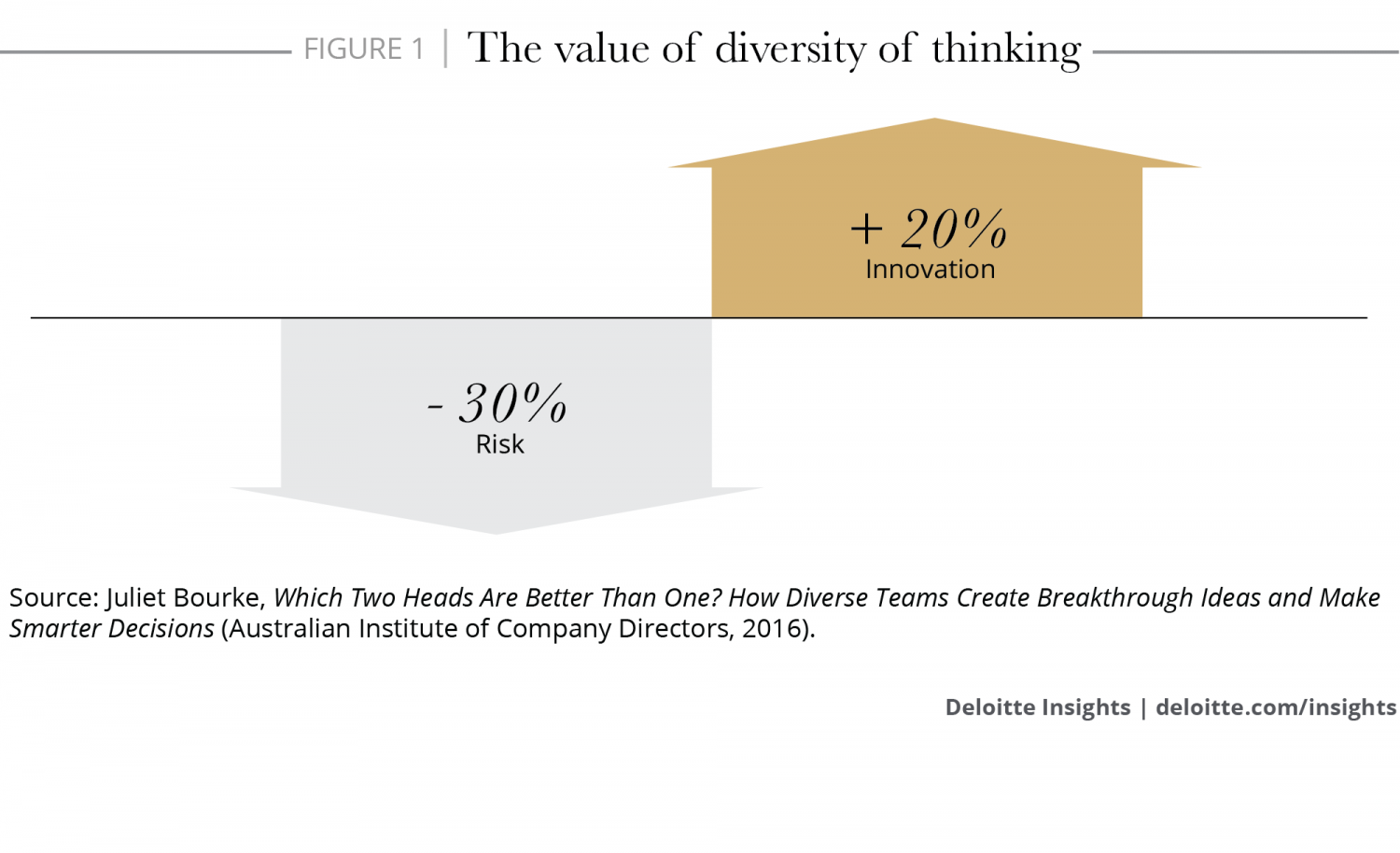
Diversity of thought in a company is valuable for at least three reasons:
- First, it contributes to creating an environment where every employee matters and feels they share common goals with others;
- Second, it better reflects the complexity of people, instead of focusing on a single specific aspect of social or demographic identity;
- Third, it recognizes demographic equality, which is useful as it is an indicator of progress toward diversity of thought.
Thus, every employee in a company will contribute based on their own cultural and educational background, as well as their skill sets, experiences, and knowledge. Therefore, differences will be noted in the ways tasks are solved or goals are achieved, as well as in the communication or coordination styles of a team.
Consequently, each different perspective from employees becomes a new opportunity to improve the organization’s strategy, processes, and procedures.
What impact does inclusion have in companies
Even if diversity is an important value in a company, without inclusion, it is not truly implemented, but will remain only a desideratum.
Inclusion represents the active involvement of the ideas, knowledge, perspectives, approaches, and style of each employee. Through the participation and contribution of all employees, a collaborative environment is ensured where support and respect dominate, values that help maximize performance.
In the study “Unleashing the power of inclusion”, Deloitte found that the number of executives who rated inclusion as a priority increased by 32% from 2014 to 2017.
The results of the study conducted by Deloitte reveal that inclusion represents a critical component of organizational culture, having a major impact on employee retention in a company.
Thus, 80% of respondents claim that inclusion is important when choosing an employer, and 39% of those surveyed state that they would leave their current job for a company that takes inclusion into account. Also, 23% of respondents declare that they left the organizations they were active in for the same reason stated above.
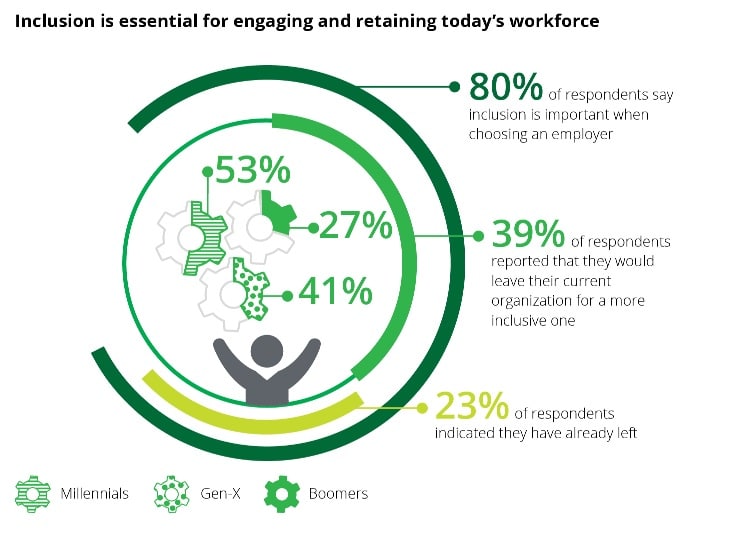
All this considering that 60% of Millennials are open to a new job opportunity, and 21% claim they have changed jobs in the last year, according to a recent Gallup survey.
Following research conducted by Deloitte, it emerged that diversity is perceived differently by different generations.
Millennials consider diversity in the workplace a mix of backgrounds, experiences, and perspectives. They also believe that taking advantage of these differences is what leads to innovation.
Gen Xers and Boomers consider diversity in the workplace as equal and fair representation, regardless of demographics, without necessarily taking into account the relationship of diversity with business results.
Gender equality and equal opportunity
Being one of the fundamental principles of the European Union, but also one of the principles of the European Pillar of Social Rights, gender equality refers to equal treatment and opportunities between men and women. The principle is ensured and promoted in all fields, including aspects such as: participation in the labor market, employment conditions, and career development.

Romania, Finland, and Croatia, the member states that consecutively hold the rotating presidency of the Council of the European Union during the period January 2019 – June 2020, signed the Trio Declaration on equal opportunities between women and men, a document that establishes the objectives, measures, and common actions specific to this field.
Among the objectives assumed by the Presidency Trio are:
- encouraging women’s participation in the labor market;
- ensuring a favorable environment for women’s entrepreneurship;
- improving the quality of life for all those in vulnerable situations.
In a ranking conducted by the Georgetown University Institute for Women, Peace and Security, Romania ranks 46th out of 152 countries in Gender Equality.
The influence of gender diversity in companies
A recent study conducted by researchers from Stanford University, Northwestern University, Dartmouth College, and Hong Kong University of Science and Technology shows that investors are more willing to support a company that has more women on the team.
Margaret Neale, a professor at the Stanford Graduate School of Business, along with two of her students, conducted research to see if investors truly appreciate a company that emphasizes diversity. Using an online survey platform, they recruited nearly 400 managers from various industries.
The results confirmed that they believe companies with gender diversity have a higher chance of seeing an increase in stock market value.
Equal promotion opportunities for women and men?
Currently, there are numerous studies on the market regarding gender and opportunity equality, aimed at directing public opinion toward a real problem in our society.
One of the most relevant studies on gender equality is ‟Women. Fast forward: The time for gender parity is now”.
Launched by Ernst & Young with the aim of accelerating progress within a company, the study is based on a survey conducted among 400 leaders from companies worldwide. This comes as a response to the report prepared by the 2014 World Economic Forum, which estimated that gender equality in the workplace, globally, would only be achieved in 2095.

Following the study, it emerged that companies identified as high performers (meaning those companies that have recorded annual growth of more than 20% in recent years) make more efforts than others toward encouraging women’s progress.
Another conclusion of the report concerns improving women’s access to leadership positions. According to it, promotion opportunities are considered an essential factor by both men (26%) and women (35%).
Thus, organizations must make greater efforts to provide a clearer picture of the path women can take within the hierarchy.
Pay gaps
One of the principles underlying the European Pillar of Social Rights is that women and men have the right to equal pay for work of equal value. However, significant pay gaps can be observed in the European area.
Supporting this statement is the research regarding the gender pay gap, conducted by Expert Market.
In Europe, women have annual salaries that are on average 16.68% lower than those of men, which is the equivalent of about two months of unpaid work.
The smallest percentage differences between women’s and men’s salaries are recorded in Slovenia (3.2%), Malta (5.1%), and Poland (6.4%).
Regarding the largest percentage differences between women’s and men’s salaries, Bosnia (46%), Ukraine (41%), and Georgia (34.8%) are in the top positions.
In Romania, women have salaries 9.1% lower than men, with our country ranking 9th in Europe in terms of the gender pay gap.
European Platform of Diversity Charters
Equal opportunities occupy an important place on the European Union’s list of priorities. In 2010, the European Commission launched the European Platform of Diversity Charters. Its purpose is to support the development and exchange of best practices between member states.
Today, the platform brings together over 1,700 signatories from 18 member states, who have committed to the Charter’s principles at a national level. Thus, over 14 million employees already benefit from the voluntary commitment of signatory companies and institutions in the field of diversity management.
Diversity Charter in Romania
In Romania, the Diversity Charter aims to motivate signatory organizations to recognize and extend the benefits of integrating diversity into organizational and human resources practices. The document can be signed, in equal measure, by public institutions, SMEs, companies, non-governmental organizations, employers’ associations, business associations, academic institutions, etc.
Thus, by signing and committing to the Charter, diversity acquires practical dimensions, becoming an integral part of the organizational culture.
The New MKOR Study on Diversity and Inclusion
MKOR joined the Diversity Charter from the very beginning, supporting the respect and promotion of diversity, equal opportunities, and social inclusion.
Currently, we are working together with the Romanian Diversity Charter to conduct the first study on Diversity and Inclusion Management in Romanian Organizations.
If you have an overview of the HR, CSR, and Diversity and Inclusion management policies in your organization, participate in our survey, and we will reward you with the complete report, made available free of charge to respondents.
Update: MKOR has finalized the report of the first study on Diversity and Inclusion Management in Romanian Organizations. You can download it for free from here.