


Between Q3 2023 and Q2 2026, we conducted a 12-quarter analysis of Romanian consumers’ perceptions of the economy, personal finances, and employment. The Consumer Sentiment study continues quarterly, and updated data remains available in the dashboard for anyone who wishes to follow it.
The purpose of this study is to measure how the evolution of the Romanian economy is perceived: whether Romanians believe that the country’s economy, their household finances, and their employment situation have improved or worsened compared with the previous year. The study also aims to identify what consumers expect over the next 12 months.
Consumer Sentiment is an indicator developed in the 1950s in the USA to evaluate consumer expectations and willingness to purchase.
Since then, retailers, banks, insurers, and employers have used it to capture behavioural shifts before they appear in sales figures or official statistics.
The reason the indicator works this way: perception and macroeconomic figures do not always move in the same direction, and consumer decisions are made on the basis of perception and emotion, not statistics.
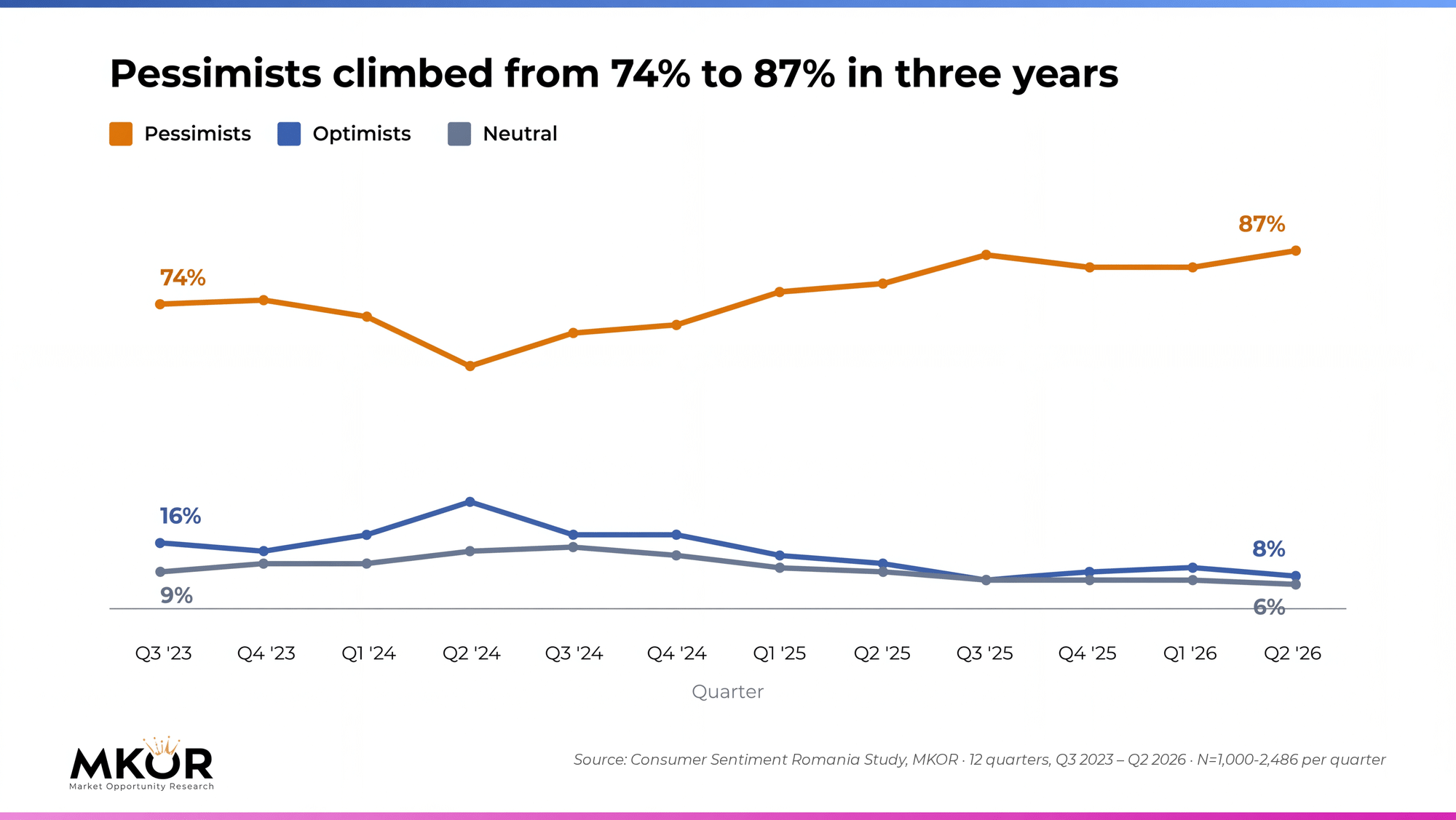
Based on how respondents rated Romania’s economy, their own household finances, and the organisation where they work on a scale from −2 to +2, where 0 means “remained the same”, they were divided into three categories: pessimists (average below 0), neutral (average exactly 0), or optimists (average above 0).
In Q2 2026, the pessimist camp reached 87% of the general population, up from 74% in Q3 2023. At the opposite end, optimists declined from 16% to 8%. In effect, their share halved over three years. The neutral group — those who consider that Romania’s economic situation and their own has remained the same — fell slightly from 9% to 6%.
Contents
Access the Consumer Sentiment 2026 dashboard for free to see more data.
The national economy looks darker than everyday life
Across the three dimensions measured — Romania’s economy, personal financial situation, and employment — the same gap is consistently visible: perception of the national economy (−1.27 on the scale from −2 to +2) is far darker than perception of one’s own household (−0.86) or of one’s workplace (−0.66).
In other words, Romanians rate their own situation more positively than they rate the country’s performance. Expectations for the next 12 months remain equally low; the average score for the national economy is −1.12.
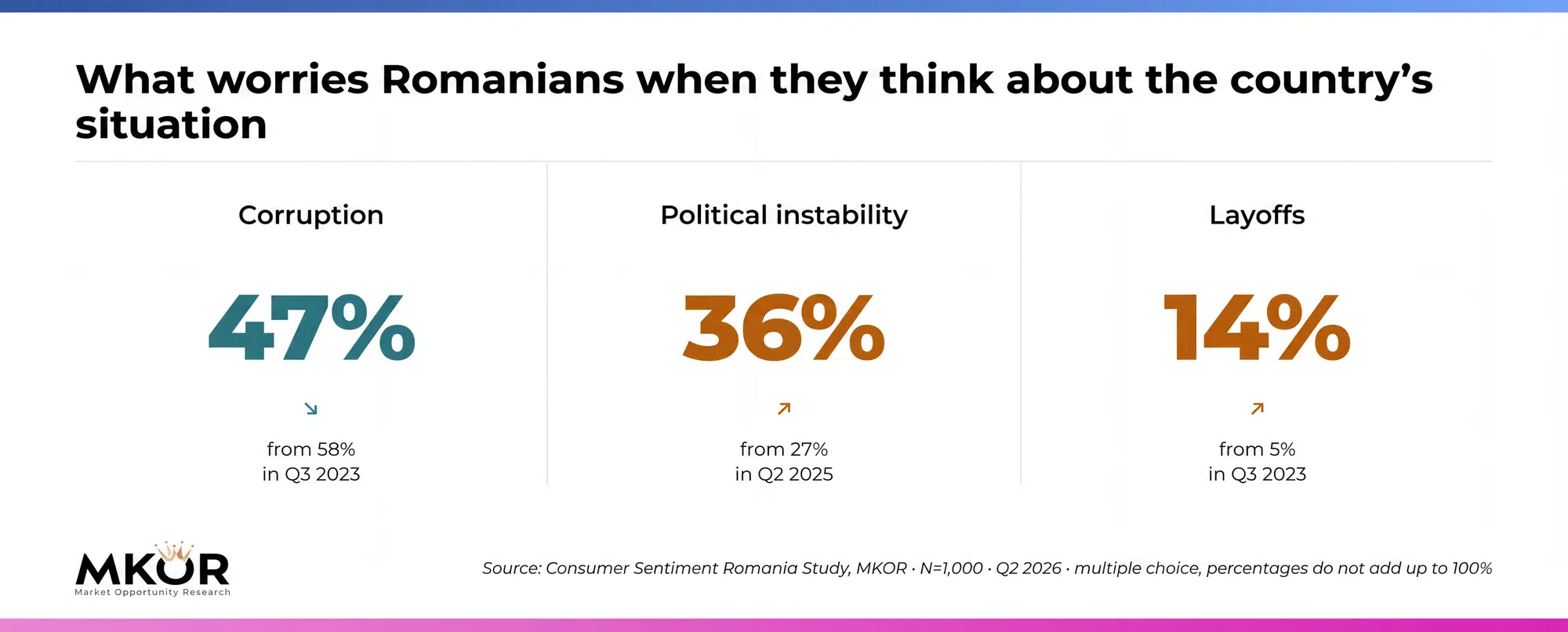
At the macro level: What worries Romanians when they think about the country’s situation?
When assessing the direction Romania is heading, concerns are dominated by institutional stability and the quality of public services:
- Corruption remains the primary concern at the national level, cited by 47% of respondents. It has fallen 13 points from the series peak of 60% in Q4 2024, but has held first place in eleven of the twelve quarters measured. The only exception is Q3 2024, when taxes and levies took the top spot, at 51%.
- Political instability has fluctuated sharply since measurement began in Q2 2025: it rose to 35% in Q3 2025, fell to 21% in Q4 2025, and returned to 36% in Q2 2026, a 12-point jump in a single quarter.
- Fear of redundancy is the only national concern showing genuine growth: it has nearly tripled, from 5% in Q3 2023 to 14% in Q2 2026, a level sustained for four consecutive quarters.
Concern about taxes and levies has also followed an interesting trajectory. It peaked at 51% in Q3 2024 and Q4 2025, before falling back to 35% in Q2 2026.
At the micro level: What worries Romanians when they think about their own family?
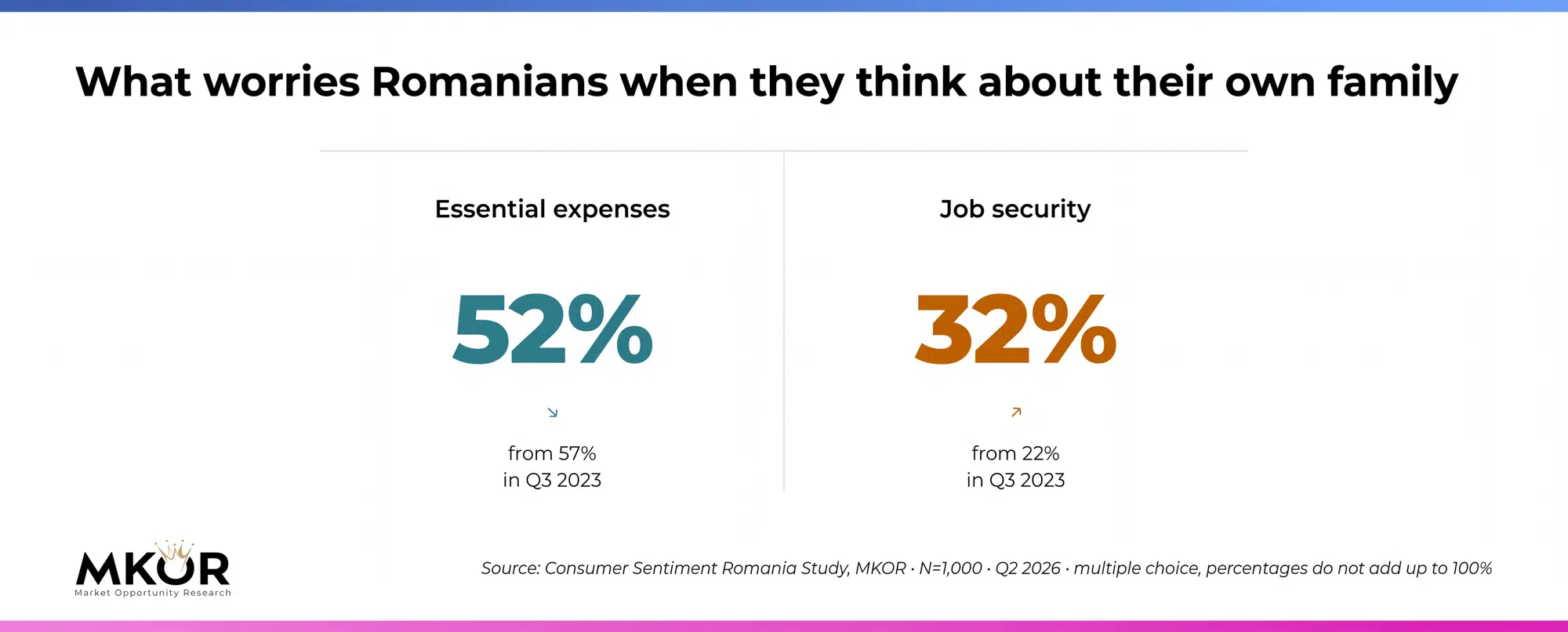
When the perspective shifts to the individual level and the security of one’s own home, financial concerns and income stability become the priority:
- Basic living costs are the primary family concern in every wave of the study. In Q2 2026, 52% of Romanians cite these daily living costs as a major pressure (a slight decrease from 57% in Q3 2023). Although a low of 47% was recorded in Q4 2025, this concern has never fallen from first place at the personal level.
- Job security is the only individual concern that is rising: it has climbed almost continuously from 22% in Q3 2023 to 32% in Q2 2026.
How trust in institutions has evolved
The average trust score across the 14 public and private institutions tracked in the study is almost unchanged over three years: 3.42 now, compared with 3.37 in Q3 2023, on a scale from 1 to 7.
But behind this stability a shift is taking place:
- banks rose from 3.4 to 3.7 (+0.3)
- the healthcare system from 3.6 to 4.0 (+0.4, the largest increase in the ranking)
- the justice system fell from 3.4 to 3.1 (−0.30, the largest decrease), reaching the same level as the press.
The full ranking shows a consistent gap between “civic” institutions and political ones:
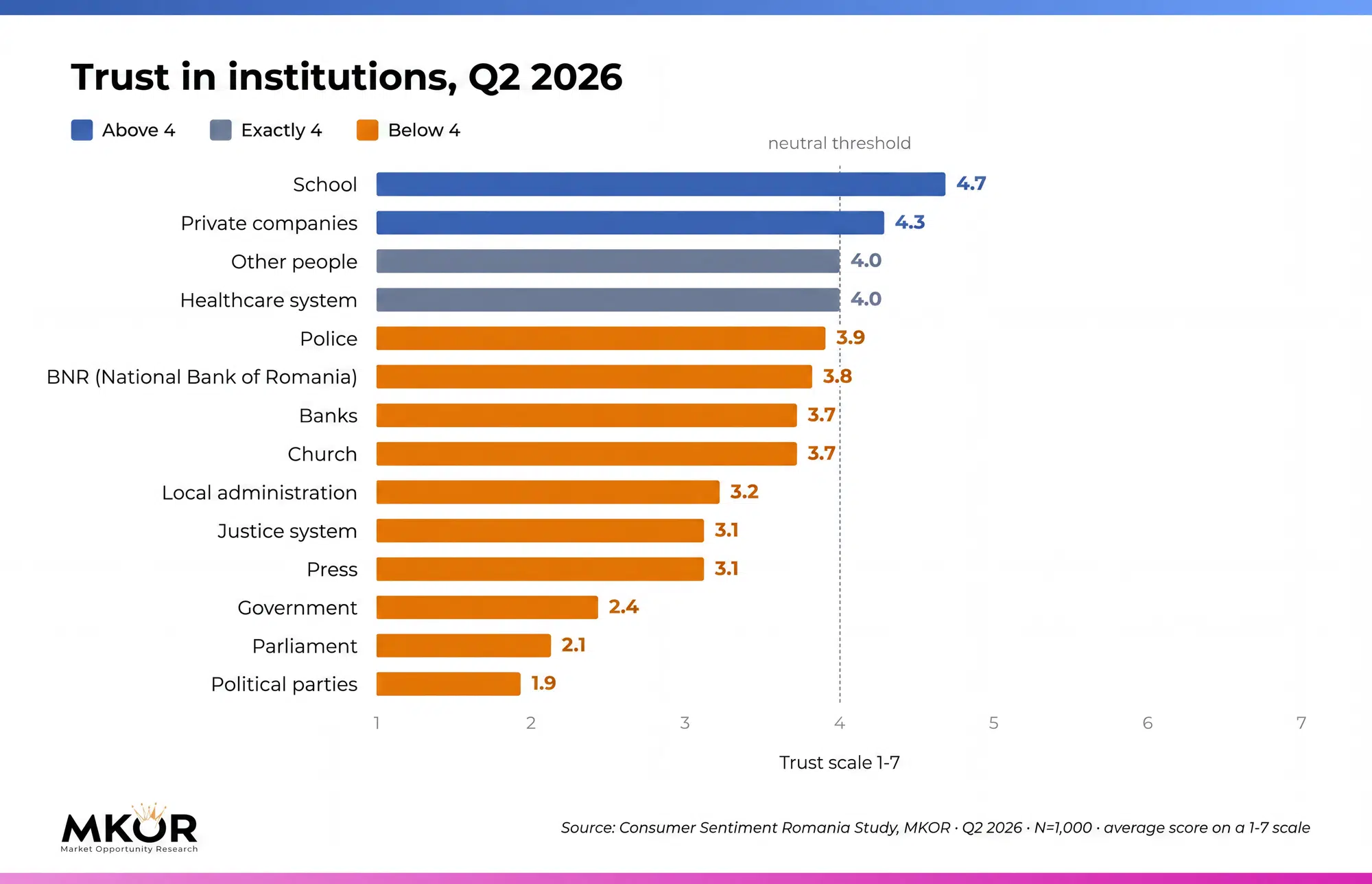
The gap between the top-ranked institution — schools — and the bottom-ranked — political parties — is 2.8 points. This gap narrowed the most in Q4 2024, to 2.5 points, because the political end rose rather than schools falling: parties reached 2.2 at that point, their best level in the entire series.
Over three years of measurement, none of the top three institutions has fallen below 3.7, and none of the bottom three has risen above 2.6.
This chimes with MKOR’s earlier Fiscal X-Ray of Romania, in which three out of four Romanians said they do not believe the state spends their money properly — a sign that distrust in political institutions runs deeper than the trust scores alone suggest.
It is notable that people place greater trust in private companies (4.3) than in the church (3.7).
The justice system and the press are level (3.1), but rank higher than the government, parliament, and political parties.
Strategies adopted to cope with economic uncertainty over the next 12 months
Faced with price pressure, Romanians respond primarily through work, not through managing savings.
The following is the ranking of stated intentions for the next 12 months, in Q2 2026:
- additional work (37%)
- looking for a better job (22%)
- requesting a pay rise (17%)
- saving in foreign currency (14%)
- credit or refinancing (12%)
- major housing expenditure (11%)
- drawing on savings (10%)
- a job abroad (10%)
- buying shares (9%).
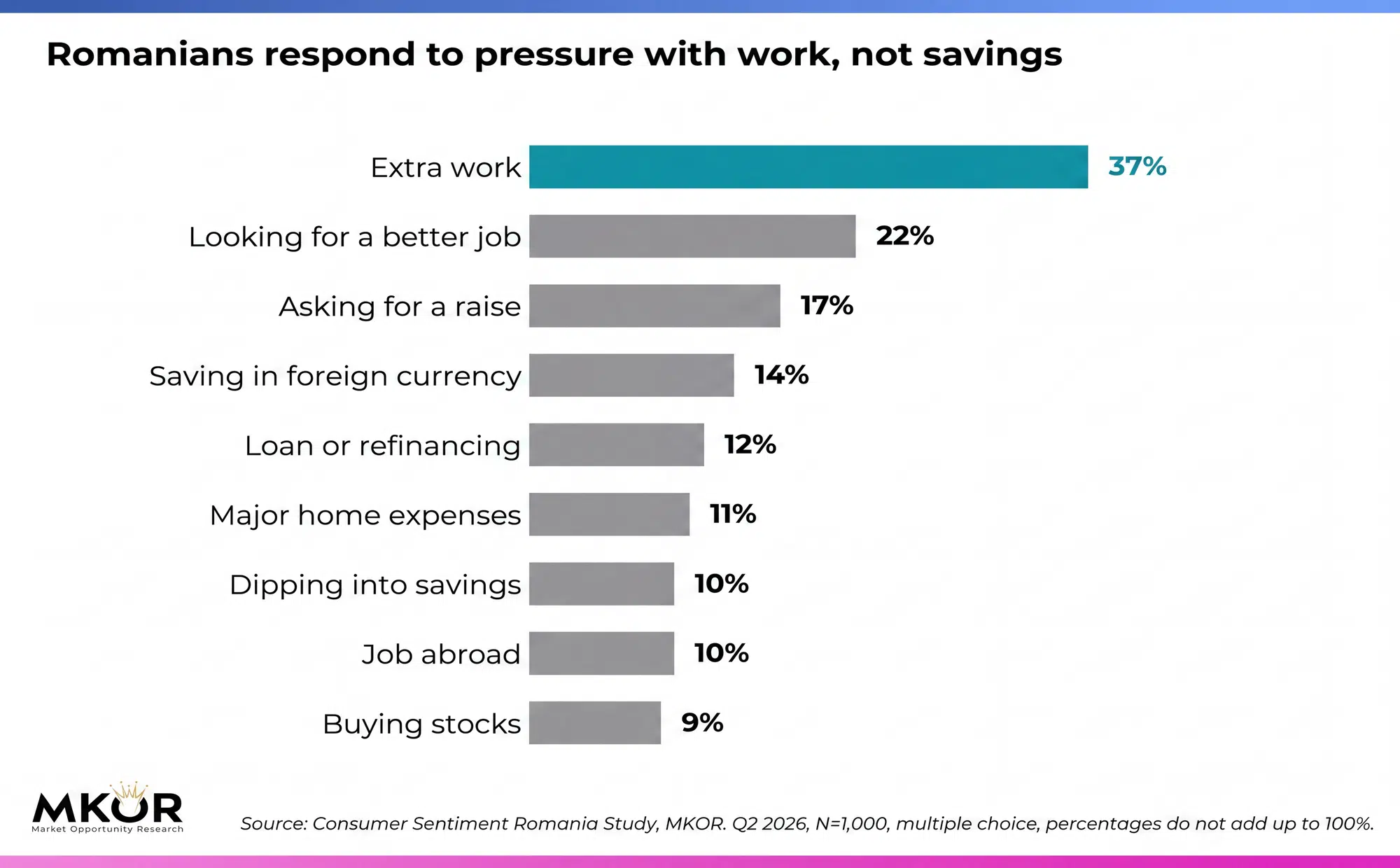
Income-related strategies — additional work, a different job, a pay rise — dominate the list. Additional work has fluctuated between 35% and 41% in every wave since Q1 2024, and credit between 10% and 12%.
The 10% weighing a job abroad sits alongside a pattern MKOR’s own diaspora research has already mapped: seven in ten Romanians who have already left rule out returning within the next 12 months, even as most continue to invest back home.
Another response to the economic situation is deferring new purchases.
The intention to buy a car has fallen from 8% to 4%, and the intention to make major housing expenditures from 16% to 11%. Lending activity has remained fairly constant.
In practice, Romanians are neither buying nor borrowing to buy.
Retail: perceived inflation falls, but prices keep rising
Over the period analysed, perceived inflation has fallen from 21% in Q3 2023 to 16% now. By contrast, perception of prices has moved in the opposite direction: the share of those who say that “prices have risen significantly” returned to 75% in Q2 2026, up from a low of 59% in Q2 2025, and 69% of respondents believe the rate of increase will continue or accelerate.
In other words, Romanians estimate a lower inflation rate, yet feel its impact more intensely.
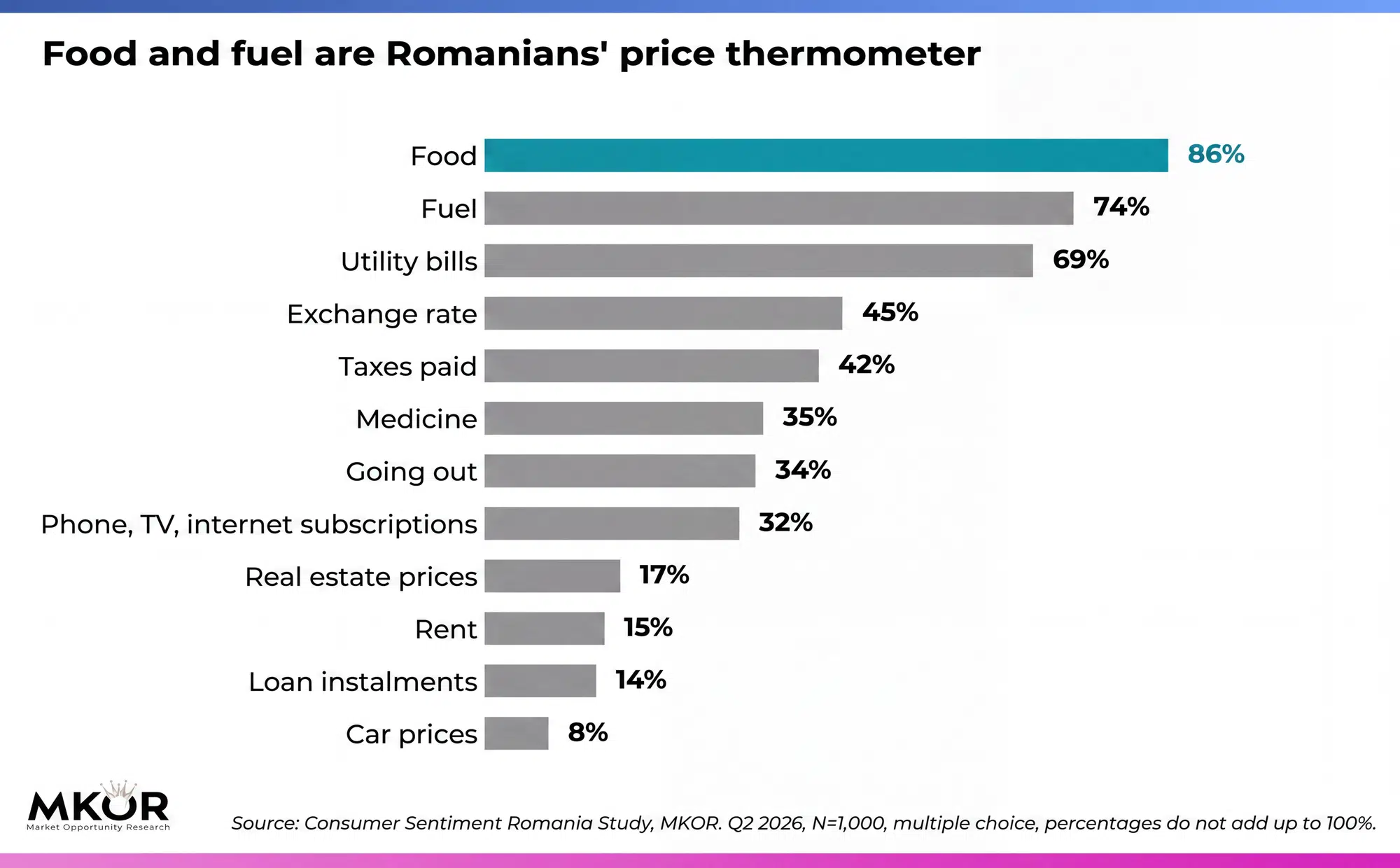
Food (86%) and fuel (74%) remain the primary reference points through which people notice that prices have changed, followed by utility bills (69%).
The exchange rate has risen to fourth place, at 45%, a sign that currency devaluation has become a visible indicator for a growing number of people.
Taxes paid (42%), medicines (35%), dining and outings (34%), and subscriptions to telephone, TV, and apps etc. (32%) remain more discrete signals.
Among Romanians who expect price increases, attention remains focused on the basic basket for the next 12 months: food (92%) and fuel (78%) lead the ranking by a wide margin. Taxes and levies (66%) and services (63%) follow close behind, whilst dining and outings (41%) and exchange rates (32%) mark a middle zone. At the bottom of the ranking remain loan repayments (23%) and rent (18%).
For a retailer, the useful question is “what is the customer giving up buying” as a result of price increases. The answer differs greatly between a low-income and a high-income customer, which influences the market entry price point and the role of own-brand products.
In the full dashboard you will find price pressure broken down across each of the 26 demographic and socio-professional segments. Access it at: sentiment.mkor.ai.
Generations do not experience inflation in the same way
To counter the perceived effects of the economic situation, generations act differently: younger people respond through work, and older people through savings.
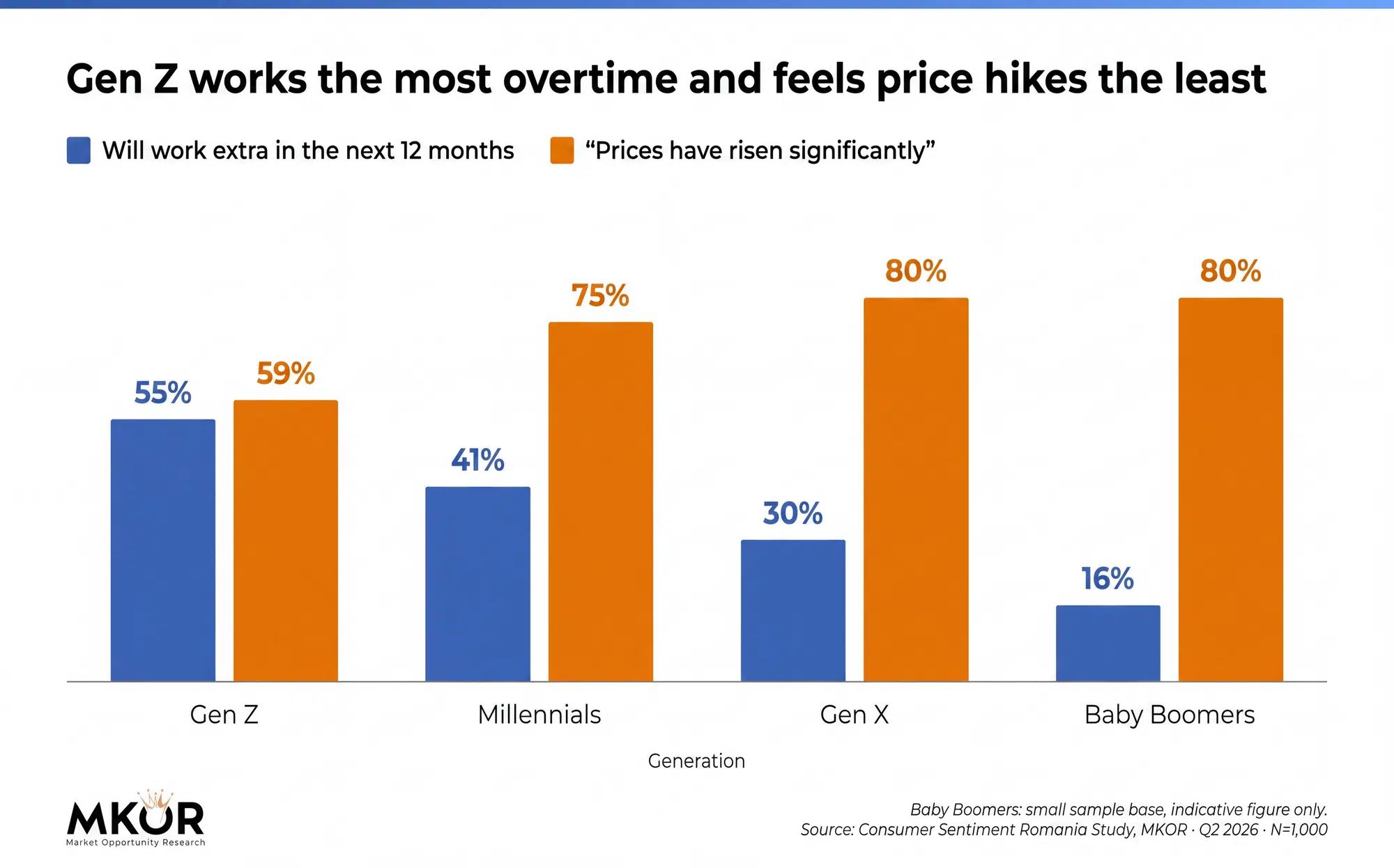
On additional work, the difference is stark: 55% among Gen Z, 41% among Millennials, 30% among Gen X, and 16% among Baby Boomers — nearly 40 percentage points between the youngest and oldest. The younger a person is, the more likely they are to work additional hours.
Price increases are felt more by Baby Boomers and Gen X (80%), followed by Millennials (75%). Only 59% of Gen Z say that prices have risen significantly.
This reveals a gap of more than 20 percentage points between the youngest generation and the rest of the population.
The reason for this difference in perception is that each generation buys different things.
Gen Z feels price increases the least in utility bills (51%, compared with 83% among Baby Boomers) and the most in the cost of dining and outings (48%, compared with 26% among Gen X). Baby Boomers, by contrast, notice higher costs mainly in food (96%) and medicines (57%, compared with 26% among Gen Z).
Rent shows the difference most clearly: of those expecting price increases, 45% of Gen Z expect to pay more in rent, compared with 16% of Millennials, 12% of Gen X, and just 3% of Baby Boomers. This is possibly because those over 61 are homeowners.
HR and the labour market: 54% expect more unemployment. 46% say it is already happening.
Fear of unemployment has risen from 37% in Q1 2024 to 54% now, and almost half of respondents (46%) say they are already seeing an increase, up from 22% two years ago.
Sentiment towards one’s own organisation has fallen from −0.21 to −0.66, and job security has become the only family concern showing consistent growth throughout the study (from 22% to 32%). For an employer, this changes the cost of retention: people are not leaving at a higher rate (intention remains at 22%), but fear is reducing their engagement.
In the full study you will discover the intention to leave and sentiment towards the organisation, by role, generation, income, and region.
Personal finances: 23% went into debt to cover basic living costs, and only 9% managed to save
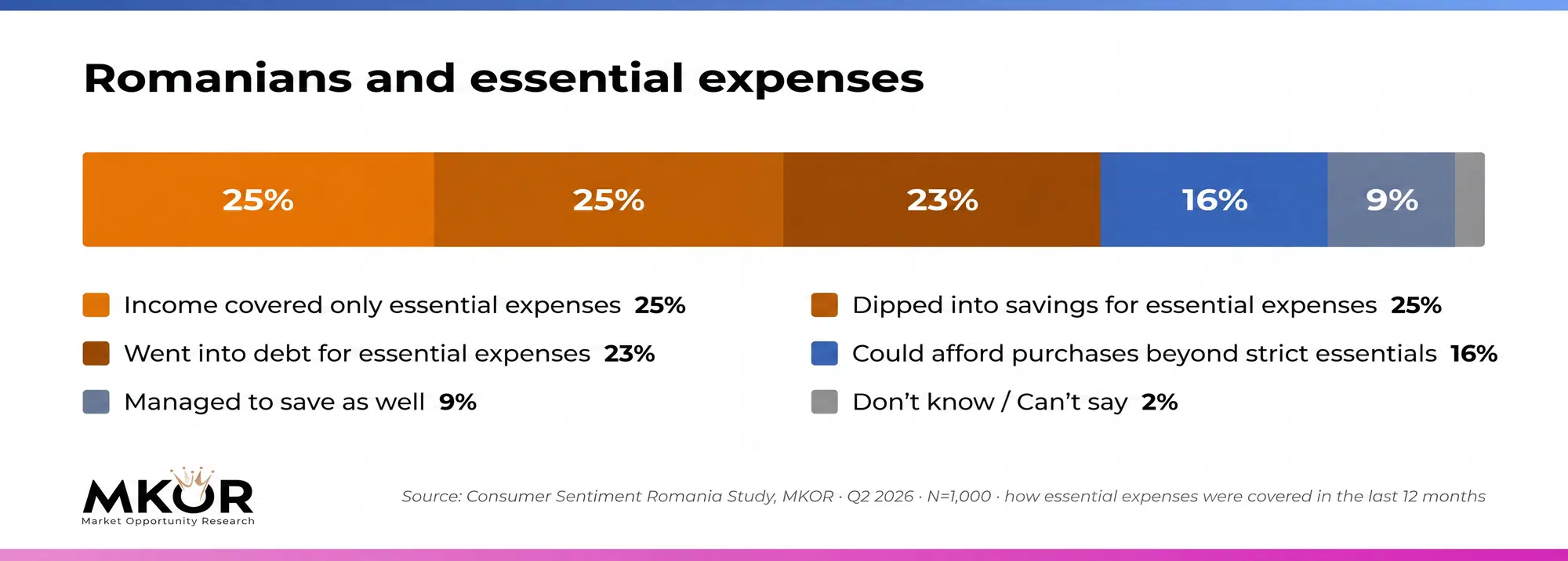
Only a quarter of households (25%) managed to cover their basic costs exactly from income, another quarter drew on savings, and 23% resorted to borrowing.
The perception of one’s own financial situation has been negative in all 12 quarters analysed (−0.86).
The sharpest year-on-year deterioration occurred in Q3 2025, when the perception of household finances fell by 0.64 compared with the same period of the previous year.
For a bank or a retailer selling on instalment plans, the signal is that pressure has reached the basic budget. Romanians’ response is primarily one of reduced consumption rather than increased debt: the intention to take on credit has remained between 10% and 12% for two years.
In the full study you will discover appetite for credit, savings behaviour, and the financial safety net, by income, residential setting, and professional role.
Healthcare: trust in the health system has risen from 3.6 to 4.0
In terms of trust levels, the health system has recorded the largest increase among public institutions, followed by banks.
It ranks in the top four of the fourteen institutions evaluated, above banks, the church, and the police, with consistent growth over three years.
At the same time, concern about medical costs has fallen from 27% in Q1 2024 to 20% now, as a family concern, and mental health has remained unchanged, between 15% and 18%, for three years.
For a private clinic or an insurer, this overturns the standard sales argument: “the public system doesn’t work” is increasingly weak, because perception of it is improving.
What remains valid as a genuine barrier is cost and accessibility.
The full study reveals how Romanians trust the healthcare system and feel the pressure of medical costs, broken down across all 26 segments. Access the dashboard here: sentiment.mkor.ai.
Real estate: 61% expect to pay more for high-value purchases (furniture, household appliances)
The intention to make major housing expenditures rose to 19% in Q3 2024, and has since fallen to 11%, exactly the level at the start of the series. The intention to buy a property or land remains at 4%.
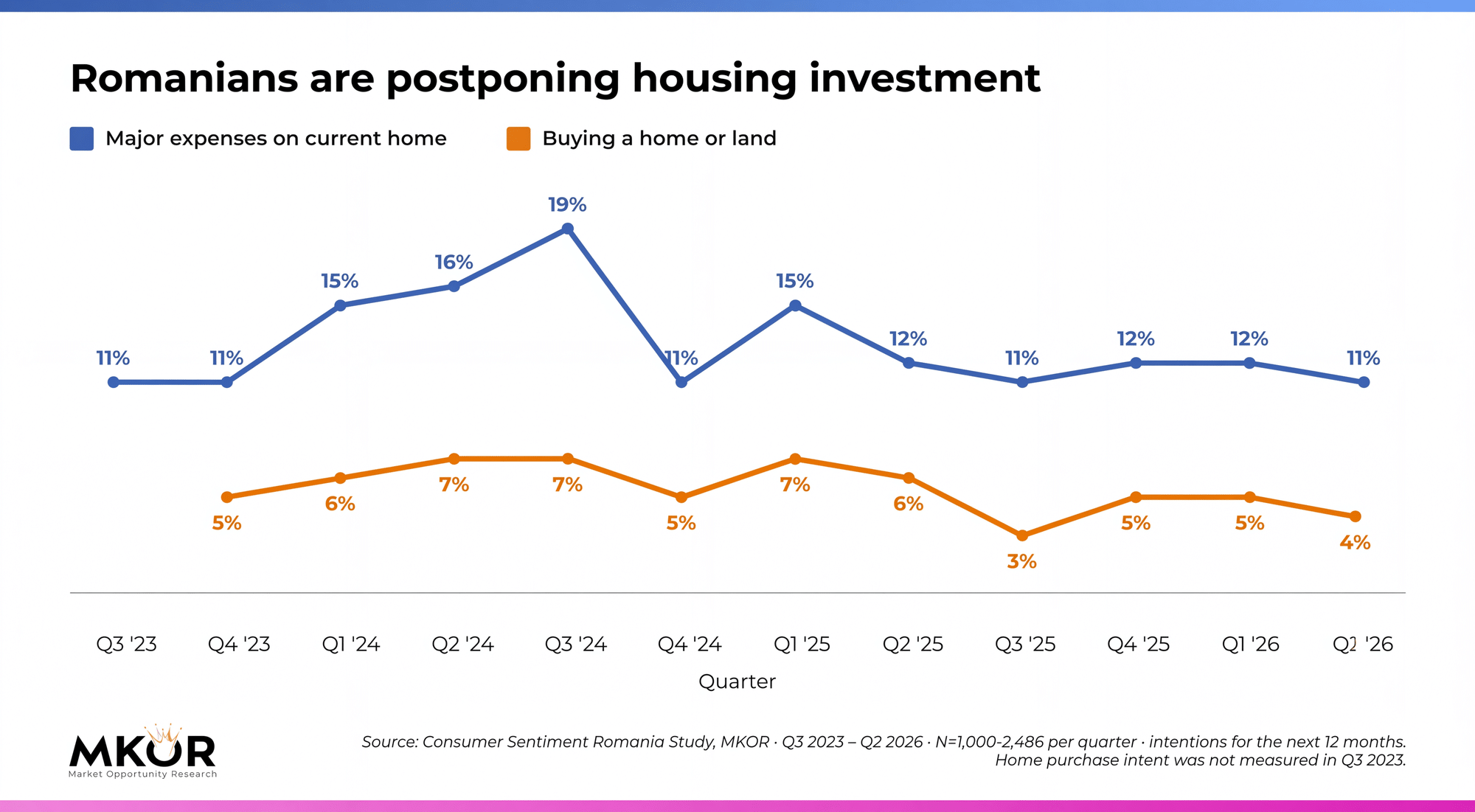
Credit and refinancing remain between 10% and 12%, which shows that financing is not the problem. The primary reaction is withdrawal: people are neither buying nor borrowing to buy.
For a developer or a furniture and appliances retailer, the conclusion is that financing is not what is missing — it is already available and accepted, at a constant level for three years. What the consumer lacks is a reason to buy now: the old furniture still works, the car still runs, the renovation can wait another year.
From the full study you will find intentions regarding housing and major purchases, by income, generation, and macroregion.
Services: taxes on bills are interpreted as the supplier’s own price increase
42% of Romanians say they notice price changes through the value of taxes paid. Of those expecting price increases, 66% attribute them to taxes and levies. In parallel, trust in local government rose to 3.5 in 2024 and has returned to 3.2, the level at the start of the analysed period, while private companies remain at 4.3.
For a utility or recurring service provider, a tax not clearly labelled as a tariff ends up being read by customers as their own price increase.
In the study you will find tax pressure and trust in public and private providers, broken down by segment.
What the full study contains
This article presents results at the national level. The full study presents them broken down across each of the 26 population segments (generation, gender, income, residential setting, macroregion, level of education, children in the household, and professional role) for all 12 quarters analysed from Q3 2023 to Q2 2026. In addition it contains:
- six sections by sector: retail and prices, the labour market, personal finances, healthcare, real estate, and services
- three thematic sections: overview, consumer behaviours, and a segment maps section
- trust in the 14 institutions, broken down by segment
- stated intentions for the next 12 months regarding work, income, credit, saving, and major purchases
- psychographic segmentation: how pessimists, neutral respondents, and optimists behave as distinct consumer groups
- recommendations on the business decisions supported by each dataset.
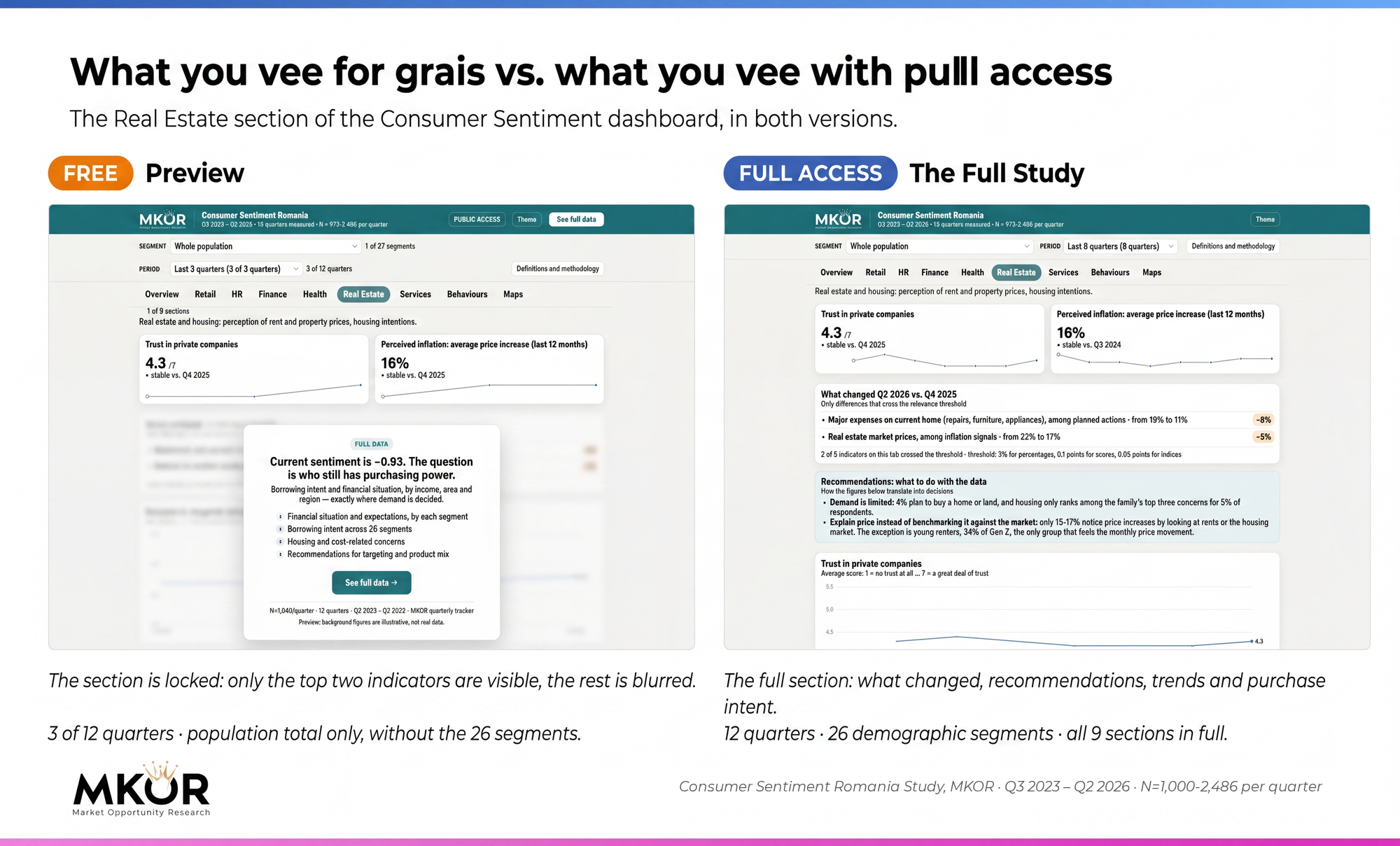
Access the study at sentiment.mkor.ai to access the free version.
Methodology
The data is drawn from the Consumer Sentiment Romania study, a quarterly survey conducted through MKOR’s Consumer Panel.
- Sample: N=1,000–2,486 respondents per quarter, weighted results
- Coverage: 12 quarters of research, Q3 2023 – Q2 2026
- Target: general population of Romania, aged 18–65
- Research method: survey (CAWI)
- Research instrument: questionnaire
- Approach: online, via MKOR’s proprietary panel
- Frequency: quarterly
Six of MKOR’s studies have appeared to date in 9 scientific publications, confirming the methodological rigour, further reinforced by adherence to ESOMAR standards, of which MKOR is a member.
Conclusions and key insights
Three years of quarterly measurement lead to a single conclusion: economic pressure has reached the base of the budget, and Romanians are responding by deferring expenditure. For any business, this shifts the question from “when will demand return” to “who is still buying, and on what terms”.
Perception of the economy has stabilised at a low level. The last three quarters have remained in the same narrow band, following two years of continuous deterioration. Any business building its campaigns or sales targets on the assumption of an imminent recovery is going against the data. A message focused on price and value represents the right positioning for the coming quarters.
Financial risk is visible in the figures. Almost a quarter of households have gone into debt for basic living costs, and another quarter have depleted their savings for the same purpose.
Trust in institutions and organisations has been reshuffled. The average across all institutions is almost the same as three years ago, but the health system has gained the most ground and the justice system has lost the most. For a company choosing partners, brand ambassadors, or public communications channels, these figures show which associations are worth making and which are not.
Behaviour differs by generation, not at the average level. Younger people respond to pressure through work and financial instruments; those over 60 through savings. Gen Z feels price increases the least in utilities and the most in rent and dining and outings. A message built for the “average consumer” is not, in fact, speaking to any of them.
The full study shows how perceptions are shifting, and how businesses in Romania are feeling the impact. Access the dashboard here: sentiment.mkor.ai.