


MKOR’s annual Employee Sentiment study documents three consecutive years of decline in how Romanian employees perceive their workplace, across all eight indicators we have tracked between 2023 and 2025:
- Salary package
- Benefits package
- Job security
- Work flexibility
- Professional development
- Workload
- Team size (number of colleagues)
- Team morale
In 2023, 1 in 4 Romanian employees reported a salary increase. By 2025 that figure had halved. Workload has climbed every year, teams have shrunk, and collective morale has hit its lowest point in the three-year window. The intention to change jobs has followed the same trajectory: 1 in 3 employees now say they are very likely to leave within the next six months.
Below: who is planning to leave, what actually motivates them, and how to keep your most valuable people from walking out.
Low morale costs nothing, until it costs everything. The 2026 data shows Romanian employees are not disappointed by one rough year. They are exhausted from three years of giving more than they get back. At some point, exhaustion turns into a decision.

Cori Cimpoca – MKOR Founder
Full access: Download the "Employee Sentiment Romania 2026" report — and see how the labour market is shifting
Gen Z in 2026: The Lowest Salaries, The Greatest Ambition
Generation Z employees, aged between 18 and 28, are redefining the rules of employer loyalty. According to our study, Employee Sentiment Romania 2026, 42% of them intend to change jobs in the next six months, compared to 30% at the national level. The average likelihood score of leaving is 5.1 out of 10 for Gen Z, versus 3.96 as the national average, and 20% gave the maximum score of 10 — meaning they are certain they want to leave.
The Gen Z paradox lies in the contradiction between their current financial situation and their perception of the future. Generation Z has an average income of approximately 3,700 RON compared to 5,200 RON as the national average, and 58% of young employees earn below 4,000 RON. And yet, 28% reported salary increases in the past year (versus 20% as the general average), and 24% perceive increased job stability, compared to just 10% across the entire sample.
Workload increased for 54% of them, while team morale declined in the perception of 47%, suggesting that young employees are not leaving a comfortable environment — but a stagnant one.
Against a backdrop of apparent stability — with 55% of Gen Z employees reporting no change in their salary package and 65% seeing no change in their benefits package — it comes as no surprise that career advancement has become the primary driver behind the desire to change employers.
Career advancement motivates 43% of Gen Z employees to look for a new employer, compared to 27% among Millennials and 22% among Gen X. Job security, by contrast, matters to only 18% of them — half as much as the prospect of promotion. Non-salary benefits (cited by 32% of Gen Z respondents) and flexible working hours (cited by 30%) round out the picture of the main motivations for changing jobs.
Unsurprisingly, income growth remains the top motivation across all age groups, at 75% for Gen Z and 78% as the general average.
The medium-term risk for employers is fairly clear: as work experience grows, so do expectations. The 42% who intend to leave within the next six months may represent an early warning signal for organizations that lack a structured retention policy for young talent.
The Gen Z picture does not exist in isolation — it overlaps with a broader context in which all Romanian employees feel the pressure of an increasingly challenging climate, as the data presented below also shows.
Pay rises have halved in two years. And that is not the only red flag.
For Romanian employees, 2025 brought more work, weaker compensation, and smaller teams. This is not isolated perception. It is a pattern confirmed year after year, across every indicator in our Employee Sentiment study.
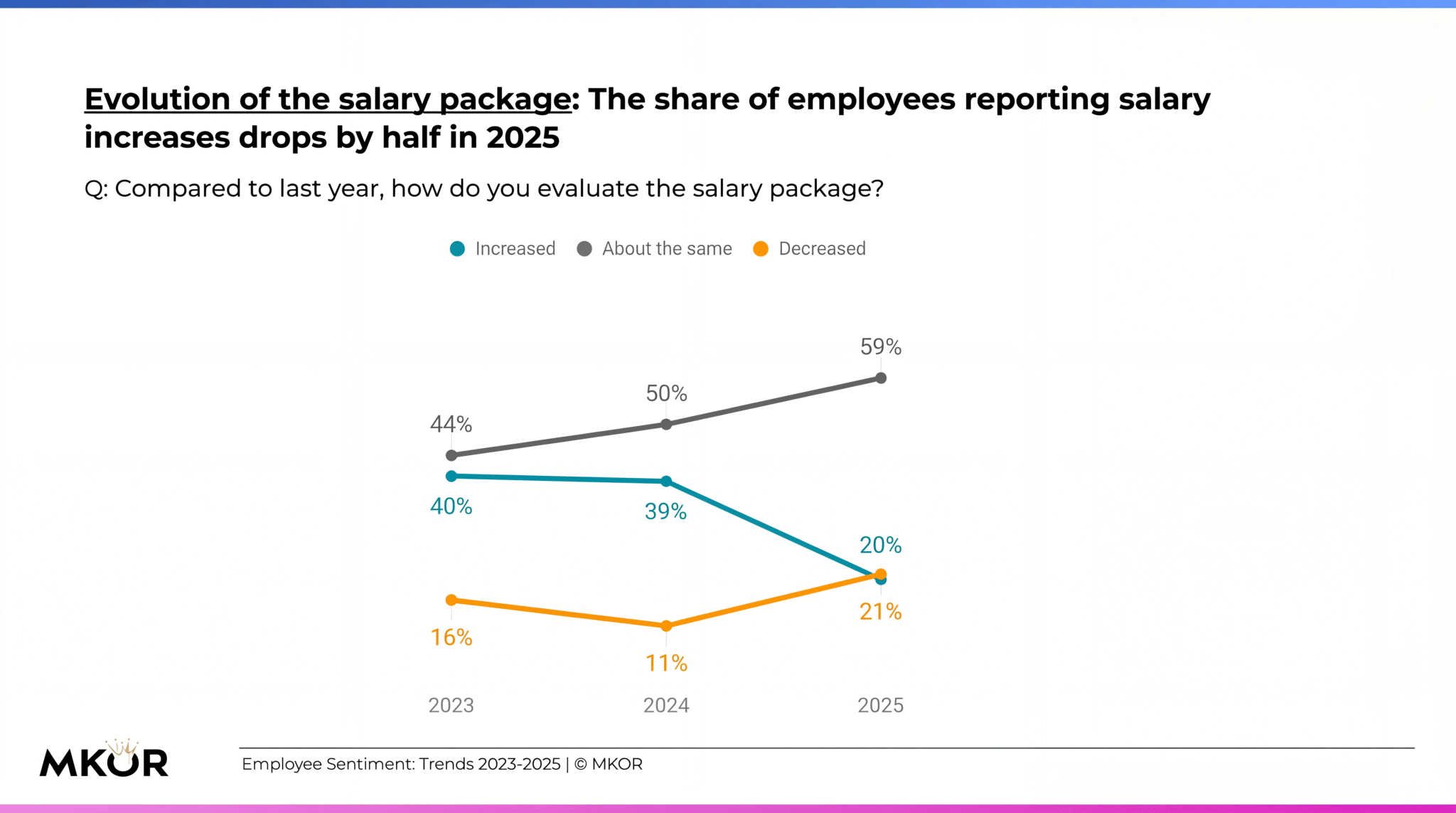
Salary package. In 2023, 40% of Romanian employees reported a salary increase. By 2025: only 20%, a halving in two years. At the same time, the share saying their salary went down rose from 16% to 21%, matching those reporting increases.
Benefits package. In 2023-2024 positive and negative perceptions roughly balanced around 17-18%. In 2025 the scale tipped sharply: 28% say benefits got worse, only 12% report improvements.
Job security. Those perceiving a drop in stability rose from 20% (2023) to 31% (2025). Those perceiving an improvement fell from 14% to 10%, the lowest level in the three-year window.
Professional development. After a slight 2024 recovery (26% reported better growth opportunities), 2025 reverses sharply: only 19% perceive an improvement, while 27% say opportunities have shrunk, the worst result in three years.
Workload. The only indicator that has stayed consistently high: 49% (2023), 54% (2024), 53% (2025) report a workload increase year over year. Sustained pressure that compounds.
Team size. Those reporting smaller teams: 27% (2023), 31% (2025). Those reporting growth: just 16%, the lowest tracked level. The equation: more tasks, fewer people, less room to grow.
Work flexibility. Those perceiving worse flexibility climbed from 18% (2023) to 22% (2025). Those reporting better flexibility fell from 15% to 13%, despite signs of recovery in 2024.
Full access: Download the "Employee Sentiment Romania 2026" report — and see what the workforce really thinks
Team morale: the steepest decline in three years
Of all the indicators we track, team morale shows the sharpest drop over 2023-2025.
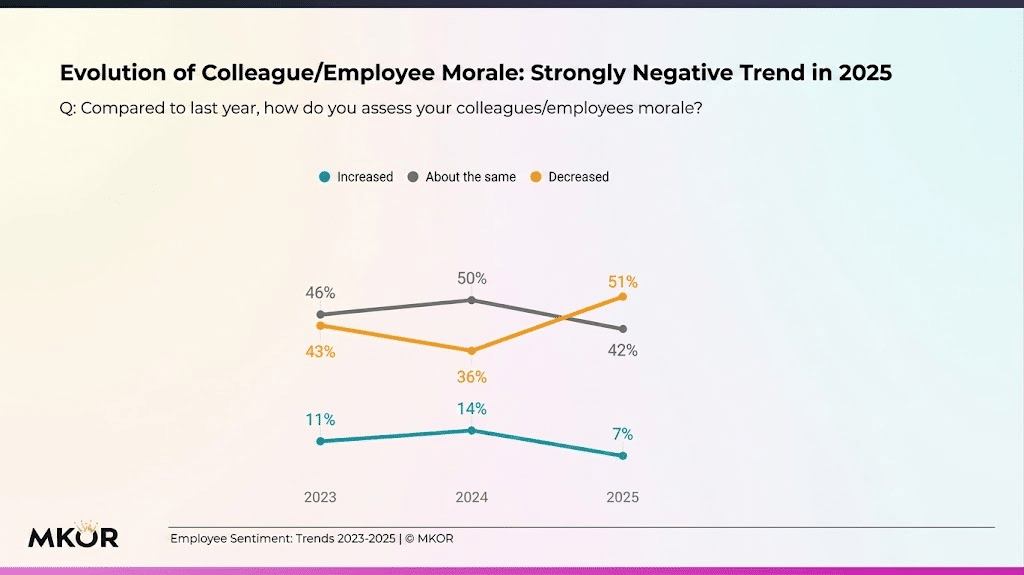
In 2023, 43% of employees perceived their colleagues’ morale as lower than the previous year. Concerning, but seemingly easing: by 2024 it had dropped to 36%. The recovery proved temporary. In 2025, the share perceiving worsening morale jumps to 51%, the highest level in the three-year window.
This deterioration may also tie back to broader institutional distrust. MKOR’s June 2025 fiscal x-ray of Romania showed 3 in 4 Romanians do not believe the state spends their money correctly.
On the other side: the share reporting improved collective morale fell from 14% in 2024 to just 7% in 2025.
This decline does not appear in a vacuum. It builds on layers from previous years: pay packages perceived as insufficient, rising workload, shrinking teams, and narrowing development opportunities. When people feel they are giving more than they get back, and the situation is not improving, the effect does not stay individual. It propagates into group dynamics, into the quality of collaboration, into the energy a team brings to daily challenges.
Low team morale is not just an internal climate indicator. It is also a leading predictor of intent to leave, and the 2025 data confirms that link clearly.
1 in 3 employees are ready to leave. Who are they, and what do they actually want?
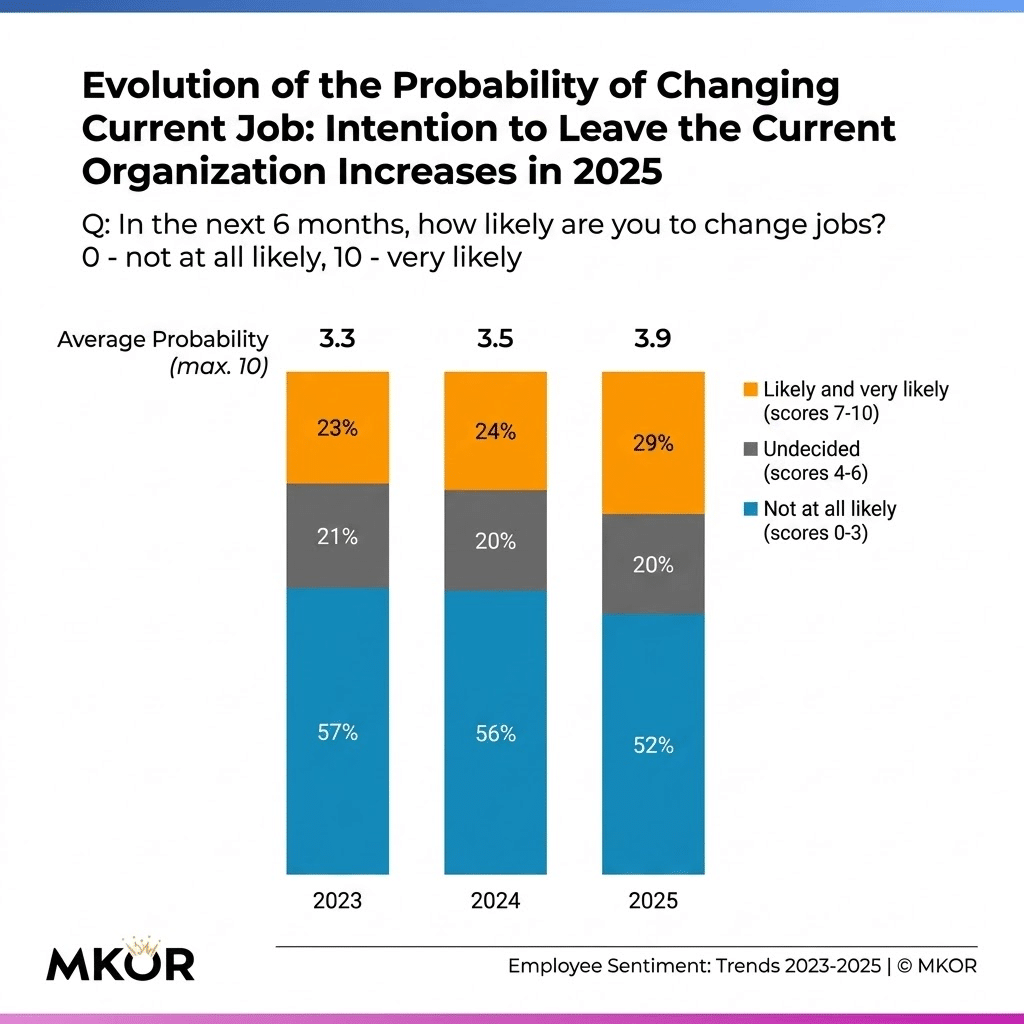
Job-change intent has climbed steadily across the three years we have tracked it. In 2023, 23% of employees said they were likely or very likely to leave in the next six months. By 2025 that is 29%, meaning roughly 1 in 3 Romanian employees has one foot out the door right now.
The average probability score, on a 0-10 scale, has risen from 3.3 in 2023 to 3.9 in 2025. Small in absolute terms, but the direction matters: the trend is linear, with no sign of stabilising.
Who are the high-risk employees?
The profile of those most likely to leave in 2025 is sharply defined:
- Gender: male
- Age: roughly 40
- Location: urban
- Role: individual contributor
- Education: degree-level
- Individual income: low — half earn under 4,000 RON (~€800) per month
- Perception: their salary package has decreased compared to 2024
Worth flagging: the decision to leave is not purely about money, even if salary remains the dominant factor. 78% of those considering a change cite a higher salary as the main reason.
For this segment, stability and growth prospects matter more than for the average respondent:
- Job security: 36% (at-risk segment) vs. 32% (average)
- Promotion opportunities: 31% (at-risk segment) vs. 26% (average)
For these employees, motivation goes beyond money. There is a parallel hunger for predictability and a clear professional trajectory.
Full access: Download the "Employee Sentiment Romania 2026" report — and see what the workforce really thinks
Who stays, and why: the profile of the stable employee in 2025
Beyond those planning to leave, the silent majority of Romania’s labour market is the stable workforce, the 52% who say a job change is unlikely in the next six months. Understanding this segment matters as much as understanding the leavers, because their stability is not guaranteed long-term unless it is actively cultivated.
Profile of the stable employee in 2025:
- Average age: ~42
- Gender split: 52% male, 48% female
- Income (45% of them): between 4,001 and 7,000 RON (€800-1,400) per month
- Perception of work environment: stable or slightly improving
What sets them apart is not that they are more satisfied in absolute terms. It is that they perceive their environment as relatively stable. Team morale, team size, and salary package score positively against the general average, but not as outstanding performances. Rather, as the absence of decline. When things are not visibly getting worse, the urge to change shrinks.
The lesson the data offers: retention is not always built on spectacular benefits or large salary jumps. More often, it is built by maintaining an environment that feels predictable, or by keeping teams intact.
The stable employee in 2025 is not an enthusiast. They are someone who, for now, does not have strong enough reasons to leave. The distance between those two states may be smaller than it looks.
What this means for HR strategy in 2026
Three consecutive years of data say the same thing, with growing urgency: Romanian employees work more, in smaller teams, with packages they consider insufficient, in a collective climate that keeps fragilising. Organisations treating these signals as a passing phase risk discovering, once they finally react, that their most valuable people have already left.
Four directions for HR strategy in 2026:
- Rethink your value proposition. Not through massive investment, but through honesty about what the organisation actually offers: pay, benefits, security, growth path. High-risk employees are not asking for more. They want to understand what concrete benefits exist and where their career is heading.
- Communicate explicitly what professional growth looks like. Not in vague terms, but with criteria and concrete examples. This can be the difference between an employee who stays and one who starts looking elsewhere.
- Fix morale through managers, not team-building events. The indicator with the sharpest 2025 decline gets repaired by managers who give solution-oriented feedback, who recognise individual contributions, and who handle change transparently.
- Run regular pulse surveys. Organisations that do not monitor internal climate work on assumptions. Periodic measurement gives you early signals before intent to leave becomes the decision to leave.
The Employee Sentiment Romania 2026 data describes what is already happening. Organisations that act on it have a real advantage over those waiting for change to arrive on its own.
About the study
At MKOR we treat every number as a promise of accuracy. To capture the evolution of Romanian employee sentiment between 2023 and 2025, we followed a rigorous methodology aligned with ESOMAR standards.
- Sample size: 1,000 respondents
- Sample characteristics: nationally representative by gender, age, and geographic distribution
- Target: Romania general population, ages 18-55
- Research method: opinion poll (CAWI)
- Instrument: questionnaire
- Approach: online, via the MKOR Consumer Panel
Key conclusions and insights
- Salary transparency and predictability. The top 3 reasons an employee would decide to leave an organisation:
- 78% – a higher salary
- 33% – better non-salary benefits
- 32% – a more secure job
Salary increases should be predictable and clearly communicated. Employees who do not know what to expect are the first to start looking elsewhere.
- Workload redistribution. 53% report increased tasks compared to 2023, while 31% say teams have shrunk. Clear redistribution of responsibilities and task prioritisation are immediate-impact moves with no additional cost.
- Active communication about company stability. 31% feel their job is less secure. Often that insecurity does not reflect the organisation’s reality. It comes from a lack of communication. Regular updates about direction and financial status reduce anxiety and stop speculation.
Employee Sentiment Romania 2026 confirms a trend that is now compounding for three years: Romanian employees work more, earn less, and the mood inside organisations is visibly degrading. One in three say they are ready to move on.
Full access: Download the "Employee Sentiment Romania 2026" report — and see the full set of findings
How to work with MKOR
National Employee Sentiment data tells you what the market looks like. It does not tell you where your company sits relative to that market.
If 29% of Romanian employees plan to leave, the relevant question for your company is simple: are you at 15% or at 45%? Without your own data, you cannot know. And the gap between those two figures is the gap between a retention strategy and an unfolding personnel crisis.
The same principle applies across every indicator. Team morale shows the sharpest national decline in 2025, but the real problem inside your organisation might be elsewhere: flexibility, career prospects, the benefits package. HR teams that run without their own data run on assumptions, or on what they hear in the exit interview after the employee has already decided.
MKOR can run this kind of internal study on your employees. Data is collected independently, which means more honest answers than through an internal questionnaire.
Long-term value: an organisation that runs this measurement year after year builds its own trend line. You can see concretely whether a management change improved morale, whether a salary adjustment reduced intent to leave, whether a development programme shifted perceptions.
Visit our Services section to learn about the studies we run. Our portfolio shows case studies from collaborations across multiple industries, plus the public research we publish independently.
Book a free strategy session with one of our consultants. You bring the business objective. We research the market.
* Methodological accuracy and data in this article were validated by Mihaela Nicolae, Senior Researcher.
MKOR’s study, featured across national media
The findings spoke for themselves: MKOR’s data on Gen Z employees was picked up by Romania’s most-read outlets — from Agerpres and Forbes to Ziarul Financiar, Antena 3 CNN and Wall-Street.ro. Here are some of the press features: