



Companies looking for an effective way to increase profitability have found it in the Net Promoter Score. It combines a metric with management action focused on what is essential for the company and what truly works.
To better understand the Net Promoter Score, you must compare your score with the industry average, against both direct and indirect competitors.
Companies with higher scores than their competitors tend to grow faster and be more successful.
NPS was born from the behavioral differences between promoters, passives, and detractors.
As mentioned in the previous article:
Promoters (with a score of 9-10) are enthusiastic, loyal consumers who will repurchase and recommend the brand to others.
Passives (with a score of 7-8) are satisfied but unenthusiastic consumers who are vulnerable to competitors’ offers.
Detractors (with a score of 0-6) are unhappy consumers who can damage the brand by spreading negative word-of-mouth.
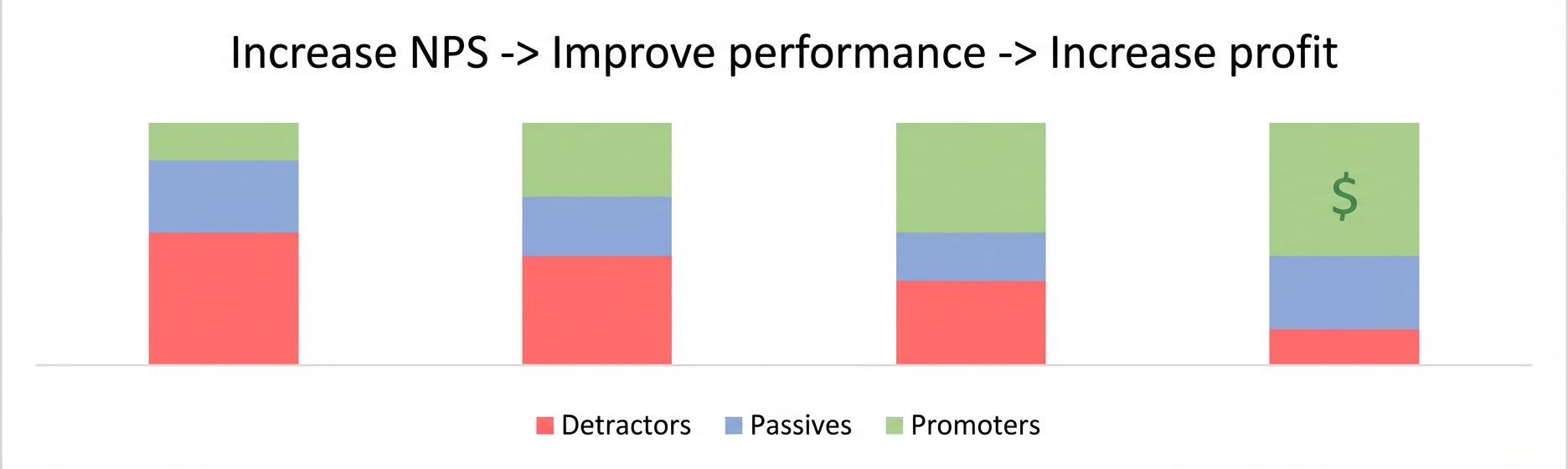
Companies should focus on increasing their Net Promoter Score to improve performance, which for some means high profit, and for others, rapid growth. A high Net Promoter Score can improve business performance in countless ways.
By improving the consumer experience, and implicitly the NPS, a series of benefits can be achieved, such as higher price thresholds (promoters are less price-sensitive), higher annual spending from promoters (promoters tend to buy more), cost efficiency, higher loyalty rates, and positive word-of-mouth. All these together can bring a significant change to any company.
Here are some effects of a high NPS:
Higher Price Thresholds
Promoters are usually less price-sensitive than other consumers. They believe they receive better overall value from your company, even if they pay more. In contrast, detractors are more price-sensitive (this can also be an advantage for a company with lower prices).
Higher Annual Spending from Promoters
Promoters buy more and more often than detractors. They tend to purchase more types of products from their preferred provider. Promoters’ interest in new products or brand extensions is higher than that of passives or detractors.
Cost Efficiency
Detractors complain more frequently and consume more service resources, while promoters reduce the cost of acquiring new customers. Through loyalty and repeat purchases, they generate referrals for potential users.
Higher Loyalty Rate
In general, detractors are more affected than promoters by various aspects of products/services/companies. This means they have a shorter and less profitable relationship with companies.
Turn detractors into promoters! You will have higher price thresholds!
Positive Word of Mouth:
The value of new consumers, which also includes savings in sales or marketing, is due to promoters who “talk” about products and attract new consumers.
On the other hand, detractors are responsible for negative opinions, which is why it is necessary to invest in turning them into promoters.
Don’t know your company’s/product’s NPS? MKOR Consulting offers you the opportunity to find out through market research targeted at customer satisfaction; all you have to do is let us know.
Have you read everything? Comment / join our newsletter / read our other research posts!