


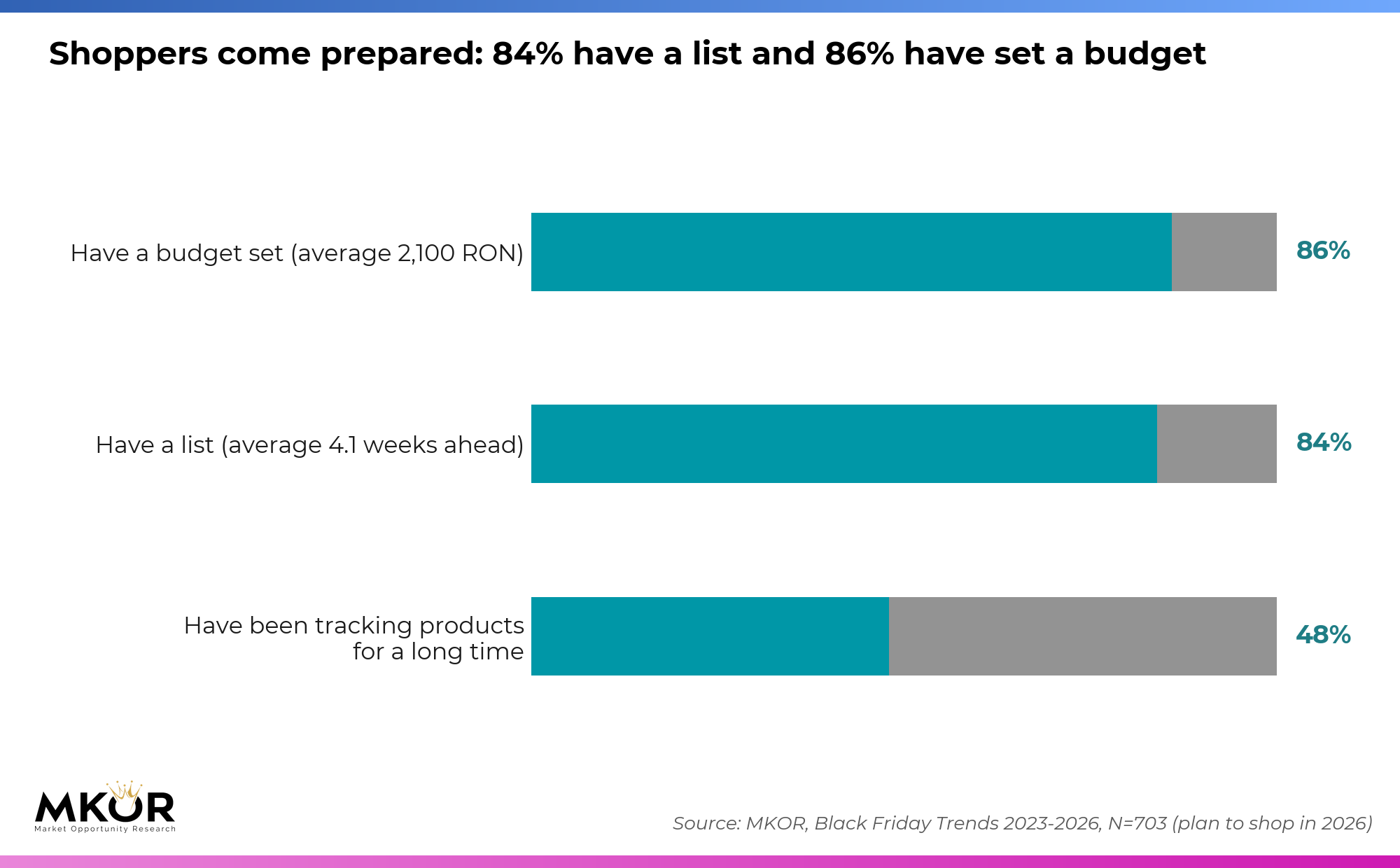
Black Friday 2026 shoppers come prepared. Of the 70% who plan to buy, 84% make a list of what they want and 86% already know how much they will spend.
Above all, they expect real discounts: three in four of those who also bought last year want substantial or genuine discounts.
Discounts also matter for the undecided, a quarter of respondents. Most of them (61%) would be won over by a big discount (49% on average).
More than a third (36%) want to be able to check the discounted price against the previous one easily.
In previous editions, the share of people who said they had bought on Black Friday exceeded the share of those who had planned to buy.
Before Black Friday 2024, 57% of respondents said they would buy, and in the following year’s study 77% said they had bought at least one product. For 2025, the figures were 62% and 79%.
If the trend holds, more people will again say they bought than the 70% who plan to buy now.
Key findings for 2026:
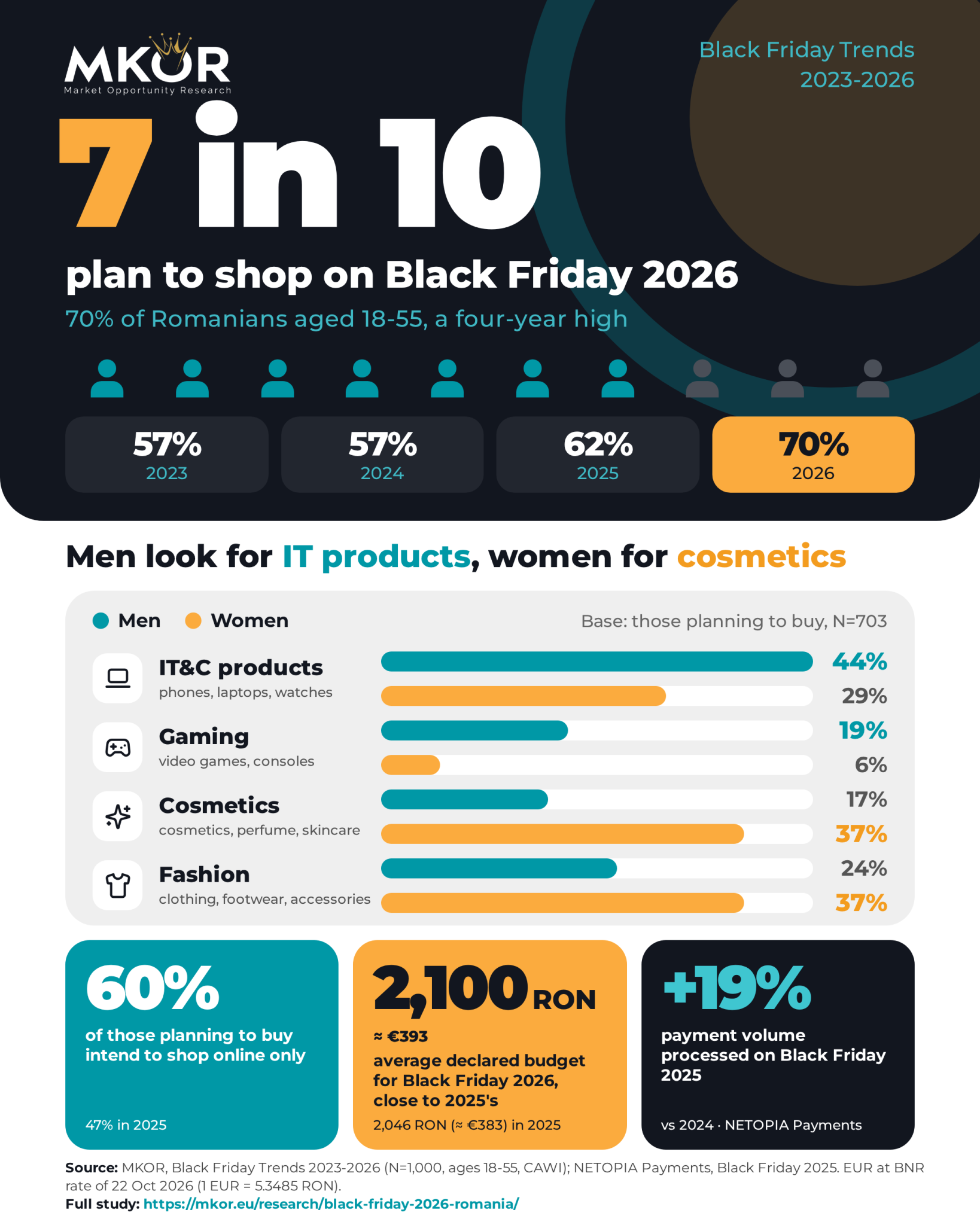
- 70% of respondents plan to shop on Black Friday, the highest level in the data series collected by MKOR. In 2023 and 2024 intention stood at 57%, and in 2025 at 62%. The share of undecided shoppers fell from 34% in 2023 to 24% today.
- Shoppers come prepared. Of those who plan to buy, 84% make a list in advance, about four weeks ahead, and 86% have already set a budget. The average budget is RON 2,100 (about EUR 393), around the same RON 2,000-2,200 (about EUR 374-411) as in the last three editions. But 75% of Romanians say prices have risen significantly (Consumer Sentiment 2026), so the same amount probably buys fewer products.
- Undecided shoppers want discounts they can check. A quarter of respondents have not yet decided whether they will buy. More than a third of them (36%) say being able to compare the discounted price with the previous one would persuade them to buy.
- Gen Z has the highest purchase intention, and Gen X the biggest increase compared with previous editions. Intention is 78% among Gen Z, 69% among Millennials and 66% among Gen X. Among Gen X, intention rose in one year from 52% to 66%. Among young people and Millennials, the increase compared with last year is small.
Contents
Every year, the share of people who bought on Black Friday was 14 to 20 percentage points higher than the share of those who had planned to (different people answered each time, so we are talking about the trend in the series). If the trend holds, I read this year’s 70% as a floor. Undecided shoppers are still a quarter of the sample, and what persuades them is a discount they can check for themselves, so shops that show the previous price from day one have something to gain.

Cori Cimpoca – MKOR Founder
Seven in ten Romanians plan to shop on Black Friday 2026
Purchase intention rose from 57% in 2023 and 2024 to 62% in 2025 and to 70% in 2026.
At the same time, the share of undecided shoppers fell every year: 34% in 2023, 31% in 2024, 28% in 2025 and 24% in 2026, roughly 1 in 4 respondents. In 2026, those who do not want to buy stand at 6%.
The 70% figure shows how many respondents, asked in September, say they will buy at least one product or service on Black Friday. It is an intention stated a few weeks before the event. It does not show how much people will spend and it is not a sales forecast.
More people bought than said they would
Every year, more people bought on Black Friday than said they wanted to.
For Black Friday 2023, 57% planned to buy, and in the 2024 study 71% said they had actually bought on Black Friday 2023.
For Black Friday 2024 the figures are 57% (intention) and 77% (purchase, reported in the 2025 study), and for Black Friday 2025, 62% and 79% (reported in the 2026 study).
The gap was 14 to 20 percentage points.
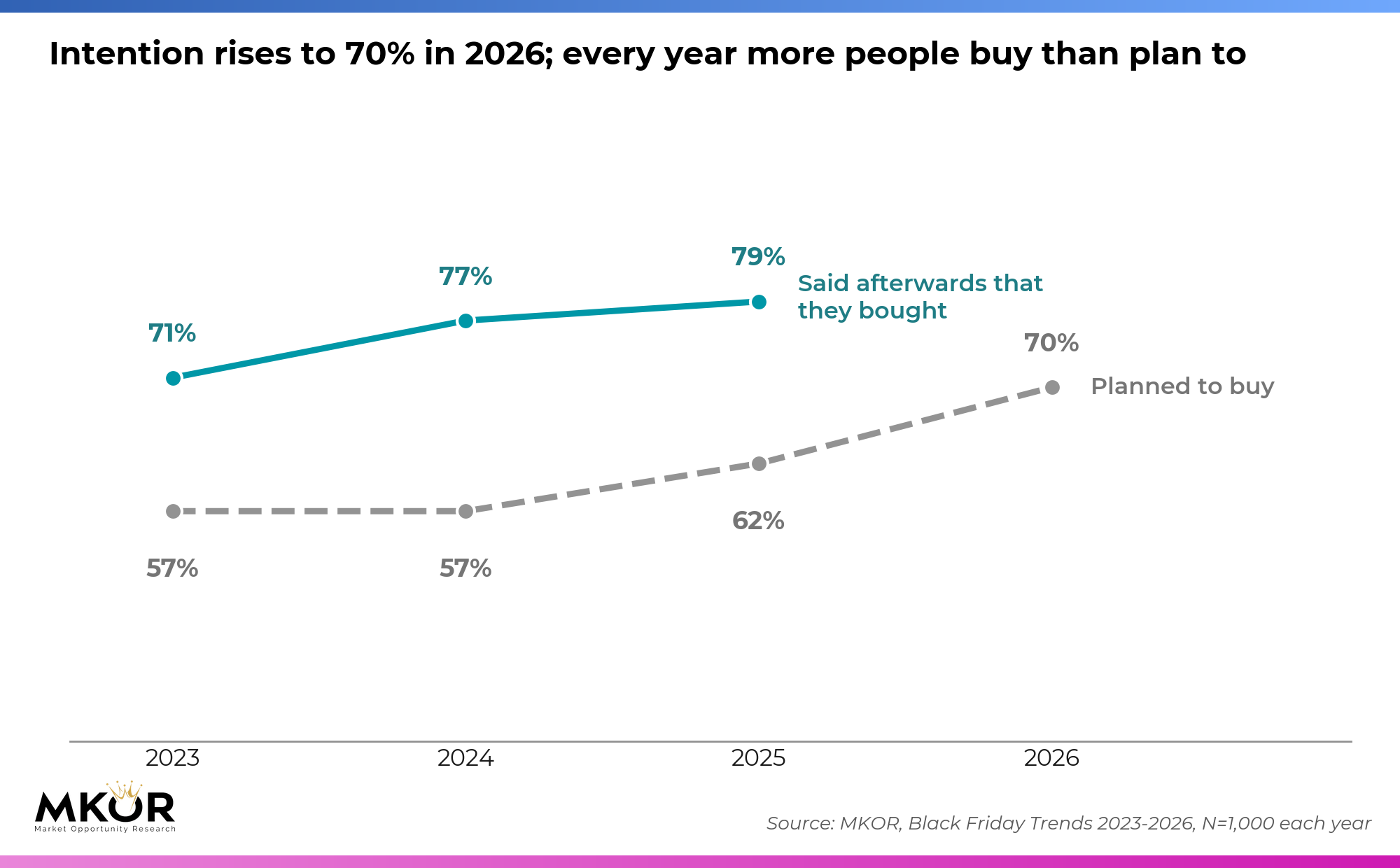
The 70% for 2026 shows how many have already decided. In previous editions, the share of those who said they had bought was higher than the share of those who had planned to buy. Different people answered each time, so the figures show the trend in the series, at sample level.
For retail, this means many customers have already decided to buy and draw up their list almost a month in advance. Offers, stock and communication need to be ready early, so products make it onto the shopping list before Black Friday.
The list is made early: four weeks ahead on average
Most shoppers do not wait for Black Friday itself to decide what to buy. 84% of them make a list of the products they want in advance, usually about a month ahead.
Millennials (aged 30-45) start first, almost five weeks ahead. Young Gen Z shoppers (aged 18-29) start a little later, less than four weeks ahead.
The top reason for buying is products people have been watching for a long time and are waiting to get at a better price.
Across the four editions of the study, this has been the main reason people shop on Black Friday every year. About half of those who plan to buy give it.
For retailers, this means the shopper knows what they want before they see the first ads. The campaign has one thing to show: that the product on their list finally has the price they were waiting for.
What you can do now for your Black Friday campaign:
- Discount the products customers are already watching: the ones saved most often to wish lists, the ones left in the basket and the most searched in recent months.
- Encourage customers to save their wish list early and let them know when a product goes on sale.
- Start communicating four weeks ahead, so the offer reaches people just as they are making their list. For Millennials, it is worth starting even earlier.
- Create a separate gift ideas section for those who use Black Friday to buy early for Christmas.
Budget and purchasing power
The average planned budget is RON 2,100 (about EUR 393), 2.6% more than in 2025 (RON 2,046, about EUR 383), but less than in 2024, when the budget was RON 2,179 (about EUR 407).
The amount has stayed almost the same for three years (between RON 2,000 and RON 2,200, about EUR 374-411). As prices have risen over the same period, the same money probably buys fewer products.
The MKOR Consumer Sentiment 2026 study fills in the background. 87% of Romanians are pessimistic about the economy, and 75% say prices have risen significantly.
23% have borrowed to cover basic expenses and only 9% have managed to save. 61% expect to pay more for high-value purchases such as furniture and home appliances. Home appliances and electronics are also the most wanted category on Black Friday (51%).
This year, the budget is almost the same regardless of age: between RON 2,050 and RON 2,160 (about EUR 383-404).
Shoppers set their budget based on the money they have available (50%), the price of the products or services they plan to buy (43%), the economic context (25%) and the option of paying in instalments (25%).
So Black Friday is when people buy what they have wanted for a long time, at a price they can afford. For shops, that means careful price comparisons, and a small discount will not change anyone’s mind.
Undecided shoppers: a quarter of respondents, persuaded by a big discount that is easy to check
Almost one in four respondents (24%) do not yet know whether they will buy on Black Friday. Most of them could be persuaded by a big discount (61%) or by an offer on a product they are interested in (50%). Others would buy if they needed a product right then (37%).
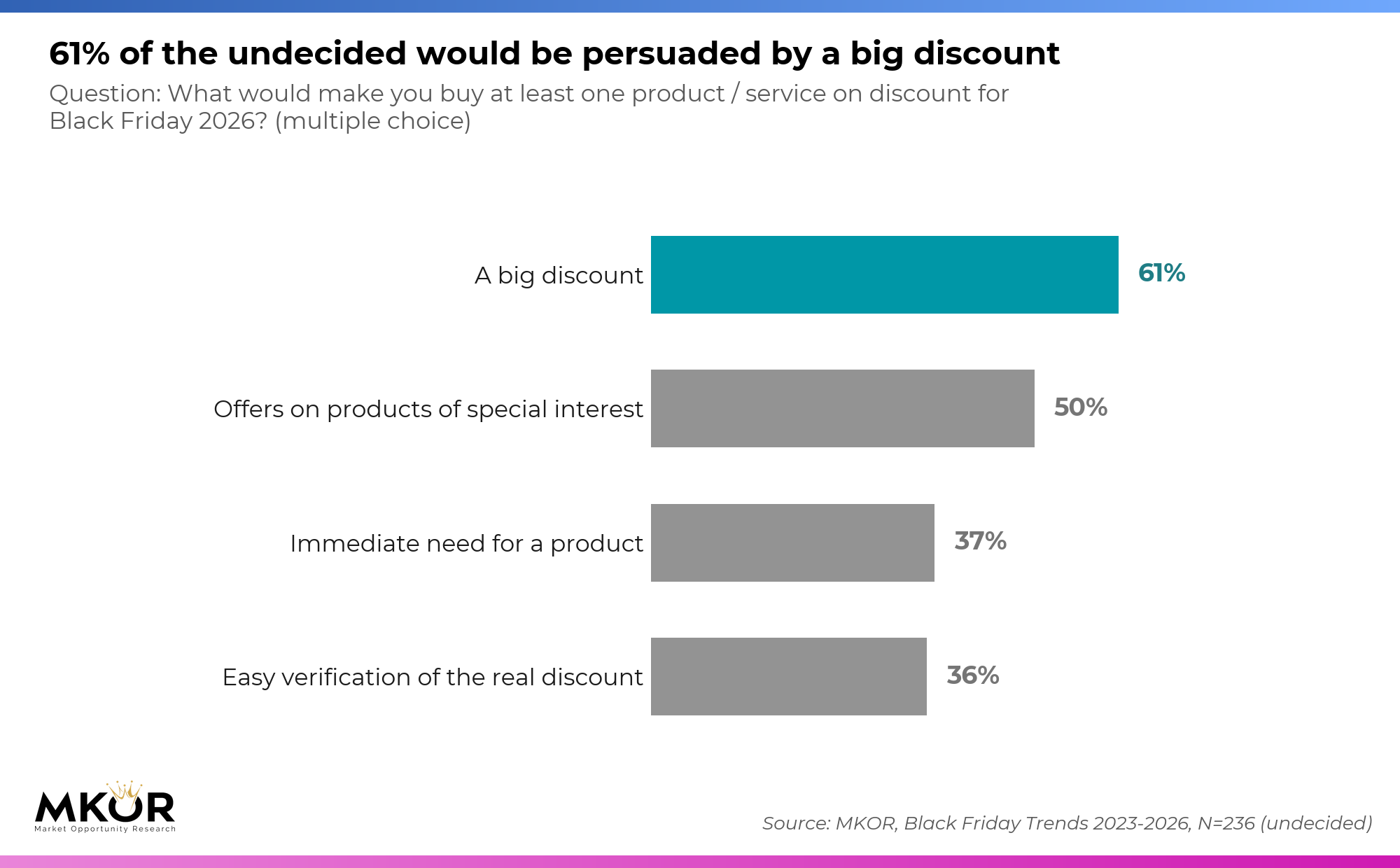
For undecided shoppers, the discount has to be big and reliable. 36% would buy if they could clearly see what the product cost before.
Those who named a threshold ask, on average, for a discount of about 50%, and most of them (72%) would decide at a discount between 25% and 50%.
The generations differ in another respect: young Gen Z shoppers rely on other customers’ reviews much more often than Gen X (indicative figures, as the respondent base is small).
The 6% who do not want to buy at all point first to the economic situation (28%) and lack of money (24%).
Lack of trust in discounts comes up less often than in 2023. Here too the respondent base is small, so the figures are indicative.
For an undecided customer, the discount has to be big and easy to check at a glance. If you work in retail, three things help:
- Show the previous price next to the discounted price. The rules on announcing price reductions, transposed in Romania from the EU Omnibus Directive, already require the previous price to be the lowest price of the last 30 days. Retailers who display it visibly, possibly with a simple price history chart, turn a legal obligation into a potential selling point.
- Choose discounts customers can feel, in the 25-50% range, where most undecided shoppers who named a threshold stop. Avoid “up to 70% off” announcements that apply to only a few products.
- Put reviews in plain sight on offer pages, especially in campaigns aimed at younger customers.
Gen Z has the highest purchase intention for Black Friday 2026
Young Gen Z shoppers are the most determined to buy on Black Friday (78%), ahead of Millennials (69%) and Gen X (66%).
In 2025 only half of those aged 46-55 wanted to buy, while in 2026 they have reached two thirds. They were also the most dissatisfied with the 2025 experience: 13% of Gen X shoppers, compared with 5% among Gen Z.
Among both young people and Millennials, purchase intention has risen compared with last year: among Gen Z from 71% to 78%, and among Millennials from 64% to 69%. The increases are small, however.
Each generation has fewer respondents than the full sample, so the margin of error is larger, and differences of 5-7 percentage points can occur by chance. So we can only say that intention has not fallen, not that it has clearly risen.
Where they shop and how they find out about offers
The biggest change is among young people. Last year, most of them combined online shopping with store visits (56%). This year, 57% of them will buy only online, compared with 35% in 2025.
Online is also growing among Millennials, from 51% to 63%. Among Gen X the change is small, from 53% to 57%.
Each generation finds out about offers in different places. Young people see them on Instagram (33%) and TikTok (31%). Gen X learn about them mainly from television (44%) and Facebook (40%).
When it comes to products, young people are more drawn to clothing and accessories (38%, compared with 25% among Gen X) and video games (24%, compared with just 5%).
Home appliances and electronics appear more often on the lists of older generations: 55% among Gen X and 53% among Millennials, compared with 42% among young people. Toys and children’s items appear twice as often among Millennials: 20%, compared with about 10% in the other two generations.
Home appliances, marketplaces and retailer websites
Home appliances and electronics top the 2026 shopping list, for 51% of shoppers. They are followed by IT&C products (37%), fashion items (30%), cosmetics, perfumes and personal care (27%) and home products (23%). On average, a shopper is targeting 3.5 categories of products or services.
Men lean to tech, women to beauty and fashion
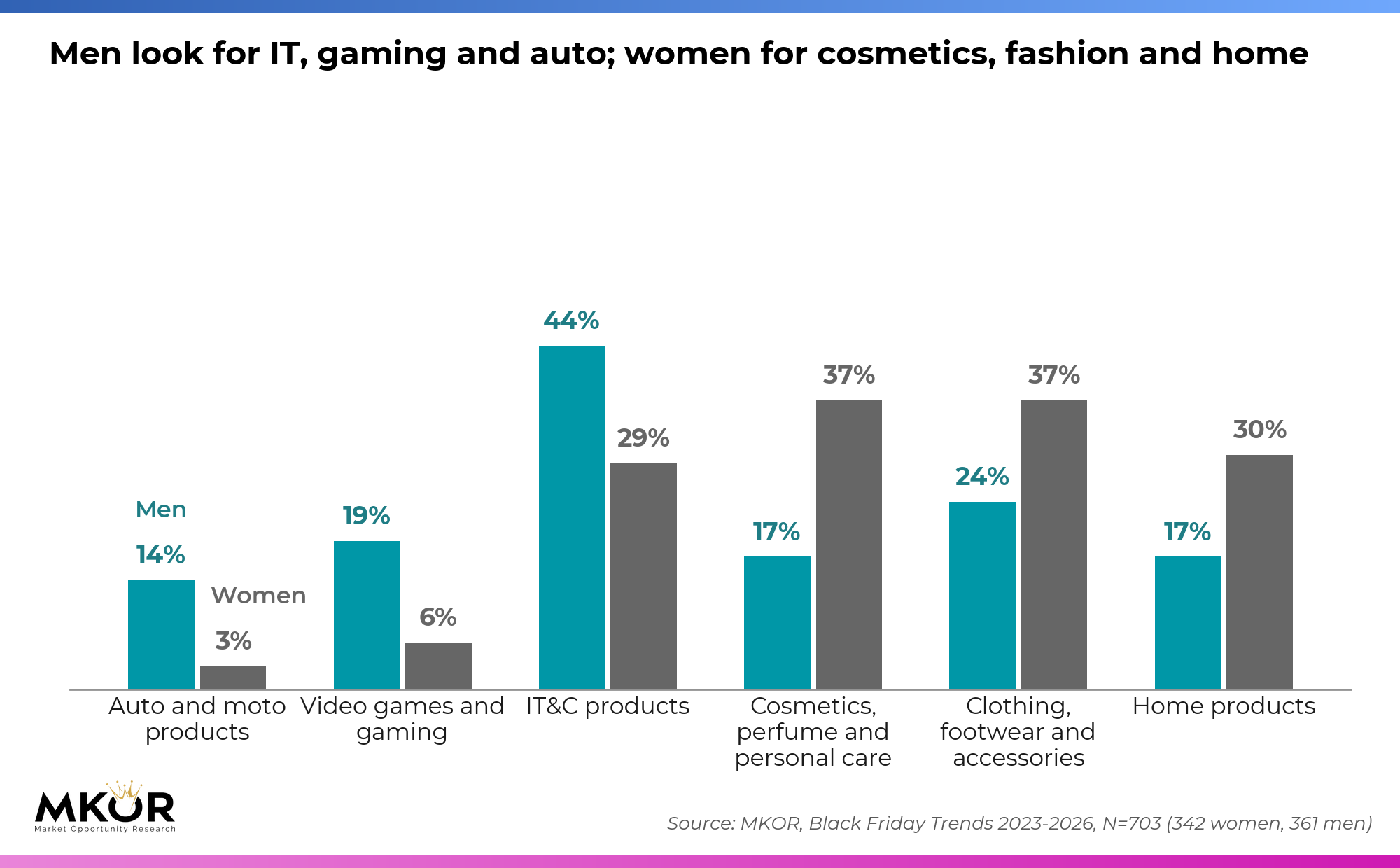
Women (70%) and men (71%) are about equally likely to plan a Black Friday purchase, but their shopping lists differ. Among the 703 respondents who plan to buy (342 women and 361 men), 44% of men want IT and electronics, against 29% of women. Men also lead on video games and gaming (19% vs 6%) and on car and motorcycle products (14% vs 3%).
Women lean to cosmetics, perfume and personal care (37%, against 17% of men) and to clothing, footwear and accessories (37% vs 24%). Home products are on the list of 30% of women and 17% of men. Beauty and spa services appeal to 10% of women and 1% of men.
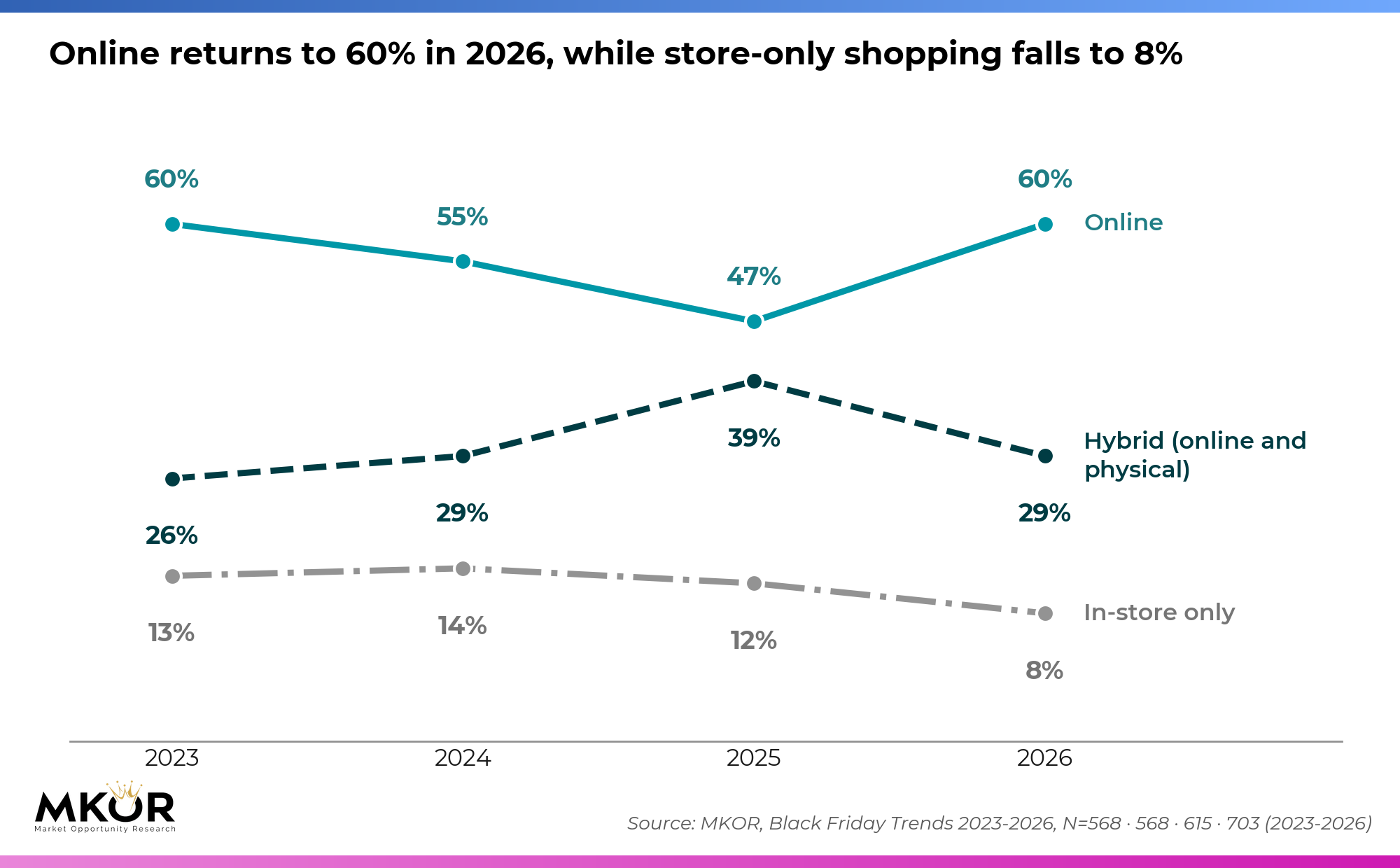
Shopping only online returns to 60% in 2026, up from 47% in 2025. Mixed shopping accounts for 29%, while shopping only in physical stores falls to 8%. The remaining 3% have not yet thought about where they will buy.
Those who shop online or in a hybrid way choose marketplaces (70%), retailer or manufacturer websites (61%) and retailers’ mobile apps (41%). Shops built into social networks remain a niche, at 12%.
They find out about offers first from the retailer (74%), then from social networks (57%) and from ads (45%). AI assistants appear as a new option in 2026 and are used by 6% of those who look for information.
Satisfaction and expectations: the discount comes first
Of those who bought on Black Friday in 2025, 59% were satisfied (scores of 6 and 7 on a scale from 1 to 7), and 10% dissatisfied.
The average score is 5.5 out of 7, the same in the last three editions. The dissatisfied (76 people, small base) point first to the discount being smaller than they expected (60%) and to items being out of stock (46%).
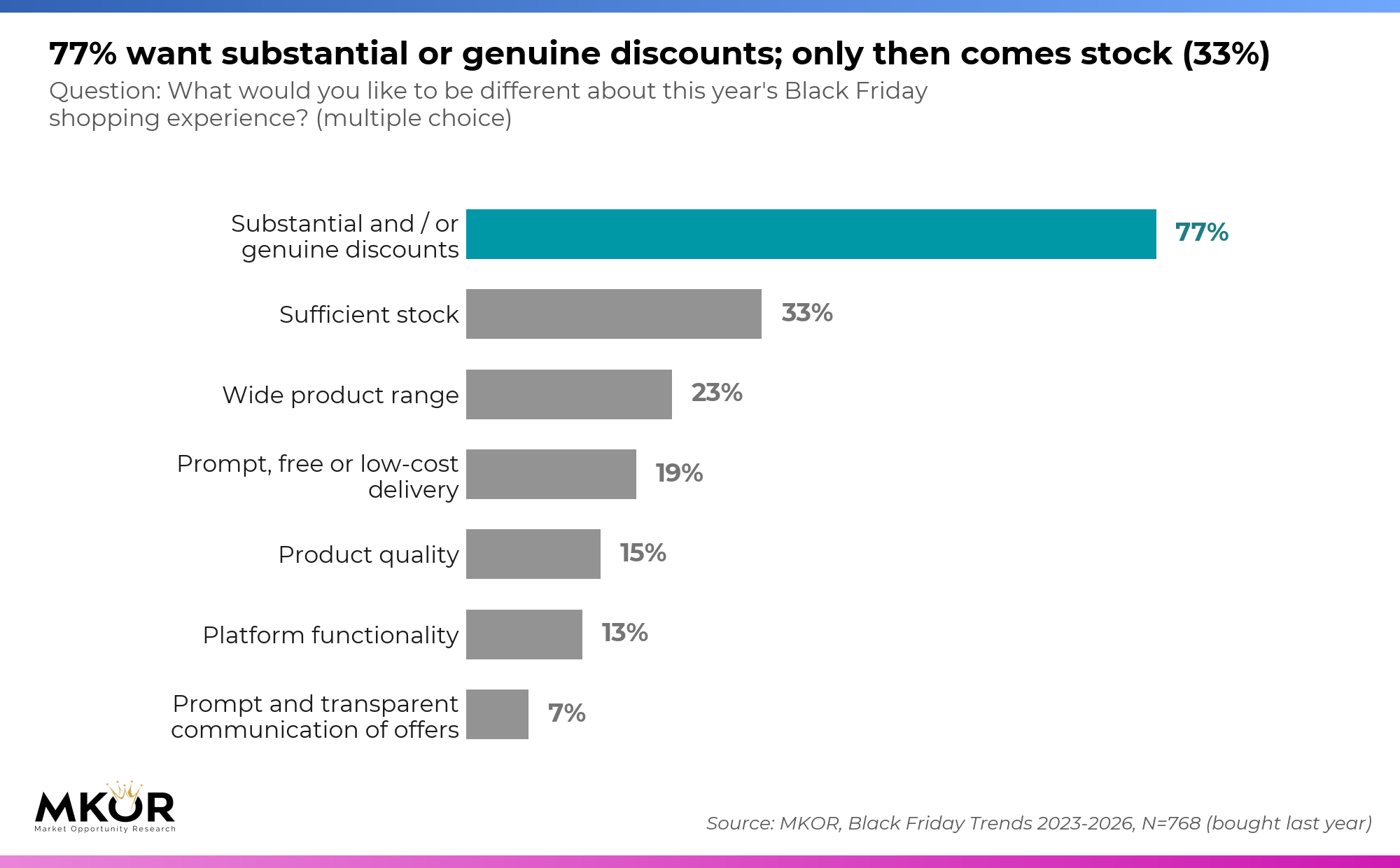
Asked what they would like to be different this year, 77% of those who bought in 2025 ask for substantial or genuine discounts, and 33% for sufficient stock (percentages calculated on the 768 shoppers who gave a valid answer to this open-ended question).
What it means for retailers
If shoppers arrive with their list made and their budget set, the campaign wins when it answers that list of products and services. Based on the figures above, MKOR proposes four directions.
- The offer: 77% of those who bought last year expect substantial or genuine discounts, and 36% of undecided shoppers would buy if they could easily compare the discounted price with the previous one. Show the previous price on every offer from day one, set the discount between 25% and 50% (the range chosen by 72% of undecided shoppers who named a threshold) and let customers save their wish list, because 84% make their list in advance.
- The timing: Shoppers open their list about four weeks before Black Friday, and the retailer is the first source of information. The campaign can start with teaser messages and with offers sent directly to customers who have the product on their list.
- The channels: The offer needs to be on marketplaces (70% of those who shop online or in a hybrid way), then on your own website and app. Keep it in store too, for the 29% who combine online and in-store shopping and the 8% who buy only in physical stores, and adapt the message by generation: Instagram and TikTok for Gen Z, Facebook and television for Gen X.
- The execution: Items being out of stock is the reason for dissatisfaction given by 46% of the dissatisfied (the respondent base is small), and 33% of those who bought last year expect sufficient stock. Reserve stock for the products on customers’ lists, test your website and app under high traffic and show the monthly instalment on the product page, because paying in instalments is a budget criterion for 25% of shoppers.
The 2026 shopper makes their own list. The campaign wins if the product on the list has a discount the customer can check.
Conclusions: what the Black Friday 2026 study shows
- Intention: 70% of respondents plan to shop on Black Friday, the highest level in the MKOR series, and the share of undecided shoppers fell from 34% in 2023 to 24%.
- Preparation: 84% of those who plan to buy make their list early, about four weeks ahead, and 86% have already set a budget, RON 2,100 (about EUR 393) on average.
- Discounts: 77% of those who bought in 2025 ask for substantial or genuine discounts, and undecided shoppers make up their minds at discounts between 25% and 50% that are easy to check.
- Channels and generations: shopping only online returns to 60% in 2026 (47% in 2025), and Gen Z has the highest purchase intention (78%).
Black Friday 2026 study methodology
- Sample: 1,000 respondents aged 18 to 55, nationally representative, stratified by age, gender and region, with statistical weighting.
- Data collection: online questionnaire, administered through MKOR’s own panel; the 2026 wave was collected in September, the 2025 wave in October, the 2024 wave in October and the 2023 wave in November.
- Margin of error: ±3.1%, at a 95% confidence level. Read each segment with its number of respondents (N) in mind: fewer than 30 respondents can distort the analysis.
How to read the figures
- Who we asked: 1,000 respondents aged 18 to 55, from the MKOR online panel. The sample is weighted by age, gender and geographic distribution.
- Why they do not add up to 100%: Because of rounding, percentages may add up to 99% or 101%. For multiple-choice questions, the total exceeds 100%, because a respondent can choose more than one option.
- The base for each percentage: Each percentage is calculated from those who were asked the question. For example, reasons for buying are calculated from the 703 who plan to buy, and the factors that would persuade them to buy from the 236 undecided.
- Intention and reported purchase: We measure intention before Black Friday, in each year’s study. We learn about purchases from the following year’s study, where respondents say whether they bought. It is therefore reported behaviour, not measured from sales. Each edition has different respondents, so the gap between intention and purchase shows a trend at sample level, not a change of decision by the same people.
- What we do not compare with previous years: Where the questionnaire has changed, we do not interpret the difference as a trend, because it may come from the change in the research instrument rather than from respondents’ behaviour.
- Budget: Amounts are estimated by respondents, in RON, at nominal value, not adjusted for inflation. The average is calculated on 562 valid answers. We excluded amounts below RON 50 (about EUR 9) and above RON 6,000 (about EUR 1,122), as well as amounts out of proportion to declared income and the product categories chosen. In 2024, the lower threshold was RON 10 (about EUR 2). EUR equivalents use the National Bank of Romania reference rate of 22 October 2026 (EUR 1 = RON 5.3485), rounded to the nearest euro.
- Generations: Age segments are defined by year of birth, so the age limits shift by one year from one edition to the next.
The study “Black Friday Trends 2023-2026. Plans and expectations from the consumer’s perspective” shows what 1,000 Romanians plan before Black Friday. Your customers, however, may have different needs, different budgets and different reasons for buying.
The shopping list is made almost a month ahead, and 77% of those who bought last year expect substantial discounts. With only a few weeks left, you need to know which products your customers put on their list, which discount persuades them and on which channels you can reach them.
With MKOR agile market research, you can test your Black Friday offers and messages on a national sample of 1,000 Romanians, with results in about a week, before you launch them.
Contact us and find out what your customers want from Black Friday, so your campaign is built on data.
* The methodological accuracy and the data in this case study were validated by Mihaela Nicolae, Senior Researcher, and Mihaela Malion, Senior Data Analyst & Project Manager.
Have you read everything? Comment / join our newsletter / read our other research posts!