


The Back to School Post-COVID study was conducted among parents of children in pre-university education, to find out what their expectations and fears are regarding how the new school year will unfold, by MKOR Consulting, in partnership with the Education Research Unit within the National Center for Policy and Evaluation in Education.
Most parents prefer the face-to-face school scenario
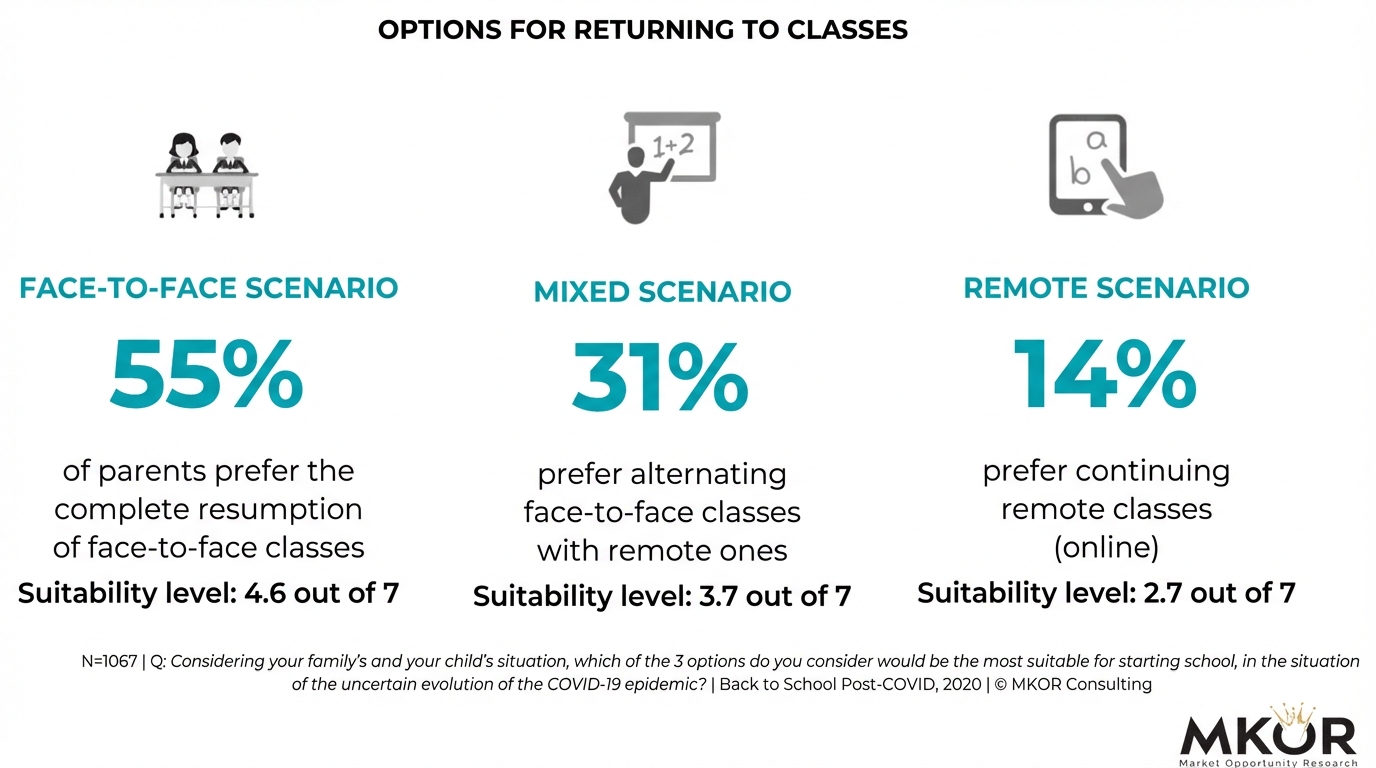
According to the study we conducted at the end of July and the beginning of August, more than half of the participating respondents expressed the desire for the 2020-2021 school year to unfold with a return to traditional, face-to-face classes (55%). Face-to-face classes are preferred especially in the case of preschoolers and high school students.
Even though they appear cautious, parents consider this approach to be the most suitable for their children, giving it an average suitability score of 4.6 points out of 7.
In general, parents are open to all proposed methods for conducting face-to-face classes, but the most agreed-upon method is that, to the extent possible, classes be held outdoors, in the form of laboratories, and the emphasis be placed on the practical side of education (6.3 points out of 7 possible).
Parents’ level of concern and measures regarding face-to-face classes
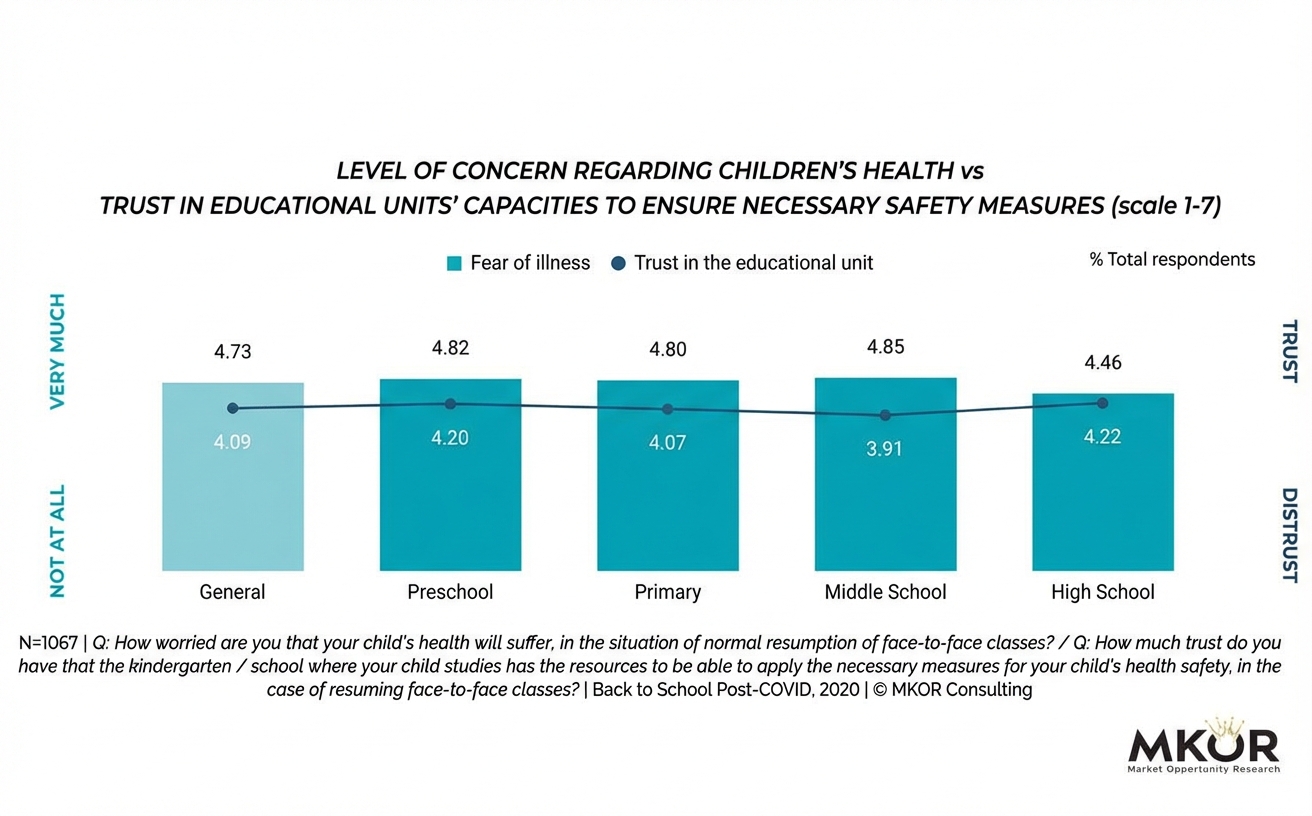
In the case of returning to school, parents show a moderate level of concern, both in the first scenario, of fully face-to-face classes (4.7 points out of 7), and in the second scenario, where children would attend classes only part of the time (4.4 points out of 7).
Parents’ concern regarding their children’s health is influenced by the trust they have in school units regarding the implementation of necessary measures to prevent Coronavirus infection.
Thus, those who do not trust school units are more fearful for their children’s health. The main fear of parents is the non-compliance with distancing and hygiene rules by the children (over 60%).
Especially parents of preschoolers and primary school students are concerned that the little ones will not be able to wear a mask for the entire duration of classes (43%). On the other hand, those who have older children, in high school, with a higher degree of independence, tend to be more concerned about the possibility of infection with the new virus on the way to school.
Prevention measures for face-to-face classes
Regarding limiting the spread of the virus, parents believe that establishing and clearly communicating sanitization rules for students, teachers, and the school facility represents the main set of measures that should be taken by authorities.
Aspects related to epidemiological triage and restrictions on children, such as wearing masks indoors, tend to be less agreed upon, especially by parents of young children (parents’ resistance to the mandatory mask-wearing measure for children is inversely proportional to their age).
Parents’ main concern relates to children’s inattention to physical distancing and hygiene rules (more than 6 out of 10 parents), but also to the fact that some parents might send their children to school, even if they show symptoms.
The hybrid learning scenario, preferred by 31% of parents
In second place in parents’ options is the hybrid option, in which children alternate distance learning with traditional schooling. This option is preferred by almost a third of parents (31%), especially for students in middle and high school cycles, as well as those living in large and very large cities of the country.
The level of confidence in this option decreases, compared to the Face-to-Face Course Scenario, to an average suitability score of 3.7 points out of 7.
The level of confidence in the quality of the learning act is also moderate, at 3.6 out of 7. This scenario is chosen especially by parents of middle and high school students.
If students were to divide their time allocated to courses, partly from home and partly face-to-face, more than 9 out of 10 parents are of the opinion that certain subjects should be taught primarily during face-to-face classes.
Among them are primarily Mathematics, Romanian Language and Literature, and foreign languages. In addition, parents of primary school students want personal development classes for their children, and for those in middle and high school, Computer Science / ICT classes.
Regarding confidence in the capabilities of educational units to ensure the necessary safety measures in this scenario, parents’ concern for their children’s health increases as the level of confidence in the capabilities of educational units decreases.
The distance learning scenario, preferred by only 14% of parents
The scenario in which courses take place exclusively online, as they were during the state of emergency, is in last place in parents’ preferences: only 14% adhere to this option. In the parents’ opinion, this option is also the least suitable for their children (2.7 points out of 7). Parents of middle school students and younger grades tend, however, to accept this form of schooling better, compared to those in high school grades.
Parents’ level of confidence in the quality of distance education is moderately low, at 3.6 points out of 7, with parents of high school children being the least confident (3.2 points). The least confident in the quality of the distance educational act are the parents of high schoolers.
Measures for the quality of distance learning
If this option were chosen, students’ parents propose a series of measures that would improve distance learning, mainly related to interaction with teachers: constant support from teachers (47%), daily interaction (45%), and their constant feedback (39%) represent the main ways children can benefit from quality learning from home.
Video recording of courses for easy access to content (39%), providing equipment for online school (35%), and printable or printed work materials (34%) represent additional ways children can be supported when learning from home.
Parents’ fears and concerns
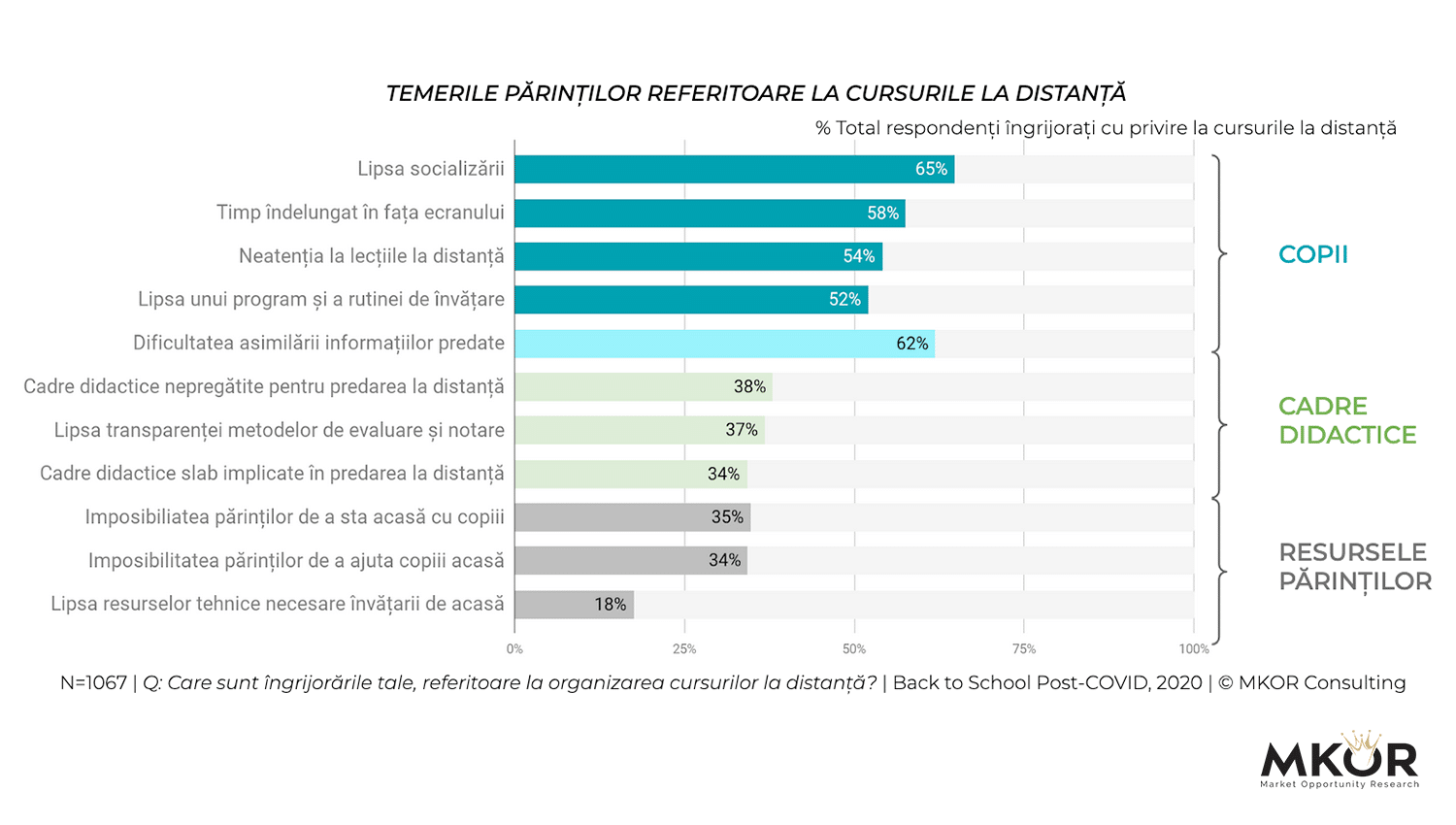
While in the case of face-to-face classes parents’ worries are related to their children’s health, in the case of remote classes the main concerns are related to the quality of education.
Parents’ worries are centered on how children are affected by the lack of socialization (65% of parents), the prolonged time spent in front of the computer (58%), but also by the poor quality of learning. The lack of socialization is felt especially by preschoolers, while the difficulty in assimilating new information is a greater concern for parents of schoolchildren.
The poor quality of remote learning is reflected in the difficulty of assimilating information taught during online classes (62%) or by the fact that students lack concentration (54%), not having a clear schedule and a specific learning routine (52%).
Parents of older students, in middle and high school, are especially worried about the skills and involvement of teachers in remote education: 38% of parents believe that teachers are not sufficiently prepared and 34% believe that they do not get involved enough in remote teaching.
Over a third of parents are concerned about the lack of transparency in student assessment and grading methods (37%). This concern increases in the case of high school students.
Other concerns of parents are also related to the limitations they themselves have in ensuring access and support for their children during online learning.
Family and technological limitations for remote schooling
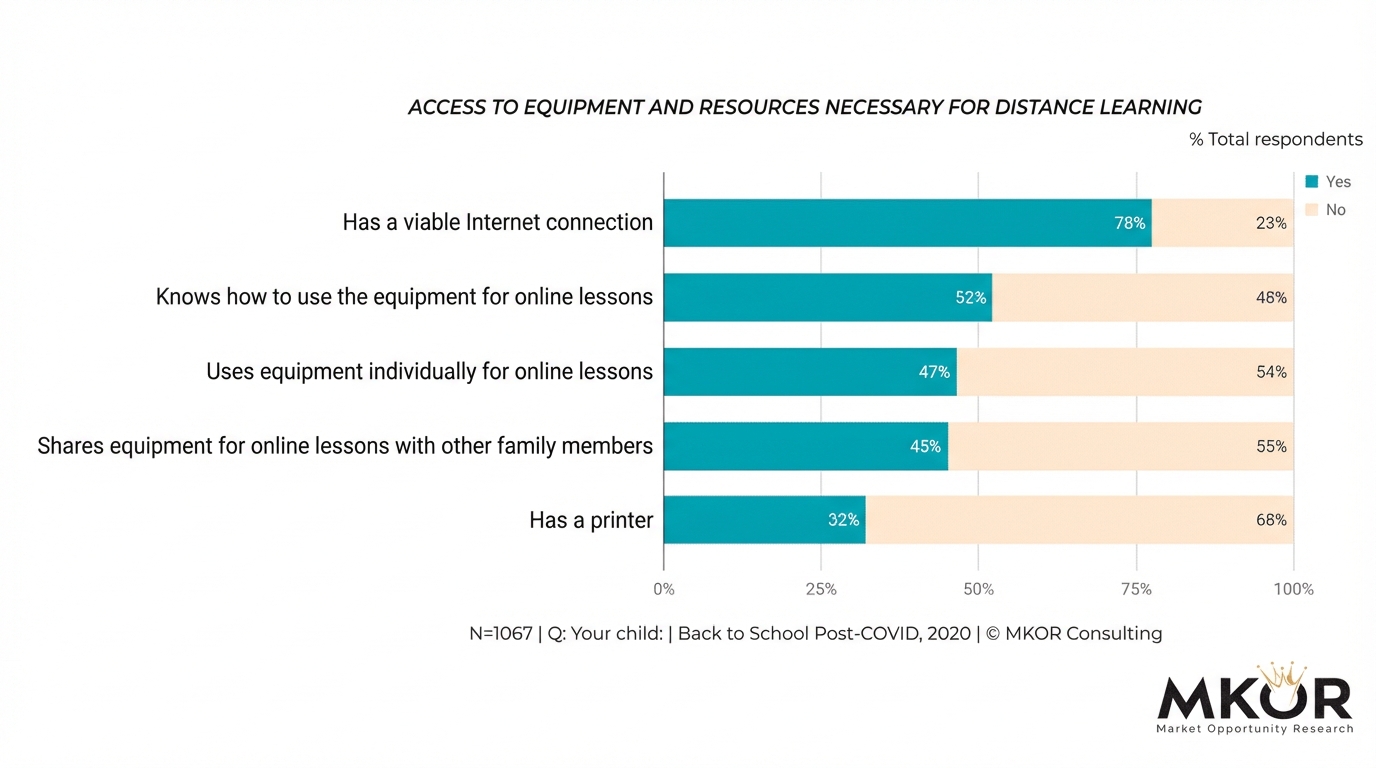
In this scenario, some of the limitations consist of technological barriers, while others are related to the family situation. The lack of technical resources necessary for online school is a problem noted by almost 2 out of 10 parents, while 1 in 3 do not have the possibility to stay at home with the children and support them in the distance learning process.
Thus, even if the majority of children have access to online networks,
- more than 2 out of 10 children do not have a viable internet connection to be able to participate in classes held remotely,
- 1 in 2 do not know how to use the equipment to participate in online lessons or do not have access to devices they can use individually, and
- 7 out of 10 do not have access to a printer.
More than half of parents have limited or no possibilities to support their children during home classes. They must find solutions for child supervision.
A quarter will call upon relatives to stay with the child and only 2% will use the services of a nanny. At the same time, one in 10 parents will quit their job to stay home with the child, half of them having children in primary school or coming from rural areas.
Communication between institutions and parents during the state of emergency
Respondents consider that they were informed at a moderate level, giving 4.1 points out of 7 to the quality of the information act during the state of emergency, related to the changes that were to be implemented once schools closed. 41% of parents in highly developed cities declare that they were very poorly informed.
Firstly, information regarding the child’s school activity and progress was missing for more than half of the respondents (53%).
In second place in the top information that parents would have liked to have during the second semester of the last school year are details regarding the evaluation of children (47%), this situation applying especially to parents who have children in primary classes (43%) or high school (33%).
A third of respondents would have liked to find out more about the online platforms used, but also about how they are used.
Communication plays an essential role in the relationship between authorities and parents. The better informed parents consider they were during the state of emergency, the higher the level of trust in authorities (local and central).
The need for information in the new school year
In the new school year, the older their children are, the more parents want to be informed about evaluation methods and how classes are conducted.
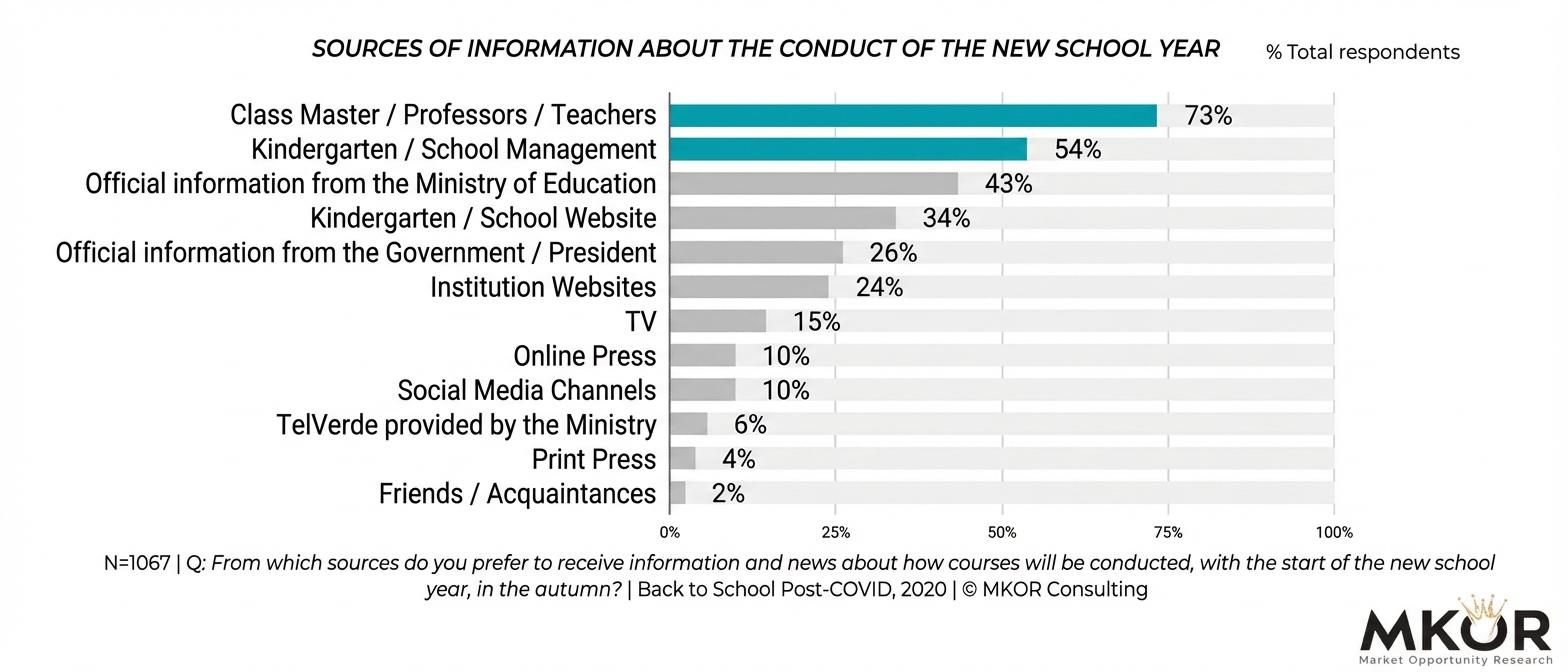
For informing parents in the 2020-2021 school year, mass media sources are indicated to be the least popular, and parents tend to access official sources instead (accessed by at least a quarter of respondents).
The main sources of information about the new school year will be local ones, specifically the children’s homeroom teachers or primary teachers, for 73% of respondents, while 54% of parents will turn to the school management to find out relevant information about courses.
4 out of 10 parents will follow the official briefings given by the Ministry of Education, and 26% will follow those published by the Government or the President.
Trust in authorities
Trust in central authorities is low, at only 3 out of 7 points. Residents of small urban areas grant the lowest level of trust in central authorities (2.7 points).
When it comes to trust in local authorities (city halls and local councils), the average is slightly higher, towards moderate, at 3.4 points. Residents of rural environments tend to be more confident in local authorities, granting the highest trust score (3.6 points).
Communication plays an essential role in the relationship between authorities and parents. The better informed parents consider themselves to have been during the state of emergency, the higher the level of trust in authorities (local and central).
Trust in the capacity of school units to apply the necessary measures for child health safety in the case of resuming face-to-face classes is moderate, at 4.1 out of 7. In this case, parents are more worried that their child’s health will suffer. One-third of middle school students’ parents have very little trust in the capacity of school units to apply child health safety measures.
In the case of returning to remote classes, the level of trust in educational units is rather low, at 3.6 points out of 7 possible. High school students’ parents are the least confident in the capacity of school units to perform a quality remote educational act (3.2 points).
Those who do not trust that the school has the resources to apply the necessary measures for child health safety, in the case of resuming face-to-face classes, are more worried that the child’s health will suffer, while those who trust schools that they can offer a quality educational process, in the case of returning to remote classes, prefer the scenario of online classes.
Intervention directions
As researchers, we want the information we provide regarding parents’ expectations, as indirect beneficiaries of the education system, to help authorities make the most informed decisions regarding the future.
Thus, we propose analyzing the option that parents can choose the return-to-school option suitable for their child and their personal situation.
Given that there is a significant percentage, of 14% of parents who would opt for the remote learning option, the possibility should be analyzed that in certain special personal situations, medically documented, families have the possibility to temporarily choose schooling their children from home.
Other intervention directions proposed by us:
- Analyzing the opportunity of conducting classes outdoors or in other informal spaces, which would allow children social distancing, but also experimentation, with an emphasis on the practical side of learning.
- Close communication of educational units with parents, who should be informed and consulted regarding the measures taken at the school level. While some regulations should be adopted unitarily, at the central level, other regulations must be established at the local level, depending on the specifics of each school unit.
- For example, the measures that should be decided at the central level, and implemented at the local level are those related to sanitization, providing disinfectants at the entrance of the unit, disinfectant, liquid soap, toilet paper, but also solving problems related to equipping toilets with running water and sewage, where these do not exist.
- On the other hand, communicating distancing rules to parents and students (including limitations imposed in case of infection) should fall under the responsibility of educational units, these being the main hub of information, from the parents’ point of view (see above, the section regarding Authorities’ communication with parents).
- Training teaching staff and school management in the sense of maintaining a close relationship of communication and consultation with parents. Whether the briefings are official news or a reinforcement of good conduct rules on the part of parents, students, teaching staff, and the school, the two actors – to whom we recommend adding the students, as direct beneficiaries of the educational act – should be in permanent contact.
Methodology
The study was conducted by MKOR in partnership with the Education Research Unit within the National Center for Policy and Evaluation in Education, on a stratified random sample of N=1067, representative of the population of parents having at least one child registered in the Romanian educational system in the 2020-2021 school year, by the child’s education cycle, area of residence, and geographic distribution (development regions).
Data was collected between July 26 and August 3, 2020.
Confidence level 95%, margin of error +/-3%
Stay informed about the impact of COVID-19
MKOR Consulting is connected and follows new market trends, publishing our latest proprietary research, whether conducted independently or together with our partners.
The present study is part of the series of studies on the impact of COVID on the lives of Romanians, which also includes
- Post-COVID Consumer Behaviors
- The Impact of the Coronavirus Epidemic on the Lives of Romanians 2020
- Study on the Impact of the COVID-19 Epidemic on the Romanian Business Environment
Stay informed with all the studies published by us and more, by subscribing to our newsletter (we don’t spam)! 🙂
Curious to find out more about us? You can explore our Portfolio or send us a message so we can chat!