


SWOT analysis is one of the most commonplace marketing tools. At least in appearance. Much like Socrates’ famous aphorism cited in the title, it seems obvious and accessible to anyone. And yet, it isn’t.
Far from being just a brainstorming session, a SWOT analysis is one of the first steps of a marketing strategy. It should be conducted seriously, as a conclusion to the data obtained through research.
Why it shouldn’t be done as a mere brainstorming session is a question with a simple answer for any business person or specialist: garbage in, garbage out. The time allocated to a SWOT analysis (and generally to everything we do) is proportional to the quality of the final result.
If we allocate just a few hours to list the things we believe fit into each of the four categories, the “reality” we see at the end will exactly reflect the effort put in. A specialist—whether internal or a consultant—is the person we would want by our side during such an analysis, as they can help us see certain aspects more clearly through expertise and objectivity.
The list resulting from each of the four “quadrants” will serve as a guide for creating the marketing strategy: the things we need to communicate (strengths), the things we need to improve (weaknesses), the opportunities we must seize, and the possibilities we must avoid (threats).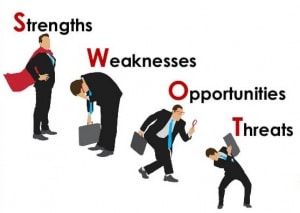
The first two (SW) differentiate us from the competition, for better or for worse. And we can only know these differences after studying the competition during the research phase mentioned previously.
Strengths are what we want to develop into as many benefits as possible for our end customers. We will then communicate these benefits, ensuring we do so effectively.
In combination with opportunities, strengths create strategic advantages that we can use for the success of our business.
The next two (OT) provide the interactions we can have with the external environment, whether dependent on or independent of our will. We will identify them after conducting a PEEST analysis, as this is what provides data regarding our company’s external environment.
To see them, we need both the capacity for synthesis and creativity at the same time. But also the courage to face them. Opportunities and threats are like the candies in Forrest Gump’s chocolate box: you never know what you’re going to get.
And, in any case, you’ll only get something if you’re there and reach out to take it. We don’t know if an opportunity will be profitable or not unless we implement it or at least analyze it more closely. We must be creative to see and then transform the potential of opportunities into success for our business. Then, we must be true strategists, creating Plan Bs to anticipate and counter threats.
A serious SWOT analysis will lead us toward a profitable marketing strategy for our business. It depends on us how well we conduct it, and the success of the marketing actions we undertake will depend on this.
Article published on Mad3.ro