



Have you ever found yourself waiting for an important email, only to eventually realize it ended up in spam? This has probably happened to all of us, but since there was no mailman to talk to, we simply resigned ourselves to it.
But why didn’t that email reach the inbox? Well, it all has to do with the reputation the sender has with the internet service provider (e.g., Yahoo, Gmail, Zoho, etc.).
And reputation is even more important when you are a market research agency like us, whose analyses often depend on primary data collected via email, most of the time.
Therefore, it is important to establish and maintain an impeccable online reputation to ensure the effectiveness of market research.
The MKOR team is multidisciplinary, so in addition to the specialists who design the research and establish the methodology and sample size, it also includes digital marketing specialists.
They ensure the targeting of a sample of respondents to collect the most relevant data in a timely manner.

What is email sender reputation?
Email sender reputation is a score established by Internet Service Providers (ISPs) and assigned to the organization sending the emails. This score is a component that ensures email delivery to the inbox.
Email sender reputation is a necessary policy that ensures inbox delivery standards for emails that truly matter to the recipient.
Emails with content unsolicited by the recipient will be marked as unwanted by the ISP and, as a result, will end up in the spam section.
Sometimes, message content is incorrectly flagged as unwanted by the ISP, preventing direct delivery to the inbox.
The higher the score, the more likely the ISP is to deliver emails directly to recipients’ inboxes rather than the spam/ junk section. Each ISP has different standards when assigning a sender reputation score. The score is determined by several factors, including:
- The total number of emails sent by the organization;
- How many recipients mark the email as spam or complain to the Internet Service Provider (ISP) about it;
- How often the organization’s emails are caught by the provider’s filter;
- Whether or not the organization is on a blacklist;
- How many of the sent emails were rejected because they were sent to unknown users;
- How many recipients open, reply to, forward, or delete the received emails;
- How many recipients click on the included links;
- How many of the addressed recipients unsubscribe from the organization’s email list.

Why is email sender reputation important and how can you use it?
If you have ever needed market data, you probably already know that an important stage of research is data collection, as it is the primary source of market analysis.
Within our agency, once the research design is approved with the client, the digital communication team launches the data collection campaign.
You need a certain number of respondents, but how do you get them?
MKOR owns a consumer & B2B panel that exceeds 40,000 active members who respond promptly to our questionnaires when they are sent to them.
Sometimes it happens that the profiles of the respondents in the panel do not cover our clients’ needs. The reasons can be diverse: the client’s business is very niche, the prospect profile is atypical, or their product/service is addressed to other businesses (B2B).
In these situations, to collect the data necessary for analysis, we use alternative methods to reach respondents: a database provided by the client, by a third party, or we collect the necessary respondents with the help of relevant social media campaigns.
You have a prospect database, but what do you do with it?
If an external database is used for primary data collection (most often, our client’s), the role of our specialists becomes even more important, because it happens that these databases contain errors or outdated contact details.
Old or erroneous contacts affect the efficiency of data collection: they lead to an erosion of reputation and, as shown above, the sender’s reputation directly depends on the accuracy of the email list.
MKOR Consulting frequently sends study invitations to panel subscribers (however, no more than one invitation per week to each Panel member).
Currently, the interaction or click rate with the emails sent by us is 52% of those who open the email. In addition, the success or final completion rate of the questionnaire is 26% of those who received the invitation email.
Database accuracy
Our digital specialists ensure that, before sending the email campaign, the database is clean. A clean database will have a minimum rejection (bounce) rate and will respect the preferences of subscribed respondents.
Reputation can always be controlled by the sender. MKOR knows the importance of a good online reputation and has access to a variety of resources and tools to ensure the correct transmission of the email containing the questionnaire, so that it reaches the recipient’s inbox.
In this way, we ensure that the email has reached as many of the most relevant respondents as possible, according to the agreed profile.

What is the bounce rate?
Bounce, from English, means “to ricochet”, “to reject”, thus it happens that emails do not reach the recipient.
This phenomenon occurs when sent emails are rejected by the email system for various reasons, most often technical: lack of hard-disk space, the server is non-functional or the recipient’s address is non-existent/wrong and in less common cases when the server directly rejects the sender’s address.
The bounce rate for emails is calculated by dividing the number of people to whom you sent a campaign by the number of emails that bounced. The formula looks like this:
Bounce rate (%) = returned emails (#) ÷ sent emails (#)
Why is it important to have a low bounce rate?
In a digitalized world, users change their email addresses quite often, so no marketing campaign will have a bounce rate equal to zero. However, digital marketers’ efforts should focus on achieving the lowest possible bounce rate.
An average bounce rate is about 1% and definitely cannot exceed 5%. A high rejection rate affects the direct delivery to the inbox of emails in both the current and future campaigns.
Ignoring a high bounce rate can lead to negative labeling of the sender, and they may end up on a blacklist. You can check your domain using MXToolbox services.
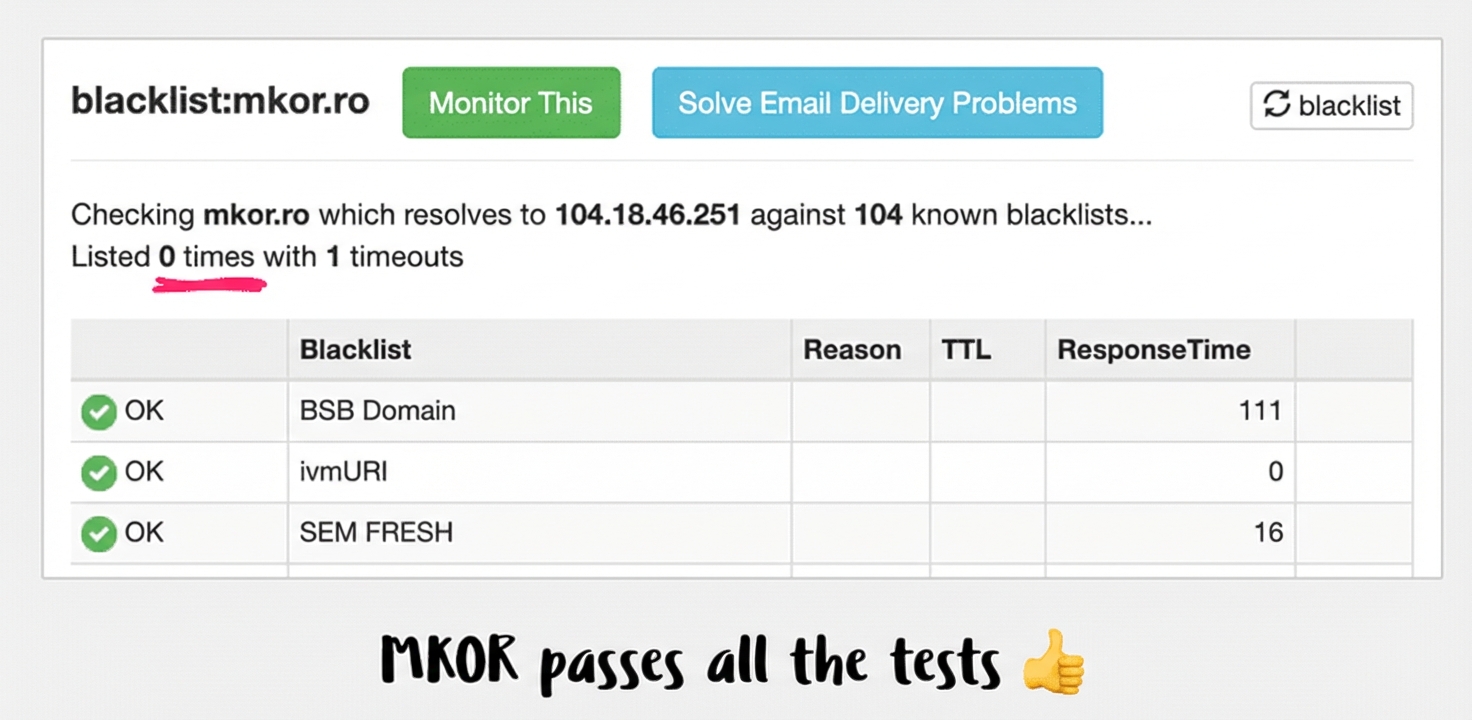
MKOR has a very low bounce rate
Our team has specialists dedicated to maintaining our online reputation at the best possible level, one of the tracked indicators being a bounce rate as close to zero as possible.
At this moment, our agency has a bounce rate of 0.87%, which means that only 9 emails out of 1,000 were rejected.
If the bounce rate is higher than 5%, then our email marketing account can be suspended, which represents an inestimable cost for us, with repercussions lasting from a few days to a few weeks.

Workflow: What can you do to keep a bounce rate within parameters?
At the beginning of the collaboration with the client providing the database, our agency performs an audit of it. If the database has a bounce rate of over 5%, our agency will refuse to work on it until a cleaned database is received.
Our agency has a continuous commitment to data quality and maintaining an impeccable online reputation, which also represents the obligation to send emails only to valid addresses.
If the client is not sure that the database they own is up to date, there are tools that can help in this regard. However, if they do not have such tools available or, for various reasons, cannot clean the database to obtain a list of valid contacts, our agency can help in this regard.
When we collaborate with our clients using databases that belong to them, we use a simple, inexpensive, and organic strategy.
Thus, the client sends a newsletter to their subscribers, maintaining their own communication style, through which they inform them that they are about to receive an email from us, MKOR. This approach has multiple advantages for all three actors involved:
- Subscribers will feel respected, knowing the purpose of the process they will take part in and will not feel threatened by the presence of an unsolicited email to mark as spam.
- Our digital specialists will have better control of the campaign and will considerably reduce the bounce rate.
- The client will obtain a relevant conversion rate and the necessary answers for conducting the study.
- It is in compliance with GDPR regulations.

GDPR Coming into Force
Last year – in 2018, this period was very busy, especially for marketers, who were worried about the coming into force of the new General Data Protection Regulation (GDPR).
Their fears were not unfounded, but about a year after the implementation of the changes, we can observe that the modifications had a beneficial effect on marketing activity.
Users received emails requesting their consent to remain subscribed. Digital communication managers initially feared those who answered “no” or did not respond to the invitation at all.
But it is precisely these users who do not interact with the email content and are the ones who make email campaign statistics look unfavorable.
Thus, those who applied this strategy following the emergence of GDPR now enjoy a clean and responsive database.
Maintain and Increase the Email Sender’s Reputation
The sender’s reputation depends on factors that are complex and dynamic, changing with each IP address used and each campaign sent. A single misstep can compromise the reputation and, simultaneously, the delivery of emails.
Build an emailing strategy that corresponds to the best practices in the field that ensure a solid reputation. In this regard, we offer you some practical tips from our digital specialists:
Communicate in a personalized way
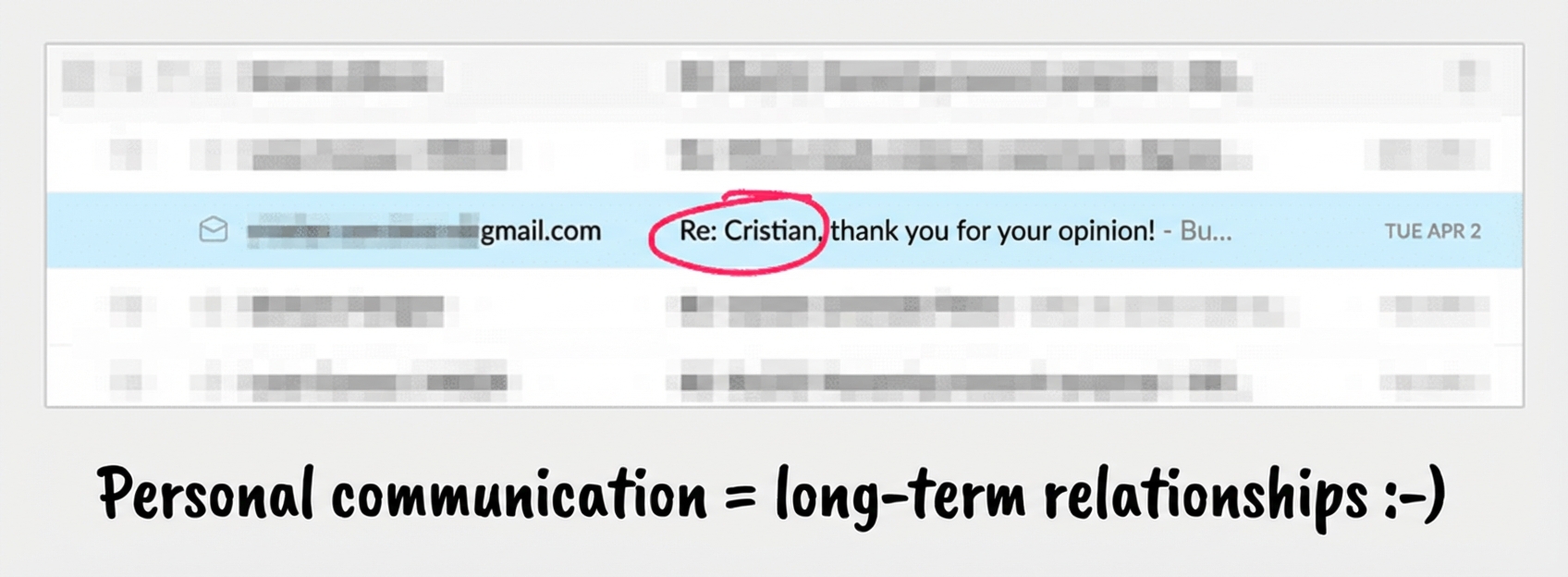
Address each email using respondents’ names. You can do this starting from the email subject line to ensure the highest possible open rate.
An email that is addressed directly builds a personalized relationship and gains the trust of both recipients and the ISP.
Offer the possibility to unsubscribe
It can be tempting to try to maintain your subscriber base by hiding the unsubscribe option, but you are only undermining your own efforts.
Emails marked as spam by recipients can affect your reputation. So can emails that are deleted without even being opened. Usually, those who do this indicate that they are not interested in the email’s content and therefore no longer wish to receive them.
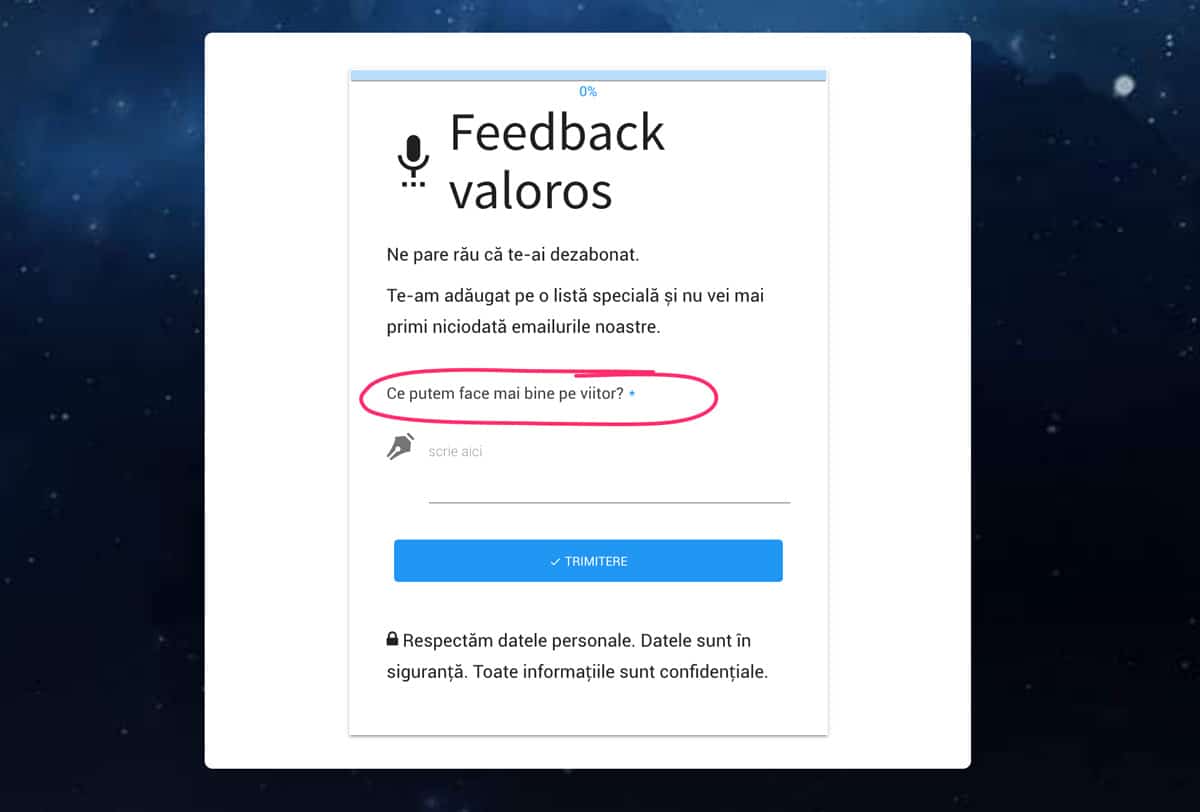
Therefore, it is important that they have the possibility to be removed from the subscriber list. Through a simple, visible unsubscribe link, you can maintain a clean database containing contacts directly interested in the content of the emails you send.
Tip: direct those who want to unsubscribe to a feedback form to improve relations with your subscriber base. Keep it as simple as possible and ask only for what is strictly necessary.
Communicate constantly
I was saying that a personalized relationship is important in email communication. And just like any personal relationship, it must be maintained, like a friendship that needs a walk in the park or a glass of beer 🙂
It is important to stay in touch with your subscribers, otherwise you risk them losing interest, finding new “friends,” or simply forgetting you, and when you return to their inbox, their reaction might be one of rejection.
Constantly send relevant content to your audience and interact with them without being intrusive.

MKOR, an email sender with a reputation
You can choose to use the information above on your own or you can use MKOR’s services. We offer you the guarantee of an established reputation over more than 6 years of work, during which we have not deviated from the basic principles that ensure email delivery directly to the inbox.
MKOR provides you with a panel of over 40,000 respondents, or we can work with your database (for example, for a customer satisfaction study).
And if you are not sure about the quality of your database content, don’t worry, because our specialists have the most effective technical means at hand to achieve the results you want. Write to us about your idea.
Be part of the MKOR subscriber community!
Subscribe to our newsletter if you find the information in this article useful and if you want to receive more like it!