


When companies and agencies talk about AI in market research, the conversation almost always begins with the same word: speed.
Reports delivered almost instantly, not in two weeks. Data processing ten times faster. Automations that promise to save months of work.
But at MKOR, our relationship with AI didn’t start with the question “How can we do things faster?”, but with a more important one: “How can we think better?”
We started using AI as early as 2021, when we underwent a technological reconfiguration: we developed our own automation scripts, Realtime Sync systems, and AI-assisted workflows.
Our goal was not to replace people or turn insights into instant results. We use artificial intelligence as a thinking and working partner: to analyze more deeply, to test hypotheses, to see connections between data more clearly, and to reduce repetitive tasks.
Often, the discussion about AI is framed in black and white. We either use it or we don’t. If we don’t use it, we fall behind. If we do use it, it means we do everything faster. AI will replace human work or, on the contrary, it will become the solution for everything.
However, we believe that reality is more nuanced.
In market research, speed is certainly a concrete benefit. But it shouldn’t be the goal. The goal remains the same: to better understand people, their decisions, and the context in which they are formed. And AI becomes valuable when it helps us navigate the journey with more clarity, rigor, and depth. This is how we choose to work with artificial intelligence in market research.
The Speed Trap: When Efficiency Only Produces More Mediocrity
For many agencies, the promise of AI in market research sounds simple: a report in two days, not two weeks. Faster, more automated, more efficient. And yes, technically, this is possible.
At MKOR, we have seen this possibility since 2021. We used AI to shorten processes, but speed was not the goal. Rather, it was the quality of delivery to the client. The time saved from processes or other routine tasks was reallocated to activities that require more human thinking.
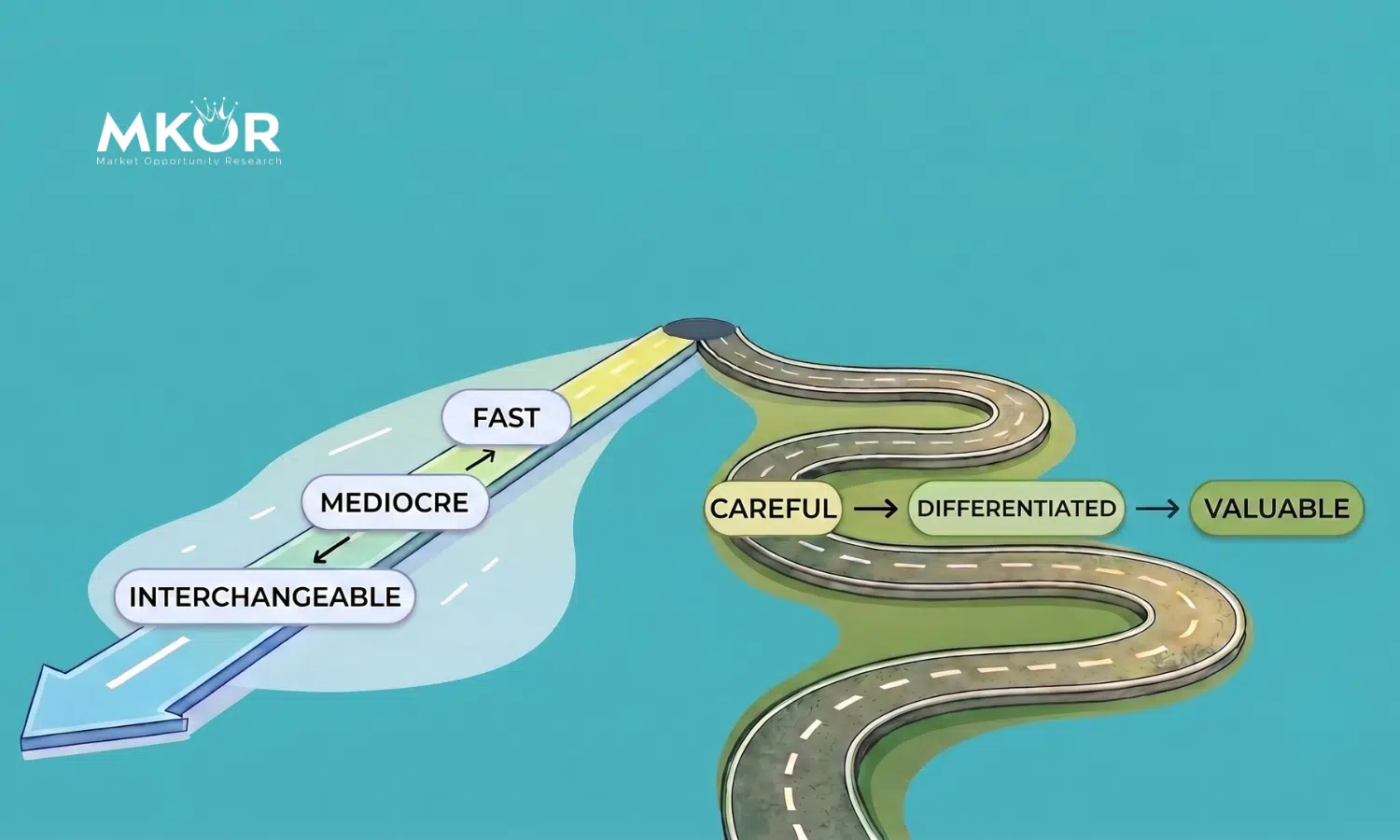
Because there is an invisible trap in the way many organizations use AI: they confuse efficiency with progress. Or, even worse, they confuse a fast result with a good result.
Speed allows you to produce more in the same amount of time. But if what you produce is only decent, then AI doesn’t offer you greater value. It only offers you more mediocrity, faster.
It’s the same logic Seth Godin talks about when he draws attention to convenience. Google Maps doesn’t automatically make you a better navigator. It can make you more passive. You follow arrows without truly understanding the route anymore.
Similarly, AI can write decent marketing copy. It can formulate business strategies based on online “market research.”
But this very “decent” becomes a trap because you choose to stop exploring. You no longer look for a different angle. You settle for something “good enough.” And in market research, this convenience can become dangerous.
A “decent” report, delivered in two days, may seem efficient. But if the analysis doesn’t bring a real perspective, if the insights are general, if the recommendations could just as well be used by ten other clients, then speed is not an advantage. It’s just a shortcut to an interchangeable result.
Especially today, when the same AI tools are available to everyone. ChatGPT, Claude, Perplexity and other similar solutions are accessible to both market research agencies and companies. This means that simply using AI no longer differentiates anyone.
If a research report is generated with the same tools, the same patterns and the same general logic, it is not fundamentally different from the report received by the competition.
In this context, speed is no longer a competitive advantage. It’s a trap. The difference only appears in how you use the time gained.
For us, the best use of AI in market research is not to replace researchers, but to reduce repetitive work and give experts more space for interpretation, validation and strategic thinking.
In other words, speed is not the ultimate goal. Freeing up human energy is our primary objective.
AI becomes valuable not when it helps us finish faster and check off a deliverable, but when it helps us go further than we would have gone without it: to test more hypotheses, see more connections, validate more rigorously and build more relevant recommendations for the client.
For MKOR, AI is not about convenience. It’s about the responsibility of using a powerful lever without lowering the standard of work. Speed can be a benefit. But the real value remains in the quality of thinking that follows after AI has done its part.
What we do with the time AI gives back to us
“How much time has MKOR saved since using AI in research?” We don’t know, because we haven’t stopped working. We’ve just allocated our team’s energy and time differently.
Because, if AI reduces work for a client by 20 hours by cutting down repetitive tasks, there are two ways to use that gain. The first way is to deliver faster, close the project, and move on. The second way is to reinvest those 20 hours into the things that make research truly valuable: interpretation, validation, better questions, context, nuance, and strategic recommendations.
The value of artificial intelligence thus emerges when we use that time to introduce more humanity, flexibility, and courage into what we do.
Here is specifically what we do with the time gained:
- We don’t stop at the first idea
AI quickly provides us with an initial interpretation, but we view it only as a starting point. We check if the ideas are truly supported by market data, so we don’t mistake a coincidence for a real opportunity.
- We look for respondents who “don’t fit”
Algorithms love averages and patterns. We, on the other hand, use the time gained to look at exceptions. Often, the most important insights lie not in what the majority says, but in the tensions or unspoken needs of those who stand out from the pattern.
- We build alternative hypotheses (Roast my Idea)
For every important conclusion, we ask the AI to propose “competing” explanations. Then, the MKOR team validates which of these is supported by data and the context of the Romanian market. In this way, we avoid hasty conclusions that might go unnoticed.
- We integrate multiple sources
We don’t limit ourselves to what people say in questionnaires, interviews, or focus groups. AI allows us to connect study data with what they say or do in other contexts: from spontaneous discussions on Reddit, TikTok, or forums, to internal data from CRM, call centers, or reviews.
The result is a strategy anchored in reality, not hypotheses, always filtered through the lens of ethics and confidentiality.
- We refine segments and create “living” profiles
The foundation of our research remains rigorous statistical analysis. However, we use AI to transform these volumes of numbers into ready-to-use working tools (personas, avatars). Essentially, AI helps us “translate” statistical segments into detailed psychological portraits, with motivations, fears, and aspirations. Our role is to validate each profile and ensure it can be used immediately by marketing or sales teams, for example, to communicate and sell more effectively.
- We allocate time for dialogue and context
AI takes over the heavy lifting of data processing, precisely so we can dedicate our resources to the most important stage: the conversation. Although our reports are complete and detailed, we believe real value emerges when we go through the results together, live.
We reinvest the time gained into debriefing sessions where data comes to life in the real business context. This is the moment when internal departments (Marketing, Sales, or HR) sit at the same table to transform a study into a shared vision, with objectives understood and embraced by all decision-makers.
- We explore multiple scenarios for high-impact recommendations
AI is an incredible sparring partner for us when we need to move from “what the data says” to “what we do with it.” We use it to quickly generate dozens of communication variants or repositioning directions, all based on real figures from the study.
Our role is not to take them “as is,” but to pass them through the filter of our experience: we evaluate what is credible, what is too risky, and what truly has the potential to bring results for the client. Thus, the strategic recommendations we put on our clients’ tables are the result of a thorough exploration of multiple possible angles, validated through MKOR expertise.

From automation to exploration
AI can automatically analyze 10,000 open-ended comments. It can group themes, identify patterns, propose coding, identify the dominant sentiment, and bring to the surface the language most frequently used by respondents. But this is just the new starting point. At MKOR, we do not rely on the AI’s conclusion. The conclusion and strategic recommendations are formulated by our researchers.
AI can quickly identify dominant themes, but the researcher must go further with the analysis:
- To verify if a theme really means what it seems.
- To observe misclassified respondents, because sometimes it is precisely these who bring relevant tensions to the surface.
- To distinguish between an authentic positive response and one that hides irony, politeness, or resignation.
- And not to ignore atypical responses, because sometimes an important insight is not found in the sample average, but in the exception.
This is where real research and the value of human thinking begin. AI can see the general structure faster. Humans can see the tension, the exception, the contradiction, and the meaning.
That is why, for MKOR, using AI does not mean delegating thinking, but being able to dedicate even more time to more thinking.
For example, AI might say: “I have identified eight main reasons for product rejection.” The researcher asks: “Which of these reasons are real and which are just rational justifications?”
AI might say: “The dominant theme is price.” The researcher asks: “Is price the problem or the lack of perceived value?”
AI might say: “Segment X is dissatisfied.” The researcher asks: “What does this mean for positioning, communication, user experience, or the perceived benefits of the product?”
Generating options: AI opens new directions, we give them meaning
A good specialist does not ask AI for a single “perfect” solution. They use it to explore dozens of variants, compare directions, and test angles they didn’t think of at first. Similarly, we use AI in market research at MKOR: to generate thinking options.
However, our work does not end when AI proposes, for example, three hypotheses about why a brand is losing ground. That is where, in fact, the most interesting part begins: the reflection stage. We stop and ask ourselves: “But what if the real barrier is not the one stated by people, but an unspoken tension that the data only suggests between the lines?”
This simple question has the power to change everything. It sends us back to the “kitchen” of research where:
- We reread people’s open-ended responses through a different lens.
- We separate the stated reason (what people say out of politeness or habit) and the real reason (what they do, how).
- We test new hypotheses that the initial analysis, however fast, would not have directly suggested.
- Or we build questions that address latent needs for future waves of research.
Here AI becomes an exploration partner. And it has no final authority.

AI is an invitation to higher standards
It seems counterintuitive, doesn’t it? You would expect technology to relax our work. In reality, for us, the responsible use of artificial intelligence does not reduce important work, but amplifies it. And it shifts the focus from repetitive execution to the responsibility of thinking.
Because, once AI quickly provides you with a first analysis, lack of time is no longer an excuse. You can test more hypotheses. You can check more sources. You can compare more segments. You can look for contradictions. You can go deeper into the answers that don’t fit.
This means that AI is not an invitation to convenience. It is an invitation to higher standards:
- If before you had time to check two hypotheses, now you can check six.
- If before you analyzed only the predominant answers, now you can also analyze the extremes.
- If before you stopped at one interpretation, now you can build alternative scenarios.
- If before you delivered a correct report based on the collected data, now you can deliver a strategic perspective more oriented towards business.
AI makes the repetitive part easier. And more importantly, it puts the human part in the foreground.
And yet, what are the limits of AI?
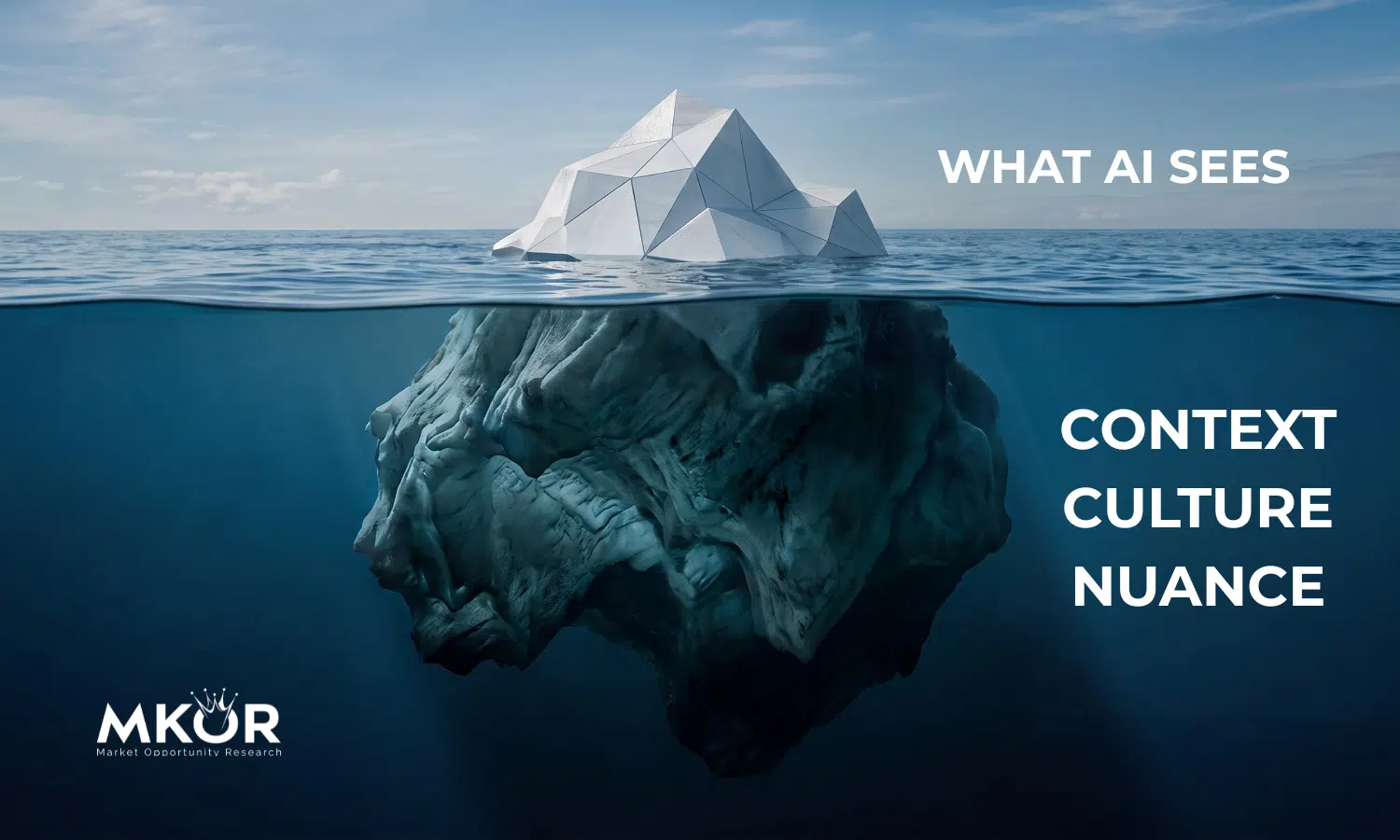
AI can process language, but it doesn’t always understand culture.
It can identify an apparently positive tone, but it can miss irony, social politeness, or local humor. It can classify a comment as “satisfaction,” when in reality the respondent expresses resignation. It can detect a correlation, but it cannot explain causality on its own. AI can show you all the available options. Which one you choose remains a business decision, not one to leave to an algorithm.
Recent studies show that large language models can extract psychological cues from text, including personality traits or perceptions about the personality of public figures, using semantic structures, tone, evaluative adjectives, and associations learned from the data they were trained on.
But the same specialized literature also reminds us of the limits. Atari et al. point out that models may reflect Western, educated, industrialized, rich, and democratic psychological patterns rather than the real diversity of human experiences. In other words, AI can be very good at recognizing patterns, but it is weaker at interpreting cultural, social, or local contexts that do not align with those general patterns.
And this is where the researcher comes in:
AI might say “This language seems aspirational.” The researcher must ask: “Aspirational for whom?”
AI might say “The brand is perceived as authentic.” The researcher must ask: “Authentic in a premium, local, traditional, honest, or sustainable / ecological sense?”
AI might say “The segment is looking for simplicity.” The researcher must ask: “Simplicity in the product, in communication, in price, or in the buying experience?”
AI can accelerate analysis. But the rigor of analysis and interpretations remains a human responsibility.
How we specifically use AI in market research
At MKOR, we have integrated artificial intelligence throughout the entire journey of a project, but we have always maintained methodological control and human interpretation as final filters.
- In the brief and research design area, AI can help structure objectives, formulate hypotheses, identify unclear areas in the brief, and propose unique exploration angles.
- In the desk research area, it can quickly identify and synthesize multiple sources, compare public information, discover emerging themes, and organize data from very different categories.
- In the quantitative analysis area, it can help document variables, explain differences between segments, formulate initial interpretations, identify inconsistencies, and generate hypotheses for additional cross-tabulations.
- In the open-ended responses area, it can accelerate theme coding, sentiment detection, grouping similar formulations, identifying the respondent’s natural language, and extracting relevant quotes.
- In the qualitative analysis area, it can help summarize interviews, identify recurring themes, compare respondents, extract tensions, and organize insights based on study objectives.
- In the social intelligence area, it can extend analysis to platforms that traditional research covers with more difficulty: Reddit, YouTube, TikTok, X, forums, reviews, or online communities. Here, the value is not just the volume, but the access to spontaneous language, unfiltered by the structure of a questionnaire.
- In the results communication area, it can help transform insights into business recommendations, identify key ideas, strategic scenarios, or messages for different stakeholders.
Additionally, AI helps us deliver quality assurance at every step: it functions as a tireless auditor throughout the project. But not based on its own logic; instead, it uses MKOR’s documented know-how from over a decade as a reference.
Because we have rigorously documented internal processes and procedures, we use AI to verify the compliance of every deliverable, from the questionnaire structure to the accuracy of collection scripts and the quality of final reports.
What market research gains if AI is used correctly
Yes, AI makes research faster: we can go from brief to report in days, not weeks, in certain types of projects.
Yes, it makes it more cost-effective: a smaller team with multiple skills can take on tasks that previously required more manual execution.
Yes, it makes it deeper: we can analyze more sources, more comments, more platforms, and more scenarios than in a traditional process.
And yes, it makes it more consistent: certain analysis, verification, structuring, and documentation standards can be applied uniformly from one project to another, regardless of who is available in the team.
But all these are operational benefits. They do not represent the final goal.
The final goal is to use AI to make research more human where it matters: in the questions we ask, in the attention to context, in the interpretation of nuances, and in the courage not to stop at the first “good enough”, decent answer.
Who we do research for
We conduct market research for organizations that need more certainty before making important decisions.
We work with expanding companies that are preparing to enter new markets, product launches, M&A processes, or internationalization.
Before any strategic move, research helps in understanding the market, consumers, competitors, and real risks.
We work with brands that test and validate, from concept testing and brand tracking to consumer audits, segmentation, or positioning evaluation.
For these brands, research does not come after launch, when the costs of mistakes are already high, but before making important decisions.
We also work with consultants, investment funds, and strategy teams who need solid data for due diligence, market sizing, competitive intelligence, or market opportunity assessment.
In these projects, market research becomes the foundation upon which recommendations, conclusions, and business decisions are built.
For all these clients, we choose to state clearly where we use AI in their projects and, just as importantly, where we do not use it, because transparency is one of our most important values.
No strategic conclusion is left exclusively to AI, without human review, methodological validation, and interpretation in the real market context.
The market often talks about AI versus researchers. We talk about researchers plus AI.
For us, AI does not replace the expert, but amplifies their skills, helping them do what only a human can: think critically, validate, interpret culturally, and transform data into actionable recommendations.
Therefore, the future of market research does not belong to those who use AI just to deliver faster, but to those who use it to deliver better.
For expanding companies, brands that validate, consultants, and investors, the value lies not in access to a tool, but in the ability to transform data into well-founded decisions.
If you need to know and better understand consumer behavior, schedule a free strategic consulting session with one of our consultants.