


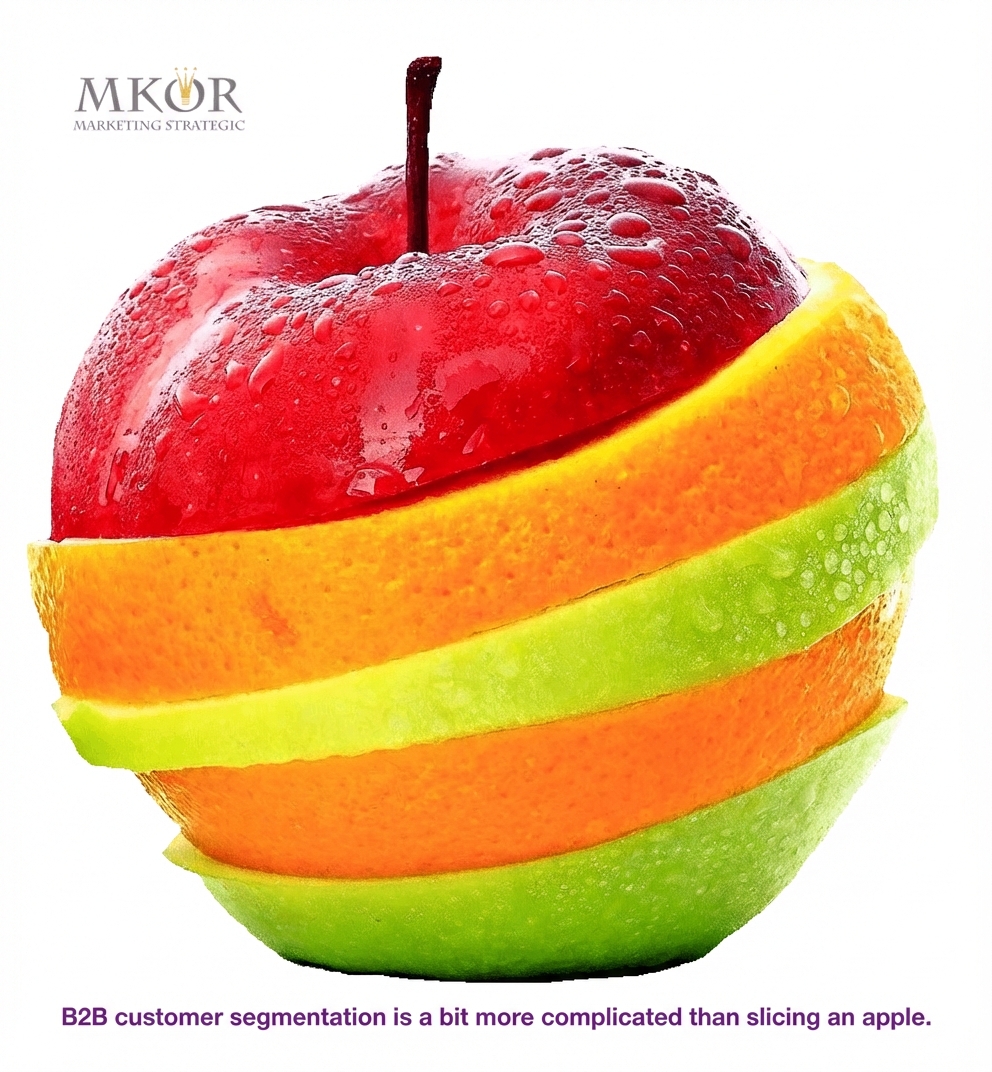
B2B segmentation differs in several ways from consumer segmentation. Business-to-business markets are characterized by many differences compared to those targeting end consumers. Below, you will find some of the main differences between B2B and B2C markets, as well as the implications for segmenting such a market.
The Decision-Making Process
B2B markets have a more complex decision-making unit: in most households, even the most complex and expensive purchases are made by a small family unit, and frequent purchases like food and clothing are made individually. Aside from items of no value or those involving no risk, things are more complex in the business sphere. Purchasing equipment can involve engineers, procurement experts, board members, production managers, and health and safety inspectors, each with their own set of priorities.
Segmenting a target audience, which is simultaneously a complex, oblique, and multi-faceted process, can be an extremely demanding task. Do we segment the companies where decision-makers work, or do we segment these individuals directly? Do we identify a key decision-maker or segment these key individuals? Who exactly is the target audience, and whom should we segment?
Want vs. Need
B2B buyers are more rational: The view that B2B customers are more rational than consumers is controversial but likely true. Would a consumer who spends 3,000 lei on a leather jacket that isn’t very warm and isn’t as durable or high-quality as one from another store costing 300 lei make similar decisions at work? Consumers tend to buy what they want, while B2B customers tend to buy what they need.
Needs-based B2B segmentation should probably be easier than consumer segmentation. In B2B markets, it is vital to identify customer needs. Sometimes these can be accurately determined based on company size, purchase volume, or job types.
Products and Services Tailored to Customers
B2B products are more complex: Just as decision-making is more complex in this segment, so are the products addressed to them. Even complex products like cars are chosen by consumers based on simple criteria.
On the other hand, in the B2B sector, even simpler products must be integrated into a larger system. This usually leads to the involvement of experts in the purchasing process. Thus, consumer products are standardized, while business environment products are customized.
This may lead to the question of whether segmentation is possible in these markets: if every consumer has complex and totally different needs, can we say we have different segments for each consumer?
In most B2B markets, a small number of key consumers are so important that they rise above segmentation, becoming segments in their own right, with a dedicated account manager. Aside from these, there are companies with similar requirements and needs that can be grouped into the same segment.
Smaller Base for Target Audience Analysis
The audience for B2B products and services is smaller than that of end consumers: in the B2B segment, a small number of customers can dominate a company’s sales volume, whereas in B2C, a much larger number is needed to make a difference (millions).
This is also due to needs; in B2B markets, a company cannot cover the needs of many segments.
Direct Relationships and Increased Loyalty
Relationships are more important in B2B markets: With a small customer base, such as B2B, it is much easier to maintain contact than with thousands of consumers. In these markets, sales and technical representatives can interact directly and visit each client. When it comes to loyalty, unlike B2C, there are B2B customers whose loyalty is measured in years.
There are a number of implications for segmentation related to the relationships between customer and “seller”: The degree of relationship can vary from one segment to another, but most B2B segments require a level of personal relationship / communication. This may raise the question: everyone wants a personal relationship, but who is willing to pay for it? The answer comes from the provider who must decide, depending on how much each company pays, to whom they will offer this relationship.
At a practical level, it is necessary to conduct market research in order to find out and understand what this personal relationship should include. For premium segments, frequent (face-to-face) visits are recommended, and for “regular” customers, phone calls or periodic correspondence.
If your field of activity also includes the B2B segment, it is good to take these aspects into account when you want to define the market segments you are addressing. Our consultants are at your disposal if you want to conduct a market study or simply receive an objective opinion from an expert.
Either way, we would be happy if you contact us to get to know each other!
Have you read everything? Comment / join our newsletter / read our other research posts!