


Email is one of the most widely used and effective communication channels in business and can be a productive tool for your company as long as you use it with moderation and professionalism.
Broadly speaking, email marketing involves sending newsletters or emails to customers who have expressed their consent. It represents a way of building loyalty and informing customers about the new products and services your company offers.
In accordance with the new legislative changes brought by GDPR, which we discussed at length in a previous comprehensive article, your company will need to adapt its procedure for sending emails to subscribers. The article is based on an interview with lawyer Cosmin Iliescu, who has over 10 years of experience in Data Protection projects.
GDPR recognizes a legitimate interest in processing personal data for direct marketing purposes.
Changes you need to make to your email marketing strategy in compliance with GDPR
Ana Maria Udriște, a lawyer, speaks at length about these legislative changes imposed by GDPR regarding the email marketing policies of organizations.
Ask for clear customer consent – View a potential customer’s subscription to your company’s newsletter as a contract for which they express their consent.
Make sure it is clear to the customer that they are opting to subscribe and also provide details such as: the content of future emails, the frequency with which they will receive them, and ways to unsubscribe.
At MKOR Consulting, we send one email per week containing exclusive information for our subscribers—information that cannot be found with a simple Google search—news about MKOR’s activity, invitations to industry events, and most importantly, free knowledge.
Keep track of subscribers – In accordance with the new legislation that will come into force starting May 25, 2018, and which applies retroactively in the case of email marketing, companies are required to maintain and update their subscriber database to always know where they come from and how they gave their consent to receive the newsletter.
Unsubscribe option – Take into account that people often change their minds and preferences. Keep only those who are truly interested and already loyal on your list, and give others the chance to withdraw.
If customers are no longer interested in the company’s services and products, they must have a visible unsubscribe option in every email you send them, as well as in the account options they have on the site, if applicable.
In all the newsletters we send at MKOR Consulting, a visible unsubscribe link is included, in case our subscribers choose to do so.
In addition to the optimizations imposed by GDPR, to keep your subscribers loyal, you need to work on certain aspects and details of the newsletter you send. Below are the aspects you can consider:
Make sure you are on the Whitelist
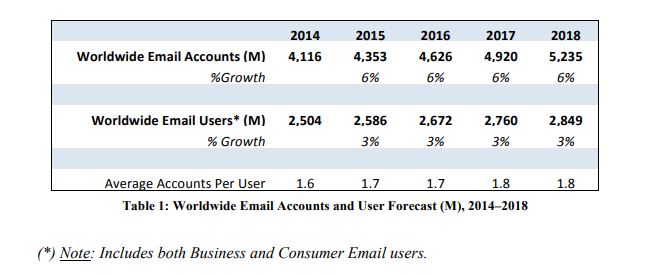
According to Email Statistics Report 2014-2018 produced by The Radicati Group:
In 2014, the majority of email traffic comes from the business sector, and represents over 108.7 billion emails sent and received per day. Email usage is growing in the business sector, and in 2018, business emails will increase to over 139.4 billion emails sent and received per day.
 How many of these will end up in Spam instead of the Inbox? An email that ends up in the user’s Spam folder has a tiny chance of being opened by them, and will most likely end up forgotten in the dark space of Spam.
At the same time, you don’t want to be given the negative label of a company that spams, because you will lose credibility and reputation, both in front of customers and in front of email service providers (ESP).
Once an email sent by you is marked as Spam, email service providers add you to a Blacklist, a real-time database that determines if the IP address sends emails that can be considered spam.
To be sure you are on the Whitelist and that your emails will reach your subscribers’ Inbox, you need to ensure that they add you to their address book from the very beginning. You can do this when sending the welcome email, in which you detail the necessary steps for them to add the company’s email to their personal address book.
Segmentation
Make sure that the people you send a certain type of newsletter to are interested in its content. You can do this by making them aware of the options they have at the time of subscription. For example, you can ask them to check what type of emails they want to receive.
Perhaps not everyone is interested in future events, but they want to be notified about potential discounts that will take place on the products and services you offer.
You can segment the database based on several criteria, such as consumption preferences, gender, age, or the subscriber’s location.
This aspect is a first step for personalizing the content of a newsletter and will make the subscriber consider the information you present as relevant, and they will not consider unsubscribing.
Personalize messages
The theory of human relations exemplified by Elton Mayo through the famous series of experiments at the Hawthorne plants, says that employee productivity is influenced by the type of relationship established between them and the leader, with attention given and the personalization of this relationship playing an important role.
We, at MKOR, emphasize this personalized relationship with our customers and subscribers to our weekly newsletter.
A friendly tone, addressing in the first person, as well as personalization by including the subscriber’s first name, are important details in a newsletter.
When writing an email to be distributed to your subscriber list, think that you are talking directly to your customer, that you have them in front of you and you are presenting your offers. Subscriber loyalty will increase if they feel appreciated and directly targeted by the messages you send.
Pay attention to the email’s writing, the placement of images and links. A simple and easy-to-understand message will be more successful than an email full of information that a subscriber might not have the time to go through. Also, give those interested the chance to learn more about the topics that interest them by inserting links in the newsletter.
The perfect timing for the newsletter
First of all, we recommend that you respect the initially announced frequency of sending emails and do not deviate from it. If the subscriber expects one email per week from you, do not exceed this number unless necessary. Provide new and updated information at the optimal time.
At the same time, welcome your new subscribers with a welcome email to be sent immediately after they give their consent. This represents a commitment you make to the subscriber, as well as confirmation that the subscription process was successful.
Another way you can build customer loyalty is to send them a personalized message on their birthday, associated for example with a gift voucher for the products you offer. It is a great way to make subscribers feel important in their relationship with the company.
We follow our own advice
Subscribe to our newsletter to see for yourself! We promise to bring you relevant information for you and free knowledge from MKOR specialists with every weekly email.
Have you read everything? Comment / join our newsletter / read our other research posts!