


When consumers decide which product or service to use, how do they make that choice? Advertising certainly has a say in this decision, but it is not enough to differentiate between similar products and services on offer.
Therefore, the experience consumers have with a brand is more relevant than ever.
Customer experience analysis is one of the steps that will help you build loyalty among existing customers and attract new ones through a recommendation system. Consumers are very receptive to recommendations made by friends and acquaintances, and are even willing to make recommendations themselves.
Customer Experience, More Important Than the Promise of Quality
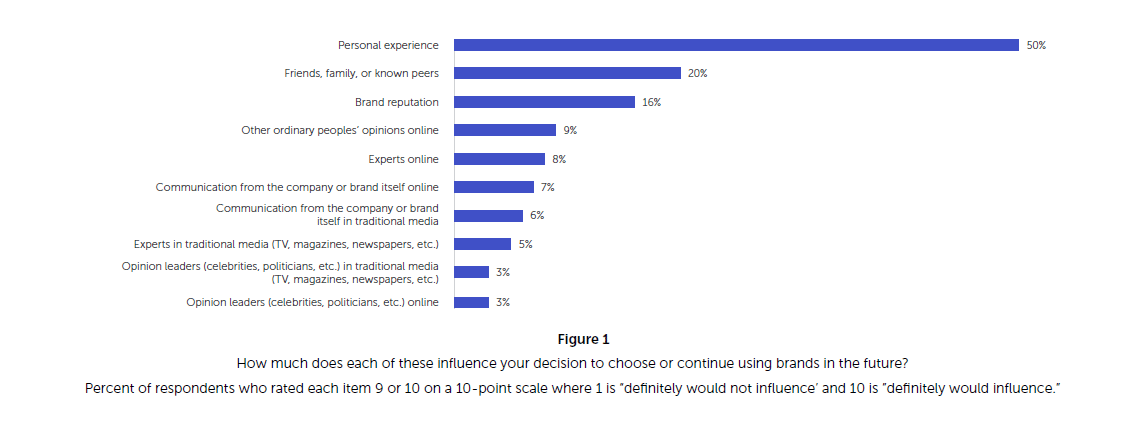
In a study conducted by Ipsos & Medallia, when asked about the factors that influence their purchasing decisions or their decision to continue using a brand, personal experience and the opinions of friends, family, and acquaintances were at the top of consumers’ responses.
Half of the respondents indicated personal experience as the primary motivation when choosing to buy from a certain brand, 20% mentioned the opinions of friends and family, while 9% mentioned online reviews about the brand from other consumers.
New technologies contribute to this system of brand building through recommendations. Social networks and review sites (for example Tripadvisor) have changed the way brands and consumers interact. Through these means, brand reputation is constantly evaluated, thus diminishing the power companies once had over their own image through traditional communication and promotion methods.
Currently, a brand’s public image is defined online through reviews that reflect the experiences of hundreds, even thousands of consumers. More than half of consumers say they have left a review regarding the experience they had while interacting with a brand.
Customer Orientation, an Essential Approach for Every Department
By 2020, Customer Experience is expected to be a central part of any business strategy. A company that aims to grow, not just survive, will adapt to market needs and consult its consumers, building loyalty and attracting them through unique experiences that stand out from competitors.
The change is already happening. According to a study by Walker Consulting, 86% of consumers or potential consumers are willing to pay more for a better shopping experience. If you’re wondering how to improve the customer experience, we’re here to help with a series of indicators to track.
Consumers are more informed than ever; with the help of smartphones, they have access to any type of information about brands at any time. They base their purchasing decisions on personal preferences and recommendations received. Thus, consumers dictate the type of experience they want. They expect brands to know their preferences and needs, and to personalize their experience down to the smallest detail.

What You Can Measure, You Can Control
To meet your customers’ needs you first have to identify their preferences and quantify them. Tools like the NPS score or satisfaction studies let you learn what consumers actually think about your brand — insight that lets you make grounded decisions and respond in time, before dissatisfaction turns into negative reviews and defection to competitors.
Your customers send you information constantly — all you have to do is collect it and listen. Every interaction between a consumer and your brand tells you something about their preferences and expectations.
For example, you can track an online shopping session — which pages the user visited, which products caught their interest, and where they abandoned their cart. Identify that friction (pain point) and you can prevent future drop-offs and start building loyalty with a new segment of consumers.
Know your consumers
To deliver experiences customers won’t just remember but will bring them back, learning their preferences as accurately as possible has to be a priority. Consumer behavior analysis means collecting data and interpreting it in a way that makes sense for every department in the company.
You have to understand their needs and preferences, and show them how your company’s product or service solves their problems and makes their life easier. Consumer data analysis should answer these questions:
- What exactly motivates them to buy your brand’s product/service?
- How can you improve their interaction with the brand?

The more consumer data sets you analyze, the better you understand their behavior. A mix of qualitative and quantitative analysis is the best approach. Start with a few numbers from your own customer base, then pull qualitative data through methods like observation, focus groups, or structured interviews. Read more about qualitative research here.
When a customer buys from you or interacts with your brand online, they hand over a wealth of information: demographic data, preferred payment methods, email address, and a delivery address that indicates the size of the locality.
On top of that, tools like Google Analytics, Hotjar, and Heap Analytics give you extra data: the customer’s operating system, the landing pages they hit, time on site, and bounce rate.
Put together, this information shows you the consumer journey and profile without touching their personal data — so you stay compliant with data-protection regulations.
Conduct a study
Get data straight from the source and talk to customers directly. The easiest way to reach a large number of people is a survey. If that’s your approach, free tools like Google Forms can launch a satisfaction survey for you.
The study results might confirm hunches — or bring you a perspective you never would have considered. A consumer study can help with segmentation and defining categories de persona.
A brand’s consumers have certain problems and want to solve them
A particularly important aspect should not be overlooked: brand users are more than just numbers, they are people. They take certain actions because they have certain problems and because they want to solve them. Understanding the consumer experience with the brand or product helps you find out why users take a certain action or give up in the middle of it.
Customers can come from a wide variety of industries or contexts, but their common denominator is the desire to solve the problem. The product or service offered makes their daily life easier, but the way they interact with the brand can make the difference in the decision to return.
The consumer experience from MKOR’s perspective
By the nature of our mission, we are always looking for new ways to deliver results to our clients who, in turn, want to keep pace with market changes. That is why we have developed our own study for fashion consumers in the digital era.
Starting from the consumers’ need to feel at the center of attention and from the fashion brands’ need to meet them, MKOR specialists have conducted the Digital Fashion Consumer Trends study.
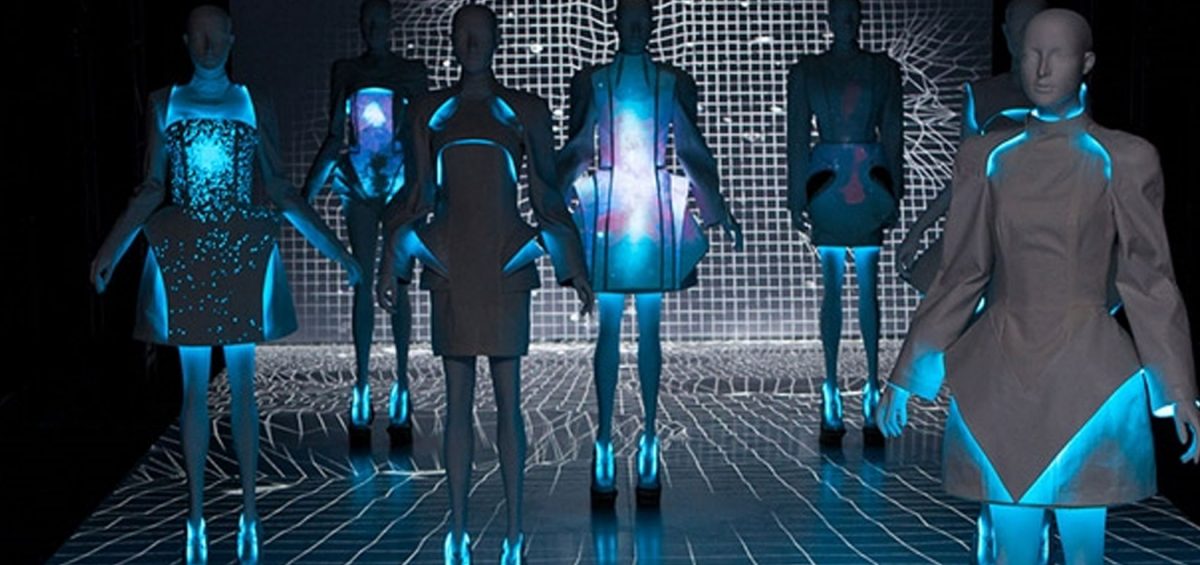
Digital Fashion Consumer Trends 2019 Study
The study was conducted for the first time a year ago, in 2017. Due to its success and the feedback received from interested players, we decided to resume it in an improved version, following the feedback received (we also apply what we advise you!).
Digital Fashion Consumer Trends presents a comparative analysis of the development directions of classic and online retail. The study includes an analysis of digital trends experienced by consumers.
The 2018 Digital Fashion Consumer Trends study will be launched this fall and will bring new comparative analyses between years (2017 vs. 2018), will track the evolution of trends, and will continue to answer the question “What does the fashion store of the future look like?”
The research report is an ideal tool for those active in the fashion industry who want to know their consumers.
For example, the study reveals the openness of Romanian consumers to using new technologies and digital communication and information channels.
UPDATE: the study on fashion consumer preferences has been published in the own studies section.
Be the first to know!
If you want to be among the first to receive exclusive access to part of the results of the Digital Fashion Consumer Trends study, subscribe to the newsletter. You will receive an email to download the results of this year’s study.
And if the fashion industry is not relevant to you, the invitation to sign up for the newsletter remains valid, as this way you will be up to date with the latest news in the field of marketing research and, implicitly, closer to your consumers.