



Jobs to be done in marketing prioritizes information, focuses on the process, and addresses problems right at their root.
An approach that can bring a breath of fresh air to any business.
Convince me to buy this camera! is a common exercise in establishing a marketing strategy. We might fall, more often than we would like, into the trap of listing the camera’s features: how well it captures colors, what resolution it offers, or what kind of lens it has.
Technical specifications are not the deciding factor when we buy a camera, even though it fulfills a need—that of taking photos. A mobile phone also takes good enough photos, which, additionally, we can share with friends in real-time.
Buying decisions are emotional decisions, and as marketers, we must take this crucial aspect into account.
In both digital marketing and the more strategic stage of market research, we tend to look heavily at statistics and figures. How many visitors we had, how many clicks, how many conversions. Figures. But these only tell us part of the story—namely what is happening, not why it is happening.
The answer to this question comes from an area relatively well-known to marketing, namely UX (or User eXperience). At the intersection of these two fields lies jobs to be done or why does the user prefer a smartphone over a high-performance camera?
In market research, describing the customer based on psycho-demographic characteristics will not be useful when we aim to bring something new. Instead, as marketers, we can focus on the problem the user has at a specific moment.
It is a paradigm shift: instead of the quantitative approach, where we find out what is happening and to what extent (camera sales are down by over 30%), we use a qualitative approach (why is it happening that people prefer smartphones for taking photos, and thus, camera sales are declining?).
What is UX?
For a truly exceptional user experience, more than just a checklist of features must be considered. Depending on the industry, design, marketing, and the graphical interface must form a combination that offers the user true joy.
In other words, it’s about the old story of features versus benefits, well-known especially to salespeople, but also to us as marketers.
UX is a concept originating from design, but it covers a wide range of disciplines, from industrial and visual design to information architecture, usability, and human-computer interaction.
The goal of UX in business is to increase customer satisfaction and loyalty through the utility and ease of use of a product.
How do you apply UX in marketing?
To meet these challenges, the jobs to be done thinking framework emerged in UX. Such an approach is different from what we are used to in marketing—creating a psycho-demographic profile of the consumer, which in UX is called a persona.
Marketing theory suggests fitting customers into psycho-demographic parameters that in turn create personas, for whom marketers then create products to sell, instead of the products customers truly need.
1. Define your market based on user problems
As a marketer, you can have a completely different approach to a market, defining it based on jobs to be done, rather than a product, an industry, or a geographical area.
Personas built on psycho-demographic traits artificially limit the audience your product addresses because this approach does not consider motivation and desired outcomes.
The personas approach explains who people are and what they do, while jobs to be done explains why people do a certain thing.
2. The formula that changes the paradigm
In the classic paradigm, persona using the camera could look like this:
- young man (20-30 years old)
- photography enthusiast (owns a blog or a profile on a dedicated platform)
- urban environment
- stable income
This profile would greatly limit addressing existing market needs, because when I am at a party, I want to take photos so that I can share them instantly with others.
When considers the context I am in, I want to expresses the reason, and so that I can focuses on the expected result.
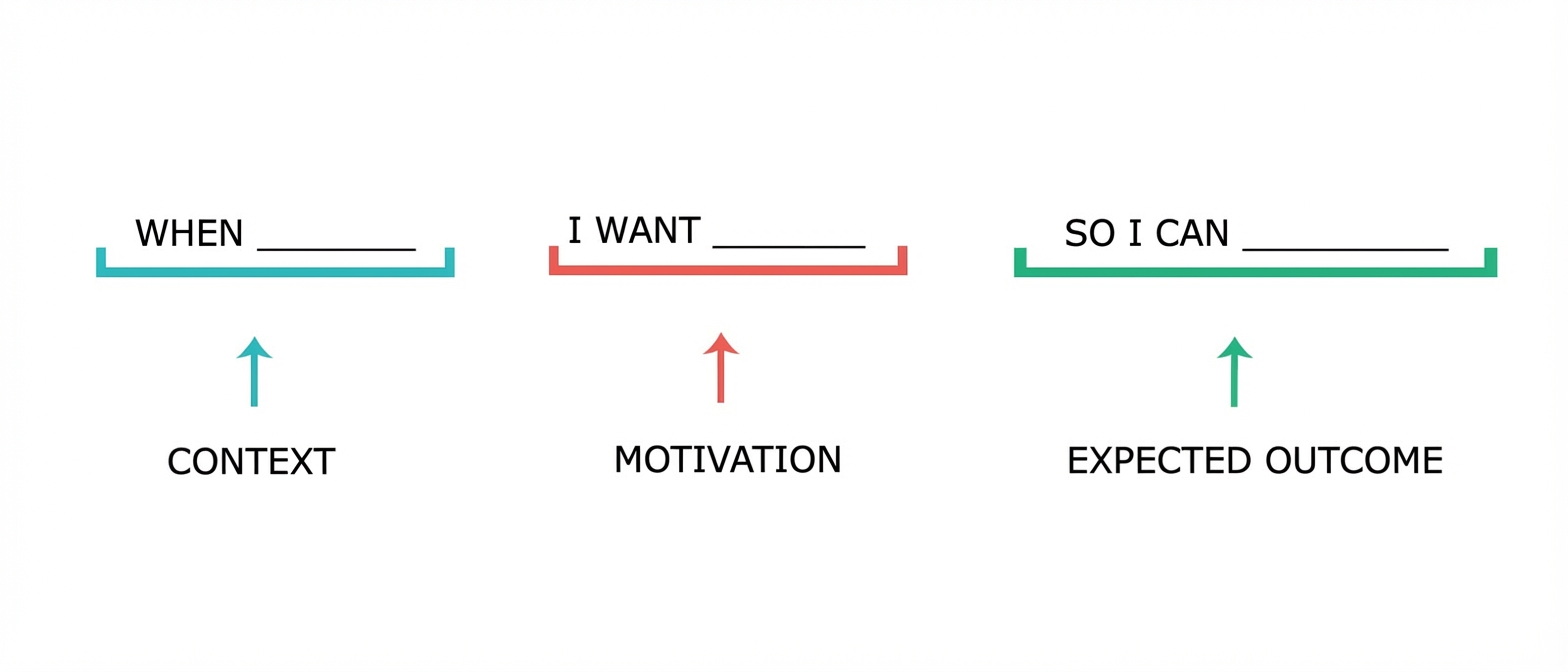
When we apply this formula, the market is defined by a performer of the action and what they are trying to solve. Defining a market in this way opens the door to a new understanding of market analysis.
The new goal is to understand the process of taking photos to be published immediately, rather than analyzing the products we use for this purpose.
3. Help your consumers solve their problems completely
Personas will always have their place, especially in advertising. However, when you are laying the foundation for a new product, you will not be able to make important decisions based on personality traits. This is because products do not address people, but the problems they have to solve.
For example, a Nespresso espresso machine solves the “make me a hot drink” problem rather than competing in the bagged coffee, tea, or kettle market.
4. Help your customers solve more problems
Products evolve over time to help people solve more problems at the same time. The more you help your customer solve their problems, the more valuable you will become to them.
For example, the smartphone helps us solve dozens, even hundreds of problems – daily! Hence the choice of the smartphone over the camera.
5. Develop your business based on the consumer’s problems
Rather than developing your business around a product that is likely to become obsolete at some point, rather develop your business around the solution to the problems you can solve for your consumers.
Thus, the company will always be focused on the optimal, increasingly better resolution of a problem. The result will be a longer-lived company, given that you are more flexible in reinventing your products and services.
It’s simple: a brand’s users have certain problems and want to solve them
What happens is that we lose sight of a particularly important aspect: the fact that our brand’s users are more than just numbers, they are people. They perform certain actions because they have certain problems and because they want to solve them. Understanding the user experience with our brand or product helps us find out why users perform a certain action or give up in the middle of the action.
Focusing on customer traits means focusing on what we want to sell and not on their needs. Customers can come from a wide variety of industries or contexts, but their common denominator is the desire to solve the problem, i.e., jobs to be done.
UX and, especially, jobs to be done, bring a new perspective on marketing and the way we interact with the user. Through UX, we make the transition from statistics to people, from what to why, from quantitative to qualitative.
If your business needs the definition of jobs to be done, we are at your disposal
Our user experience approaches can provide you with concise actions for differentiating your products and services, for accessing market opportunities, and for optimizing the user experience.
Adopting our solutions can create unique experiences for your users and ensure their retention as end consumers.
UX and jobs to be done represent growth potential for your business, and if you are wondering how, our consultants will be happy to answer. We invite you to contact us to discuss your needs.
Have you read everything? Comment / join our newsletter / read our other research posts!