


How do Romanians actually see Artificial Intelligence? How far have they come to rely on it, and where do they stop? These are the questions answered by the AI Adoption Report Romania, the study MKOR ran in 2026 with three broad objectives:
- how Artificial Intelligence is perceived and how much Romanians trust it
- how well known and how widely used AI tools actually are, and
- what the presence of AI means for working life, from job-related anxiety to the relationship between junior and senior colleagues.
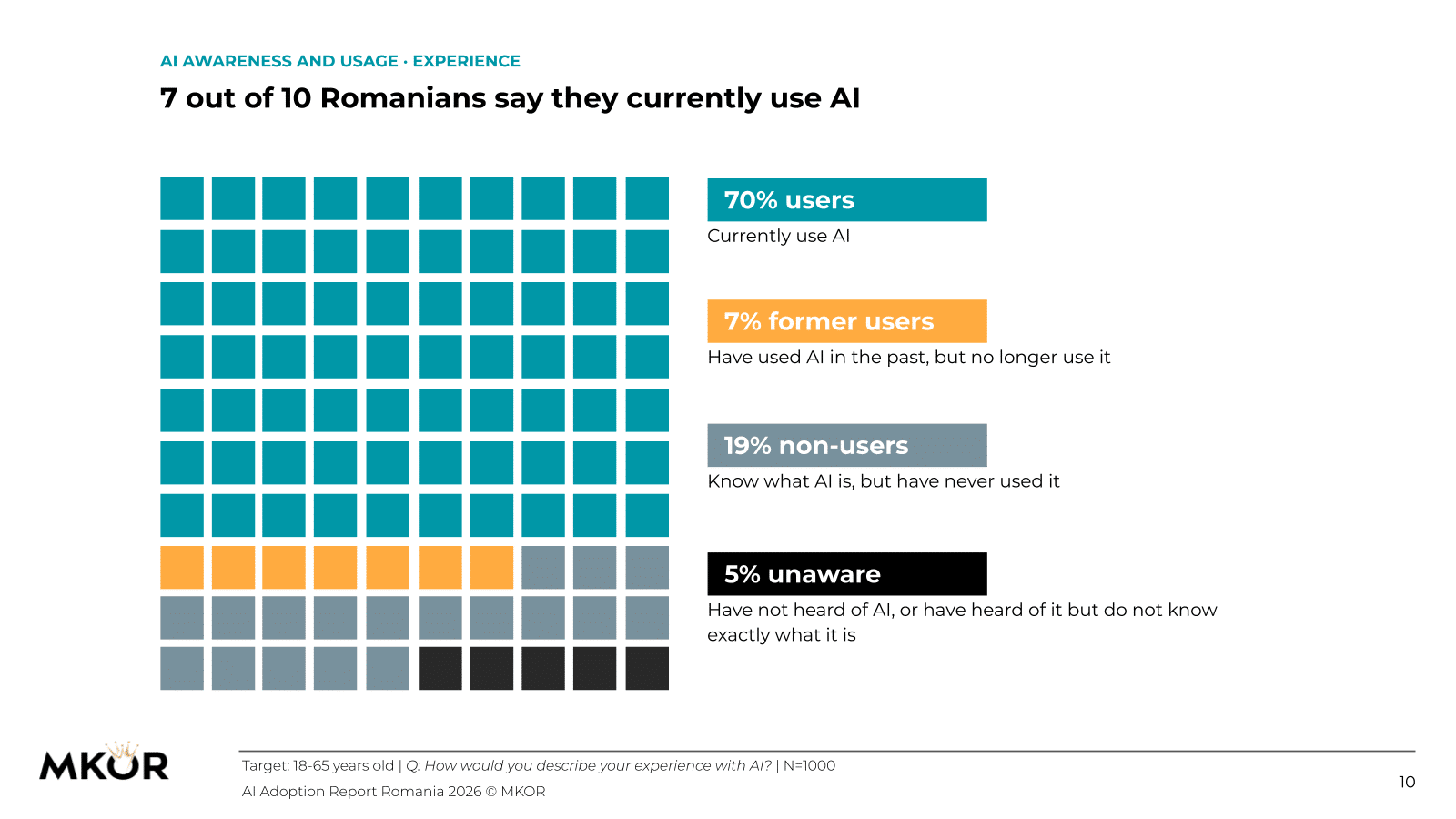
In 2026, artificial intelligence is in widespread use across Romania. Seven in ten Romanians (70%) say they currently use AI. The first association Romanians make with the term “AI” is a pragmatic one: help and usefulness accounts for 16% of answers.
Contents
Associations, relationships and trust: how Romanians “see” AI
Romanians’ perception of AI takes shape both through the words that come to mind and through the way they picture their relationship with the tool.
Beyond the spontaneous association with the help and usefulness of AI (16%), Romanians aged 18-55 link AI to tools and technology (11%), progress and innovation (10%) and even to the names of specific AI assistants (10%). Fears around disinformation, manipulation or deepfakes stay below the 7% threshold, while the “risk, fear, control” category sits at 8%.
Asked to describe their relationship with AI as though it were a person, almost three in ten respondents (27%) see it as a personal assistant they give clear instructions to, and 22% treat it as an acquaintance they turn to only when needed. Just 11% consider it a work colleague and 9% a friend. Taken together, the answers suggest that for most Romanians AI is still perceived as a useful tool to reach for when required, rather than as a partner in a genuine exchange.
Human or AI? Half of Romanians cannot tell the two texts apart
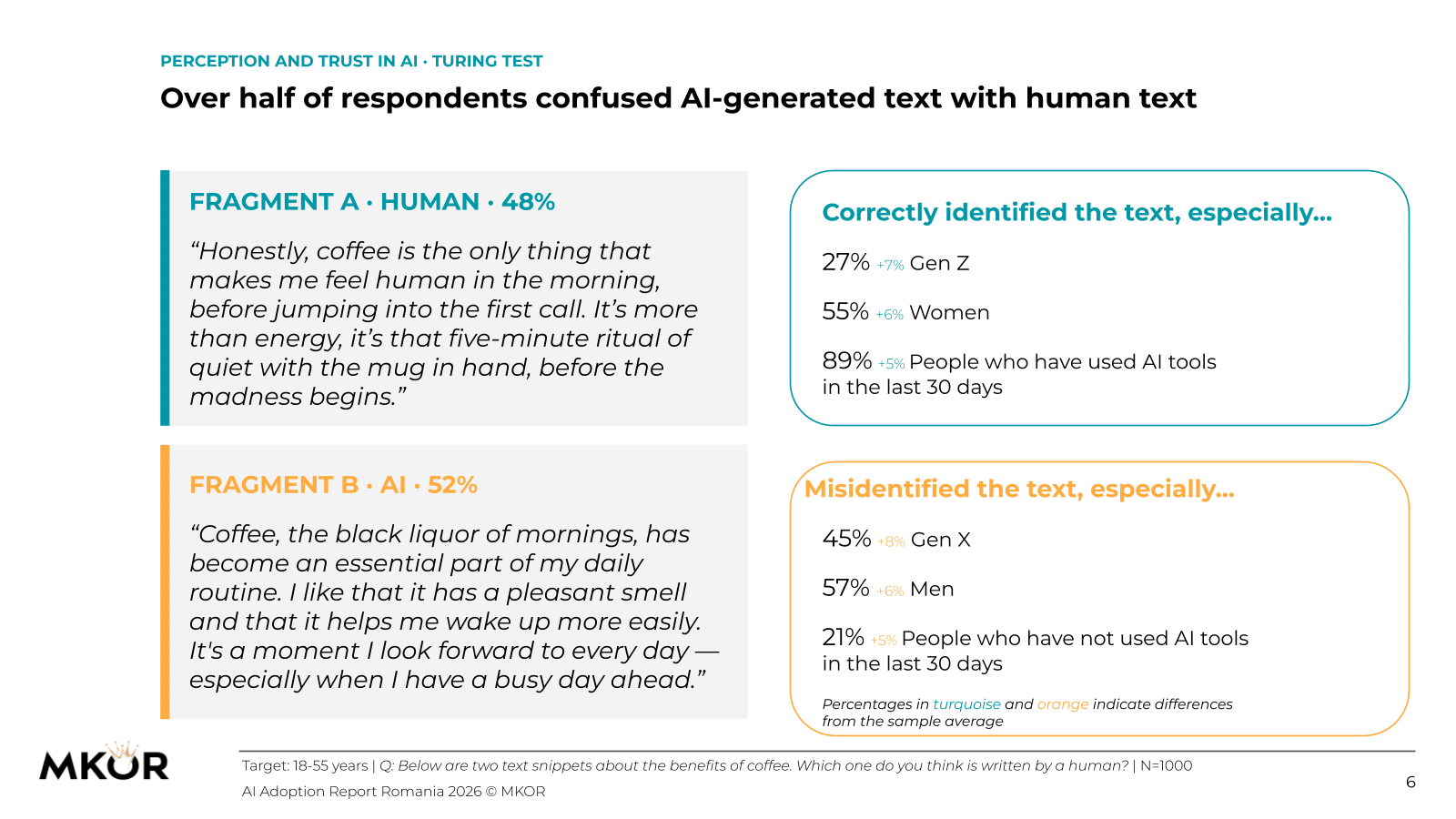
The test for recognising AI-generated writing shows how hard the distinction really is: more than half of respondents (52%) attributed the AI-written passage to a human, while only 48% correctly identified the passage written by a person.
Generation Z (18-28), women and those who have used AI recently recognise human writing somewhat more often than the sample average. At the same time, Generation X (45-60) and men confuse the two texts more often than average.
When transparency matters more than usefulness: the discomfort behind undisclosed AI
On perception and trust in AI, the greatest discomfort appears when AI steps in undisclosed in situations with high personal stakes. A third (32%) of respondents say they would feel “betrayed” to learn that it was AI, not their doctor, who sent them their test results with an explanation. Similar shares (27%) appear when speaking to a psychologist or counsellor online, and when calling a bank believing they are talking to a human adviser. Emotional support received from “someone” bothers a comparable share (26%) if it turns out to have been AI-generated.
Professional stakes weigh heavily too. 24% would be bothered if a recruiter assessed their CV with the help of AI, and 21% if an article carrying a journalist’s byline had in fact been written by AI. Performance feedback from a manager (16%) and product recommendations from influencers (11%) generate the least discomfort — these are areas where the personal stakes are lower.
Overall, 15% say nothing would bother them in any situation, as long as the AI does a good job.
AI awareness and usage: who uses it, which tools, and what keeps the rest away
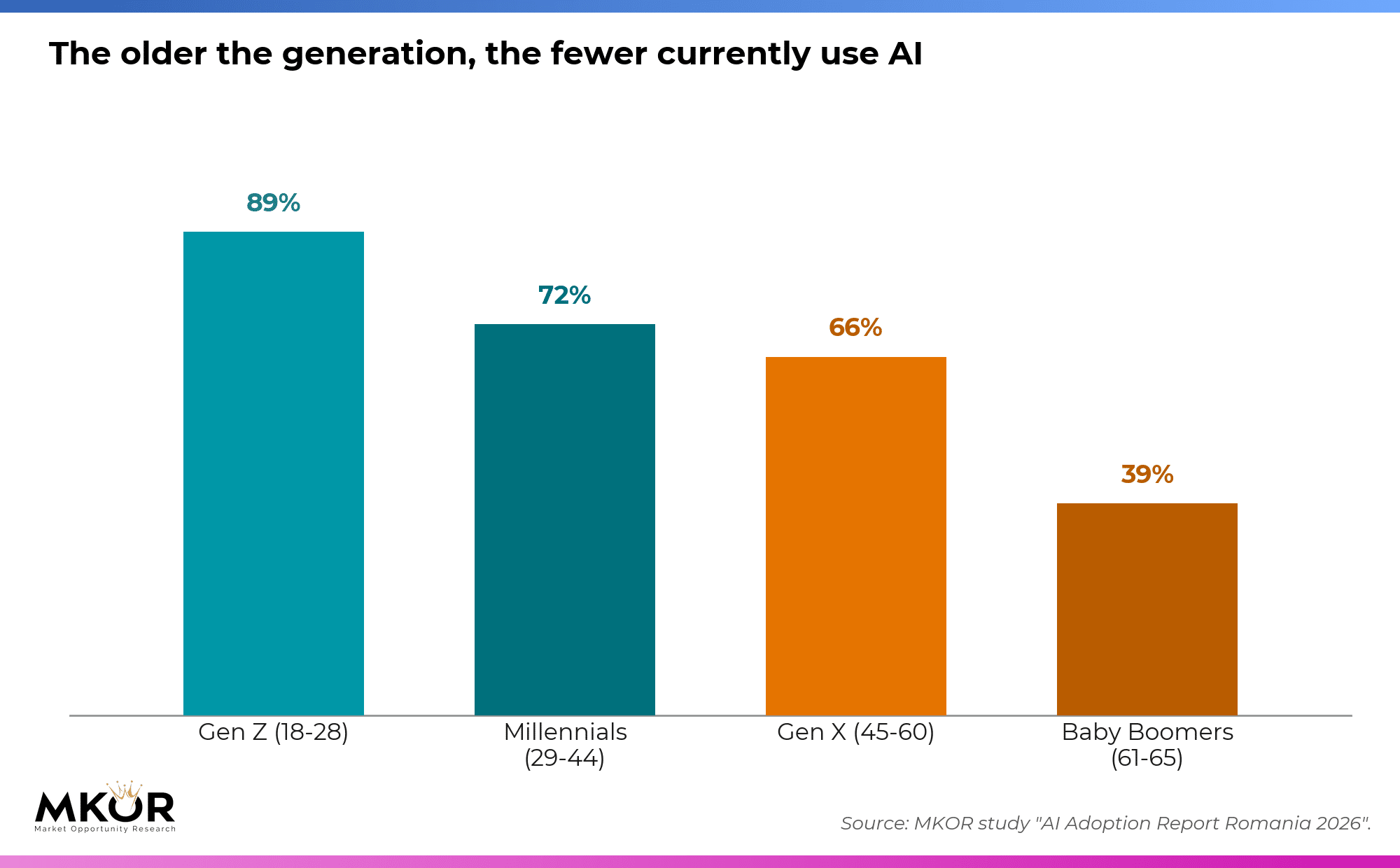
Our research found that seven in ten Romanians (70%) describe themselves as current AI users, 7% are former users, 19% know the concept but have never used it, and 5% are not sure what AI actually is. Current usage falls with each older generation: from 89% among Gen Z (18-28), to 72% among Millennials (29-44), 66% among Gen X (45-60) and 39% among Baby Boomers (61-65).
At European level, Eurostat data published in December 2025 paints a different picture: only 32.7% of EU citizens (16-74) used generative AI in 2025, and Romania sits at the bottom of the ranking at 17.8%, below Italy (19.9%) and Bulgaria (22.5%), and far behind Denmark (48.4%), Estonia (46.6%) or Malta (46.5%).
The gap against the 70% figure in our own study may come down to collection method: our data was gathered online, therefore from a structurally more digitised group, which can lift the share of users compared with research run through mixed methods — face to face, by telephone and online. The Eurostat sample was also broader than ours, covering 16-74, which can produce differences against a tighter sample of people active in the labour market (18-55 and 18-65 respectively).
Beyond how many Romanians say they use AI, what matters is where, with which tools and how often they do it — and here the picture changes considerably.
Usage context over the past 30 days confirms that adoption is anchored first and foremost in personal life (83%). Professional activities follow at 58%, and education at 16%.
Awareness of AI tools remains concentrated at the top. Out of 10 tools listed, Romanians know an average of just 3.5. ChatGPT is known by almost everyone (98%) and Gemini by nearly four in five respondents (79%), while Claude and Copilot each remain at 37%.
Actual usage is even more concentrated than awareness. On average, only 2 of the 11 tools listed were used in the past 30 days. ChatGPT dominates at 86%, Gemini stays at 48%, while Meta AI, Claude and Copilot all sit below the 20% threshold.
As for the 160 people in the sample who used no AI at all in the past 30 days, the reasons vary: almost half (49%) prefer to do things themselves or to deal with real people, 42% simply say they had no concrete reason to try, a quarter (25%) consider AI dangerous for the future of society, and only 1 in 10 cite a lack of time to explore it.
You could say the Romanian AI market has a “winner takes all” structure: adoption is broad at a declarative level, but in practice it narrows to a single dominant tool, used mainly for personal needs. The rest of the ecosystem, from Claude and Copilot through to use in education, remains territory the vast majority of Romanians have yet to explore.
AI at work: its perceived role and the impact over 3-5 years
At work, AI is seen above all as an escape from repetitive, boring tasks (42%) and as an advantage over other professionals in the field (39%). A third (34%) consider artificial intelligence a necessity, and only a few experience it as negative: 7% as added pressure and 5% as a source of stress.
The picture changes when it comes to the future. Asked how they think AI will affect their responsibilities over the next 3-5 years, a third (33%) believe their work will not change at all, a quarter (25%) expect AI to take over only minor or routine tasks, 22% anticipate significant changes to their role, and just 12% believe their role will become rare or disappear altogether.
Mentoring, early-career challenges and the skills that will matter in the years ahead
How is the relationship between generations at work changing in the age of AI? MKOR’s data shows a fragmented picture, with no clearly dominant trend.
16% of respondents note that firms are hiring fewer juniors and using AI for simple tasks, 13% say juniors become productive faster with AI’s help, another 13% observe that juniors turn to senior colleagues less often and go straight to AI instead, and 12% see mentors teaching juniors to check the work AI produces.
When they do not know how to solve a work task, almost a quarter (22%) of employees ask an AI first. That is a higher share than those who search the internet or the organisation’s internal resources (17% each), and than those who ask their line manager (16%) or a colleague (15%). Even so, taken together, human sources remain the first choice for most respondents.
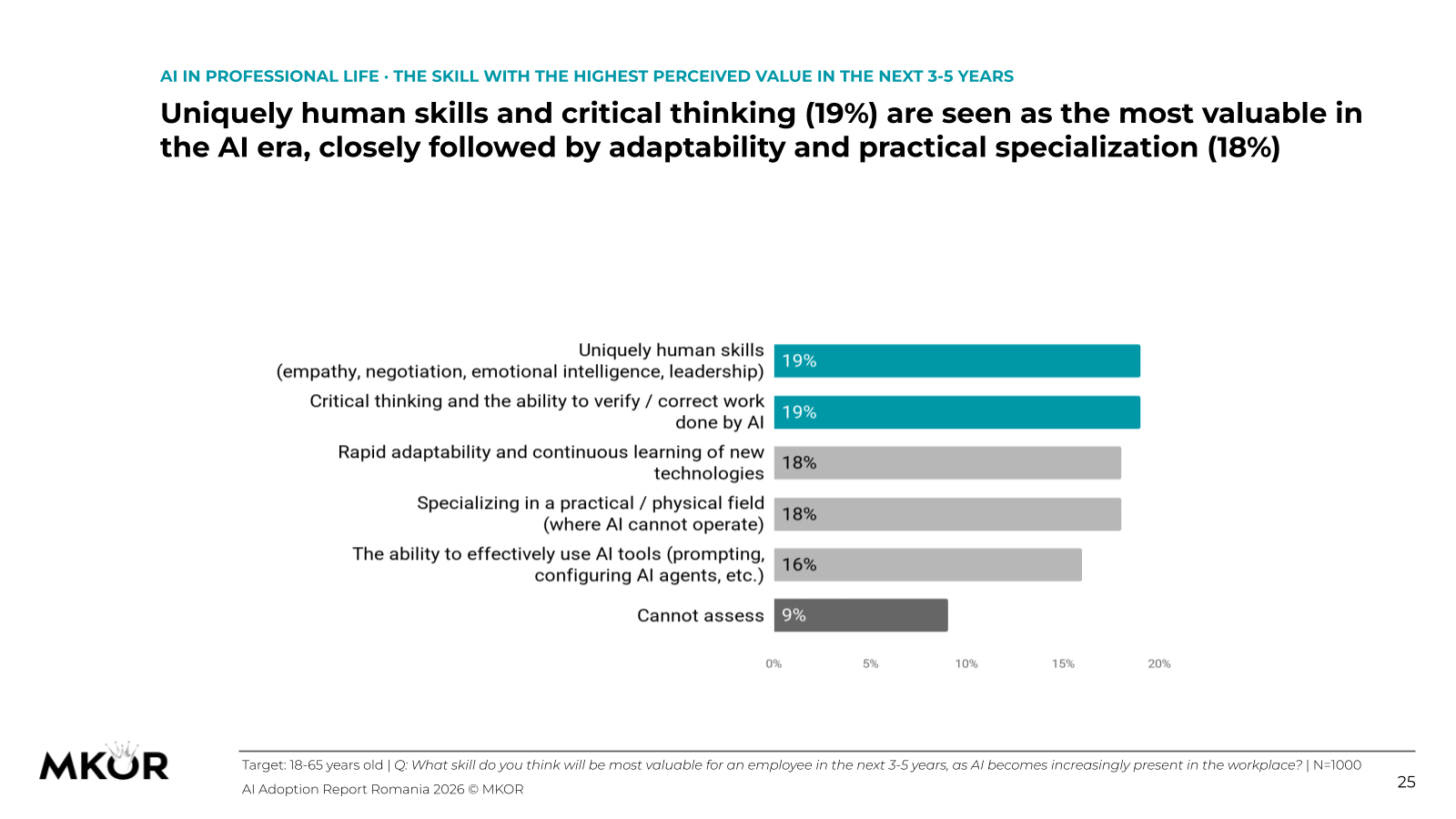
On the skills carrying the greatest value over the next three to five years, exclusively human skills such as empathy, negotiation or emotional intelligence, together with critical thinking and checking the work done by AI, are considered the most valuable, at 19% each. Rapid adaptability and practical specialisation follow closely at 18% each, while the ability to use AI tools effectively comes last among the relevant options, at 16%.
In 2026, Romanians appear to understand that knowing how to use AI is not enough. The human side counts just as much, if not more: critical thinking, working with people, and the ability to check what artificial intelligence produces.
About the study
At MKOR we treat every figure as a promise of accuracy. To capture faithfully the profile, attitudes and behaviours of Romanians regarding the level of AI adoption, we followed a rigorous methodological protocol, aligned with ESOMAR standards.
- Sample size: 1,000 respondents
- Sample characteristics: random, stratified, representative of the Romanian population by age, gender and geographical distribution
- Target: Romanians aged 18 to 65
- Research method: opinion survey (CAWI)
- Approach: online, through the MKOR Panel, in two distinct waves: May and August 2026
How to use this data in your organisation
If you are a business leader, the data above points to an organisational opportunity: this is the moment to move from AI used ad hoc, individually, by each employee, to secure enterprise tools that automate repetitive tasks without replacing people. It makes particular sense now, when 70% of Romanians already use AI — but mostly at home, not within a structured company setting.
If you work in marketing, PR or customer relations, set clear transparency rules for when you use AI, keep human interaction in trust-based areas such as healthcare or financial services, and check the quality of generated content carefully. The data shows why it matters: people feel “betrayed” when AI is used without their knowledge, and more than half of respondents, in a simple test, mistake human writing for AI-generated text.
If you work in HR or organisational development, rethink how you onboard juniors, adapt your recruitment to the new efficiency standards, and be transparent in employee evaluation.
If you are part of a learning and development team, build balanced programmes that develop exclusively human skills, critical thinking and the ability to check AI’s work, adaptability and effective use of AI tools alike. The order matters: Romanians put human skills and critical thinking first (19% each), not the technical use of AI, as you might assume at first glance.
Study conclusions
Most Romanians already use AI, but unevenly and, above all, through a single tool. Seven in ten (70%) are active users, yet usage remains mainly personal (83%) and far less present at work (58%) or in education (16%). Almost everyone knows ChatGPT (98%), but few have heard of Claude or Copilot (37% each).
The relationship with AI remains one of command rather than collaboration: 27% see it as an assistant they give instructions to, but only 11% as a colleague. Trust drops sharply wherever the stakes are personal — health, money, psychological counselling — where undisclosed AI bothers almost a third of people. One striking finding is that more than half (52%) cannot tell writing produced by a person from writing generated by AI.
At work, AI is seen as a help rather than a threat: 42% use it to escape repetitive tasks, and anxiety about the future of their job remains moderate (3.9 out of 7). The real pressure is felt at the start of a career — juniors are considered the most exposed (34%) — and when it comes to future skills, Romanians put human qualities and critical thinking first (19% each), not the technical use of AI (16%).
* The methodological accuracy and the data in this case study were validated by Dr Madalina Iorga, Senior Researcher & MKOR Associate.