


The MKOR “Diaspora Sentiment 2026” study starts from three crucial questions to help us better understand the situation of our diaspora:
- how integrated Romanians outside the country are
- how likely a permanent return is in the next 12 months, and
- what kind of economic relationship they still have with our country, and their voting behavior and concrete expectations of Romania’s political class.
The answers come from 2,000 respondents aged 18 to 65 who live outside Romania for at least 7 months a year, surveyed online through MKOR’s own panel and targeted social media campaigns, in October 2025.
The study’s main conclusion is that the diaspora is a community already settled abroad, one that keeps investing and voting, but which has increasingly strict conditions for a physical return, such as: a competitive salary (44%), a better healthcare system (44%), better jobs (36%), and fiscal and legislative stability (34%).
Content
The diaspora’s profile in 2026
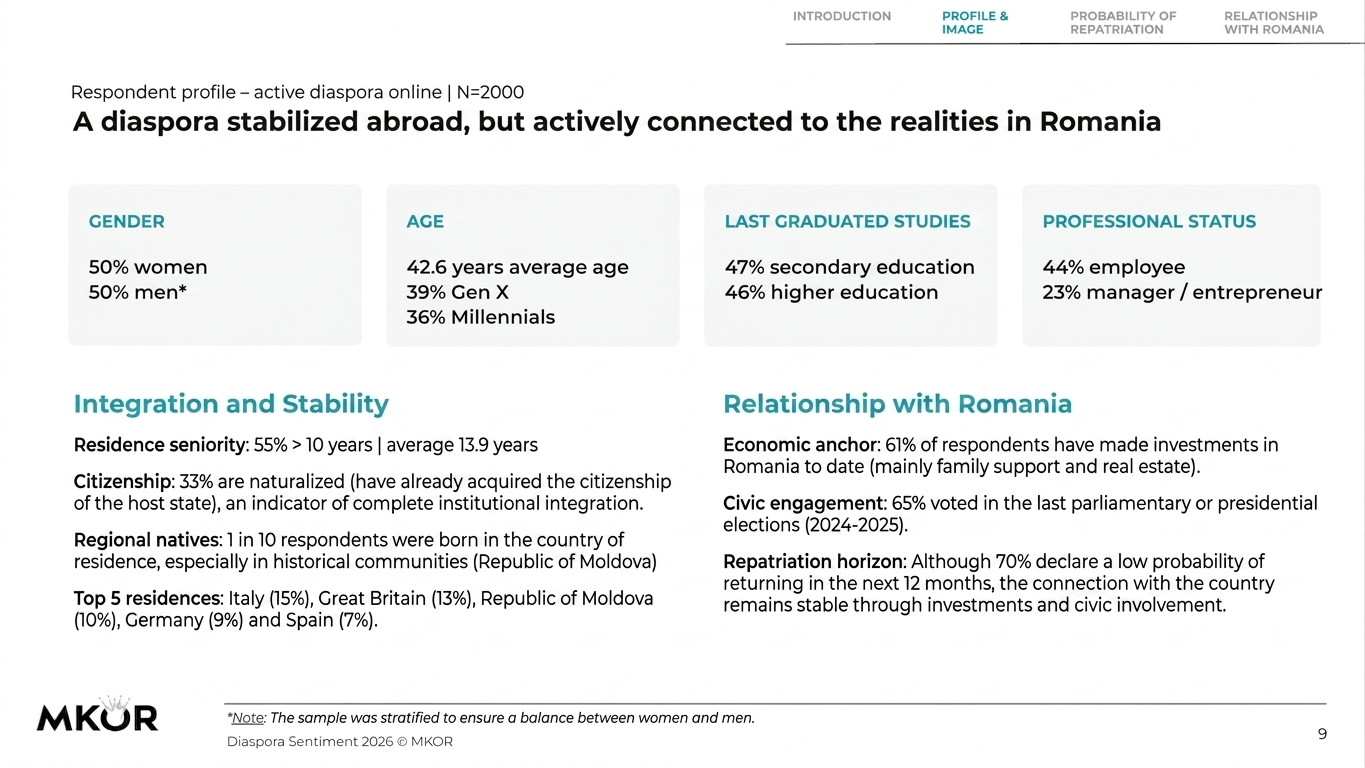
The average age of respondents is 42.6 years, with a stratified sample ensuring gender balance (50% women, 50% men). Generationally, the sample is dominated by Gen X (39%) and Millennials (36%). Nearly half of respondents have a high-school education (47%), while a nearly equal share (46%) hold a university degree. Professional status shows that the largest share are employees (44%), while 23% hold management or entrepreneurship roles.
Time spent abroad says a lot about the stage of integration: 55% of respondents have been away for over 10 years, with an average of 13.9 years. A third have already obtained citizenship in their host country, a sign of full institutional integration. 1 in 10 respondents were born in their country of residence, most of them in historic communities such as the Republic of Moldova.
Top host countries: Italy (15%), the United Kingdom (13%), the Republic of Moldova (10%), Germany (9%), and Spain (7%).
The relationship with Romania remains active on two fronts, even if physical return isn’t on the agenda: 61% have already made investments in Romania (mainly by sending money to relatives and renovating a property), and 65% voted in the last parliamentary or presidential elections (2024-2025). At the same time, 70% report a low likelihood of returning in the next 12 months.
Community map: five profiles, five different reasons for staying away
Italy, the “nostalgic veterans” (15% of the sample). 66% have been in Italy for over 10 years (average 14 years), and 20% already hold Italian citizenship. They feel well integrated: 72% believe they have a positive image in their host country, especially as “hardworking and capable”. Professional advancement remains limited — only 9% hold management or entrepreneurship roles, 14 points below the sample average. 69% rule out a short-term return, and among the reasons that would bring them back, healthcare weighs the most (46%).
The United Kingdom, the “digitalized professionals” (13% of the sample). A shorter history in the host country (only 40% over 10 years, average 11.7 years), but the most advanced professional profile in the sample: 62% hold a university degree, 29% are in management or entrepreneurship roles, 6 points above average. They are also the most determined not to return, 76% versus the 70% average. The conditions for considering a return concern what the Romanian system should guarantee: fiscal stability (45%) and cutting red tape through digitalization (44%). Civic engagement is the highest in the sample — 80% voted in 2024-2025.
The Republic of Moldova, the “proximity natives” (10% of the sample). Given the historical ties with Romania, this group has a completely different profile from the Western communities. 91% have been there for over 10 years, averaging 27.8 years, because 85% were actually born there. A young segment (average age 31, 49% Gen Z) and predominantly male (64%). This is the only community in the study where returning to Romania isn’t a scenario ruled out by the majority: only 42% say a return is unlikely, versus the 70% sample average. For this group, moving to Romania would mean a career leap.
Germany, the “pragmatic specialists” (9% of the sample). The youngest community analyzed, with 24% Gen Z. Average time abroad is only 8.5 years, and 41% settled in the last 5 years. A technical profile, dominated by men (61%), with the highest share of employees sending money to relatives back home (44%, the highest percentage among the four Western profiles). It’s also the community with the highest rate of investment in Romania (71%). 22% perceive a negative image in the media/online, and 16% feel discriminated against at work.
Spain, the “nostalgic ambassadors” (7% of the sample). The longest average time abroad in the sample (14.7 years) and the highest sense of integration: 85% feel positively perceived in Spain. In this context, 23% say nothing would convince them to return. The connection to Romania remains mostly cultural and consumption-based: Romanian flavors (23%) are what they would miss most if they settled there permanently, even though only 8% hold Spanish citizenship.

Six key conclusions of the study
- The repatriation window closes after 5 years. Past the decade mark, for 55% of the sample, uprooting becomes the norm and integration into the host country is final.
- Active investors, but lost residents. 70% rule out a short-term physical repatriation, while at the same time 61% have already invested capital in Romania, more as a way to secure family assets than as preparation for a return.
- System reform is the precondition for return. The need for a better healthcare system has reached parity with the need for a competitive salary, both at 44%. For the more established communities (Italy, Spain), medical safety is the priority.
- The diaspora is asking for a “compatible state”. The diaspora wants Romania to function the way the country they now live in does, regardless of which party is in power.
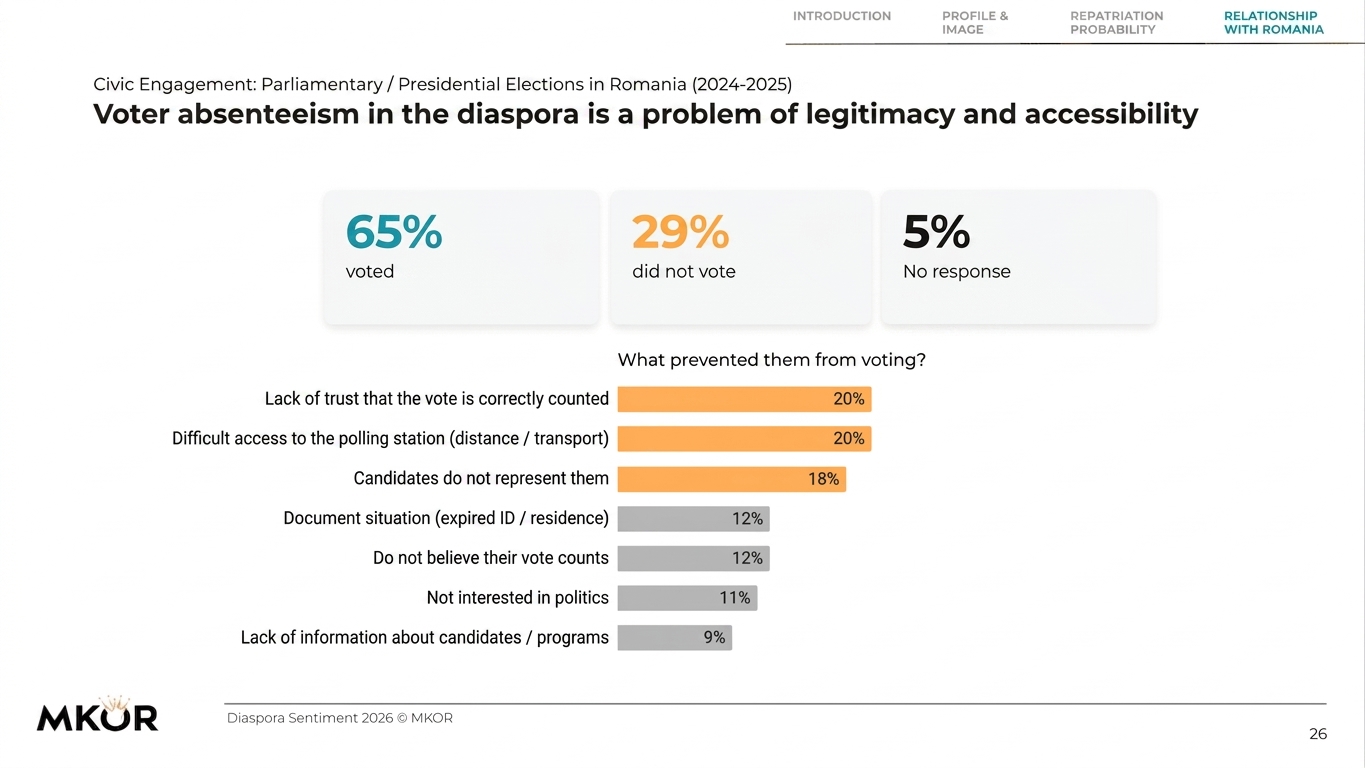
- The trust crisis outweighs logistical barriers at the ballot box. Although 65% voted, abstention is a matter of legitimacy: distrust in the accuracy of vote counting and difficult access to polling stations weigh equally (20% each), along with the feeling of not being represented by the candidates (18%).
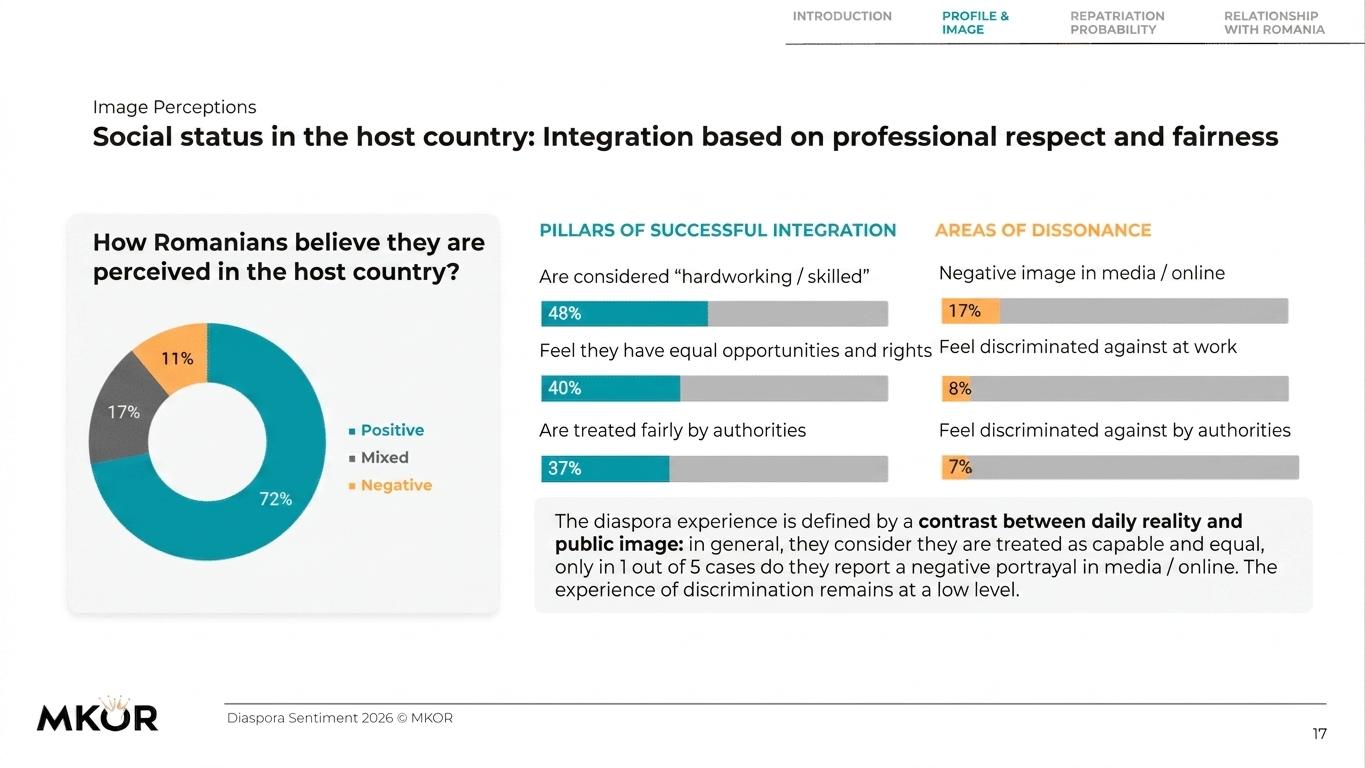
- Successful social integration keeps human capital abroad. 72% believe they have a positive image in their host country, driven mainly by the perception that they are seen as hardworking and skilled (48%) and that they have equal opportunities and rights (40%). Professional recognition and fair treatment from foreign authorities are the biggest “opportunity cost” of repatriation, while experiences of discrimination remain a minority (8% at work, 7% from authorities).
Repatriation, caught between missing family and wanting “a country like abroad”
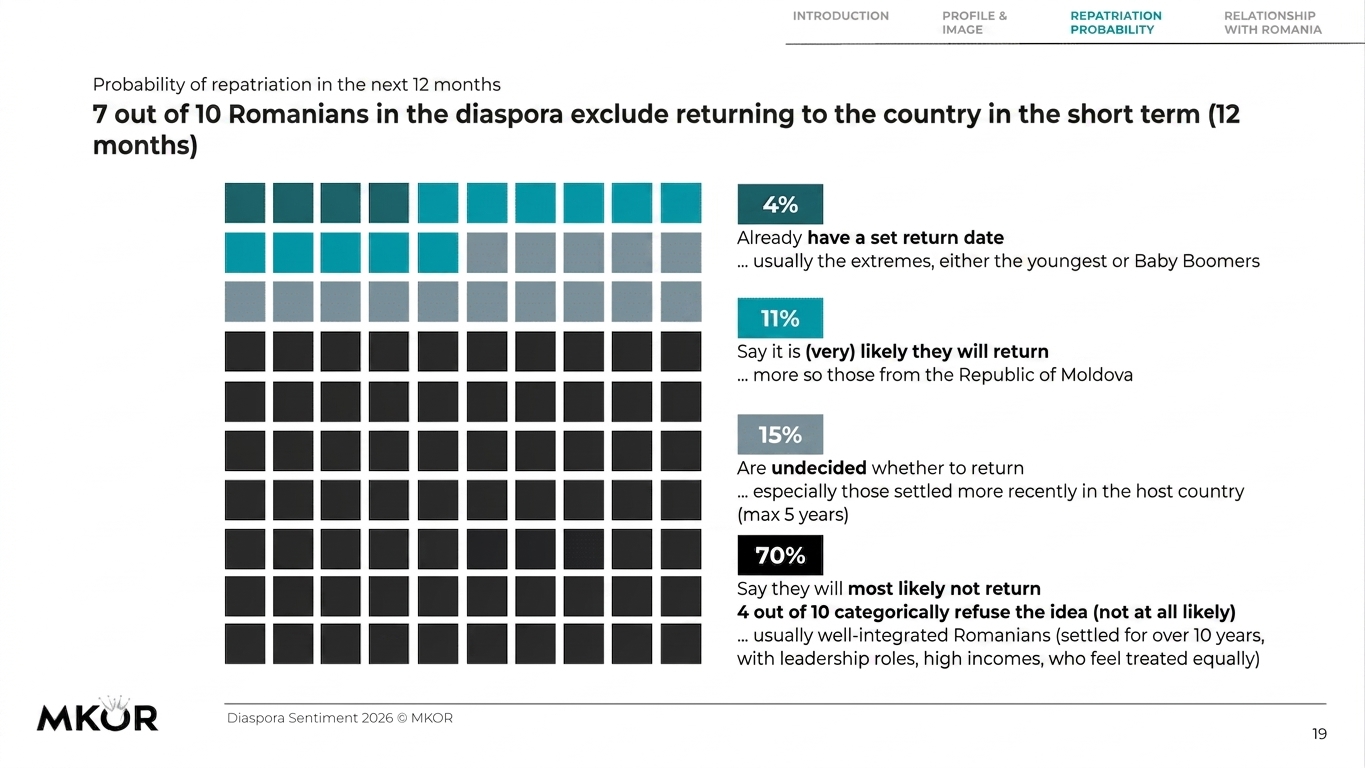
Data on the likelihood of returning in the next 12 months shows a clear distribution: only 4% have already set a return date (usually at the extremes, either the youngest or the Baby Boomer generation), 11% say a return is (very) likely, mainly those from the Republic of Moldova, 15% are undecided, especially those who settled abroad recently (under 5 years), and 70% say they most likely won’t return, with 4 in 10 categorically ruling out the idea. This last group is, as a rule, the best integrated: they’ve been settled for over 10 years, hold leadership roles, have high incomes, and feel they’re treated equally.
The reasons vary widely by segment. For those already inclined to return, the main argument is being close to family and friends (46%), followed by safety (17%) and raising children or caring for parents (17%). For those still undecided, the conditions are different: a competitive salary and a better healthcare system (44% each), followed by better jobs (36%), fiscal and legislative stability (34%), and cutting red tape and digitalizing public services (34%).
The economic relationship: money that flows, people who stay
61% of Romanians abroad have already invested in Romania, with wide variation between profiles, from 71% in Germany down to levels well below average in other communities. The dominant form of investment is direct financial support for family (59%), followed by renovating a property (29%) and buying their own home (20%). Only 12% open deposits or savings accounts, while buying land or building a house each account for 11%.
The practical takeaway for the financial-banking or real-estate sectors: capital flows are dominated by direct transfers to support family. Investments in durable assets or in business remain, for now, a secondary segment.
The civic relationship: the diaspora’s vote and the trust crisis
65% of respondents voted in the last parliamentary or presidential elections, 29% did not vote, and 5% did not answer. The main barriers to voting weigh equally on the logistical side and the structural-trust side: distrust that votes are counted correctly (20%) is just as present as difficult access to polling stations (20%). The feeling that the candidates don’t represent them adds another 18%, and 12% don’t believe their vote matters.
Voter turnout doesn’t keep rising with time spent abroad. It climbs initially, then declines for those settled for over a decade.
Regarding expectations from the political class, 88% of respondents have well-defined expectations, split across two directions. Administrative efficiency: cutting red tape for official documents (36%), digitalizing consular services (30%), transferring and porting rights (28%), efficient consulates (24%). Status and identity: improving the image of Romanians abroad (35%), constant and transparent communication from authorities (26%).
The voice of the diaspora
Upon returning to the country, Romanians in the diaspora would essentially miss predictability, institutional respect, and the high standard of everyday life. Coming back home often comes with a “reverse culture shock”, since elements that have become the norm in the West are still lacking in Romania.
The main gaps respondents feel are structured around four major pillars:
- Quality of public space and the environment: modern infrastructure, alternative urban transport, strict cleanliness, quiet residential areas, and well-kept green spaces (“the green grass”).
- State functionality and institutional respect: trust in authorities, a healthcare system you can rely on, an advanced social culture, and the feeling of being respected as a citizen by state institutions.
- Economic security and the next generation’s future: secure jobs, fair incomes, and, above all, the clear opportunities the education system and society offer children to get ahead in everyday life.
- Psycho-social climate: a general atmosphere marked by civility and optimism, in sharp contrast to the widespread pessimism and stress in Romanian society.
On the other hand, should they settle abroad for good, Romanians in the diaspora would miss most of all their emotional anchor, cultural identity, and a deep sense of belonging. Beyond the logistical or economic aspects of their host countries, the bond with Romania remains very close.
The main points mentioned cluster around three important pillars:
- Identity and the feeling of “home”: the need to be surrounded by people who share your habits and culture, language, and mindset. Abroad, even after years of integration, the subtle feeling of being a “foreigner” often persists — a sharp contrast to the psychological comfort of being among your own.
- Traditions and sensory heritage: the natural beauty of Romanian landscapes, the unmistakable taste of home cooking (authentic local products), and traditions felt to be part of one’s own DNA (“it’s in our blood”).
- Roots and moral duty: a deep connection to the past and to the education received at home. A sense of duty emerges toward the society that shaped them professionally, accompanied by a regret: the wish to have stayed home, had Romania offered the same salaries and conditions as the West.
About the study
At MKOR, we treat every number as a promise of accuracy. To faithfully capture the profile, attitudes, and behaviors of the Romanian diaspora, we followed a rigorous methodological protocol, aligned with ESOMAR standards.
- Sample size: 2,000 respondents
- Sample characteristics: stratified and balanced by gender, with representation from the main destination countries of the Romanian diaspora
- Target: Romanians aged 18 to 65 who live outside Romania for at least 7 months a year
- Research method: opinion survey (CAWI)
- Approach: online, through the MKOR Panel
Why this data matters to the public, financial, real-estate, and HR sectors
- Public sector and political organizations: can use the data to build better repatriation policies and public diplomacy, as well as to make voting more accessible for the diaspora.
- Financial-banking sector: can adapt money-transfer and savings services, knowing that most of the money goes toward supporting family, not other financial investments.
- Real estate, construction, and renovation: can build sales strategies targeted at the diaspora, given that they are active through renovations and buying their own home.
- HR companies and educational institutions: can find talented young people especially in communities such as the Republic of Moldova or Germany, where people have been away for less time or feel a stronger cultural bond, which makes returning to Romania a real career option.
Conclusion
The 2026 Romanian diaspora defines itself more by the conditions it sets for considering a return than by an actual desire to return.
The bond with Romania remains active economically and civically, but fragile when it comes to institutional trust. Any organization that wants to communicate directly with this audience should talk about concrete things: healthcare, less bureaucracy, digital services, a state as efficient as the one they live in now.
Free database access for researchers
We believe that a better-informed society makes better decisions, both at the business level and at the level of public policy and academic research. That’s why we make our data available to researchers, free of charge, for scientific articles.
9 academic papers have already used MKOR’s studies. If you’re working on an article too, we’re here.
* The methodological accuracy and data contained in this article were validated by Mihaela Nicolae, Senior Researcher.
Press coverage
The Romanian Diaspora Sentiment 2026 study was picked up by major outlets in Romania and abroad. Here is a selection of that coverage, one article for each newsroom that reported on the study.










Get full access to the Romanian Diaspora Sentiment 2026 Study
Excel database plus a one-hour strategy consultation with an MKOR expert
Buy the data and consultancy package now
The Excel database lands in your account within 24 hours of payment confirmation. You can book the one-hour consultation whenever suits you, within 30 days of purchase.
See exactly where the Romanian diaspora’s relationship with the home country stands today, based on data from a study MKOR ran with 2,000 Romanians living abroad for at least 7 months a year.
The study covers integration in the host country, the likelihood of returning within the next 12 months, investments made in Romania, voting behaviour, and expectations of the political class, with five communities analysed separately (Italy, the United Kingdom, the Republic of Moldova, Germany, Spain).
If you work in the public sector, banking and finance, real estate, HR, or communications and want to know how this audience decides today, this study gives you the numbers to work from.
What you get
The Romanian Diaspora Sentiment 2026 database in Excel format, including:
- The full study data, segmented by country of residence, gender, age and generation, education level, professional status, and years spent abroad
- Profiles of the five communities analysed — Italy, the United Kingdom, the Republic of Moldova, Germany, Spain — with integration and return indicators for each
- The likelihood of returning within the next 12 months, the reasons behind it, and the conditions set by those still undecided
- Investment behaviour in Romania: the forms of investment, their weight, and the differences between communities
- Voting behaviour, the barriers to voting, and concrete expectations of Romanian authorities
- Perceptions of how Romanians are seen in the host country, and experiences of discrimination
A one-hour strategy consultation with an MKOR expert, where we:
- Interpret the data against your market and your target audience
- Identify the communities and segments with the highest potential for your organisation
- Outline directions for your communication, product, or public-policy strategy
- Answer your team’s questions about interpreting and using the data
Questions this data answers
- How likely is a return to Romania within the next 12 months, and who is considering it?
- What concrete conditions would need to be met for a Romanian in the diaspora to return?
- What do Romanians in the diaspora invest in back home, and how much weight does each form of investment carry?
- How do the five communities differ from each other in profile, integration, and ties to the country?
- How integrated do they feel, and how do they think they’re perceived in the host country?
- How much do they vote, what stops them from voting, and what do they expect from the political class?
- What would they miss most if they returned for good, and what would they miss most if they stayed abroad for good?
What the study covers
Topics tracked
- Socio-demographic profile and years spent abroad
- Integration in the host country and citizenship
- Image perception and experiences of discrimination
- Likelihood of return and the reasons behind it
- Conditions set for a return: salary, healthcare, bureaucracy, fiscal stability
- Investments and money transfers to Romania
- Voter turnout and electoral barriers
- Expectations of the political class and consular services
Segmented analysis
- Country of residence (Italy, the United Kingdom, the Republic of Moldova, Germany, Spain, and other destinations)
- Gender, age, and generation (Gen Z, Millennials, Gen X, Baby Boomers)
- Education level
- Professional status (employee, management, entrepreneurship)
- Years spent abroad and host-country citizenship
Why buy access to the raw data
- Five diaspora communities analysed separately, not a general average that hides the differences between them
- A one-hour strategy consultation with an MKOR expert, turning the data into directions relevant to your specific organisation
- Independently collected data, with a verifiable methodology aligned with ESOMAR standards, on a sample of 2,000 respondents, stratified and balanced by gender