


Today, artificial intelligence is increasingly present in our lives. And online, information abounds. Anyone can publish a study, launch a survey, declare a trend. Social media amplifies any claim, whether it’s true or not.
In this noise that we all feel, one thing remains rare and valuable: rigorous data, collected with a precise methodology, capable of standing up to a simple test — the questions that matter to society and to businesses.
That’s why the moment a data source is cited in an international academic study is a validation that our work as a market research agency moves beyond business and becomes a foundation for advancing knowledge.
Contents
Rigorous data is the “currency of trust” and of good decisions
For MKOR, these citations confirm something we have been building deliberately for years: market research must support decision-making and advance knowledge across economic and social fields.
A report delivered to a client and an article published in a specialty journal can both start from the same place — a rigorous methodology, a representative sample, a data analysis that doesn’t stop at the first convenient explanation.
The studies that have cited MKOR data cover diverse themes:
- from Romanian consumer behavior during the pandemic,
- to attitudes toward ecological products,
- to trends in retail and food
And they come from publications indexed in international databases.
They cited us because our data passed the test that any applied or empirical academic research should pass: can the data be reproduced, verified, and developed further?
The answer, every time, has been yes. This is, fundamentally, the difference between information and knowledge. Information exists in abundance. True knowledge is (still) the one thing that cannot be generated by AI.
International validation: mental health and social stress
The most prestigious citation comes from the journal Science Progress (SAGE Journals), with an Impact Factor of 2.9. In the scientific world, this is an indicator showing that published articles become reference points, cited extensively by other researchers worldwide.
Article: Changes in mental health during the COVID-19 crisis in Romania: A repeated cross-section study based on the measurement of subjective perceptions and experiences, Florin Vancea, Mădălina-Ştefania Apostol, Science Progress. 2021;104(2)
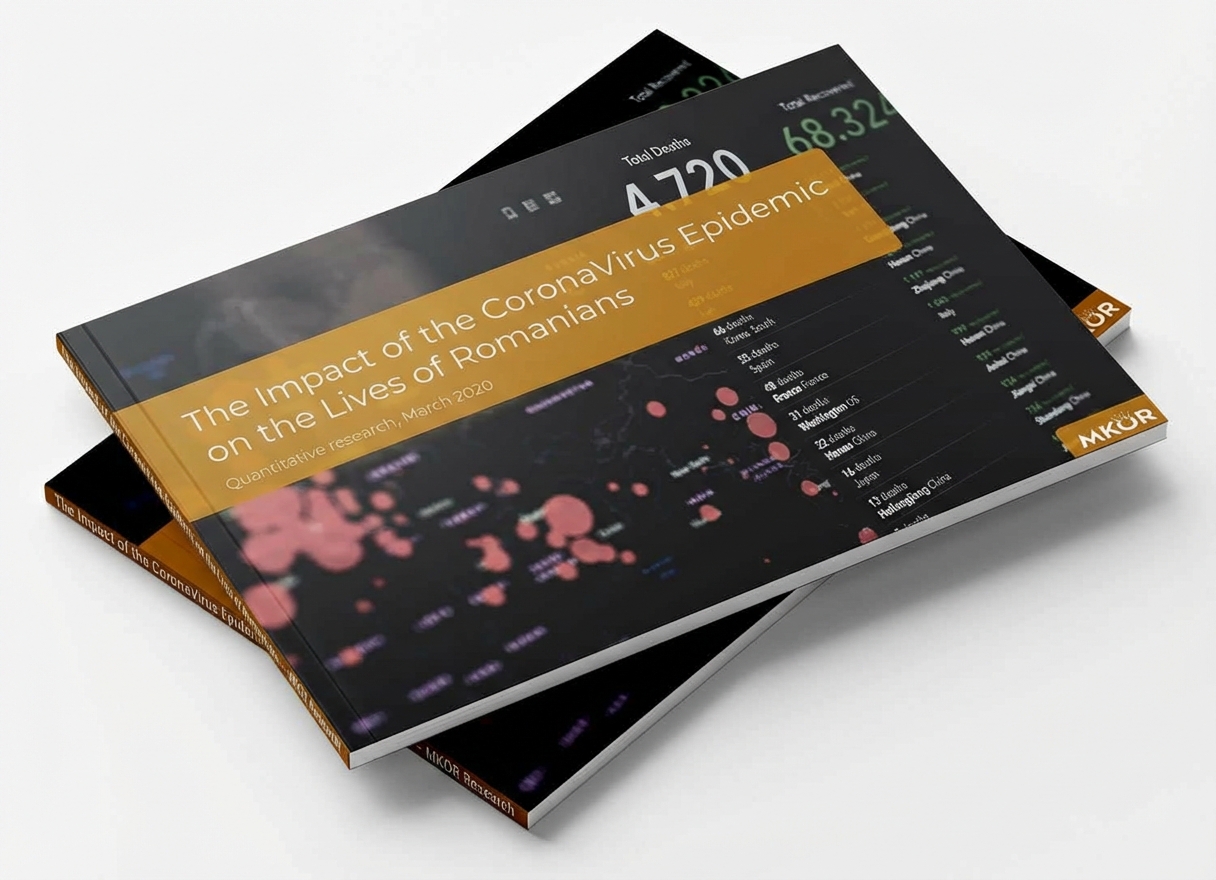
The authors used our data from the market study The Impact of the Coronavirus Epidemic on Romanians’ Lives 2020 to show that the pandemic generated high stress levels among Romanians, particularly through restrictions, uncertainty, and financial impact.
The results of our study identified the main sources of stress:
- restrictions on freedom of movement (69%)
- changes to personal plans (44%)
- home isolation (37%) and
- reduced income (24%).
Other effects included:
- changes to professional goals (18%)
- suspended employment contracts (8%)
- technical unemployment (7%) and
- job loss (4%).
Only 8% of respondents said they were not affected at all.
Publication or use of data in a journal of this caliber represents an important validation of methodological quality, confirming that MKOR studies meet high academic standards and deliver results relevant to both research and practice.
Economy, management, and business environment: we ran the first rigorous study on the COVID crisis in Romanian business
The pandemic forced organizations to rapidly reinvent how they work. Researchers in management needed concrete data on the scale of this transformation, and they found answers in MKOR studies.
At the end of April 2020, in the middle of the pandemic wave, MKOR launched one of the first rigorous studies on the impact of COVID-19 on the Romanian business environment. The data was concerning: 91% of companies felt affected, with an average impact of -10.2% on turnover for 2020 and an estimated loss of up to €100,000 per organization.
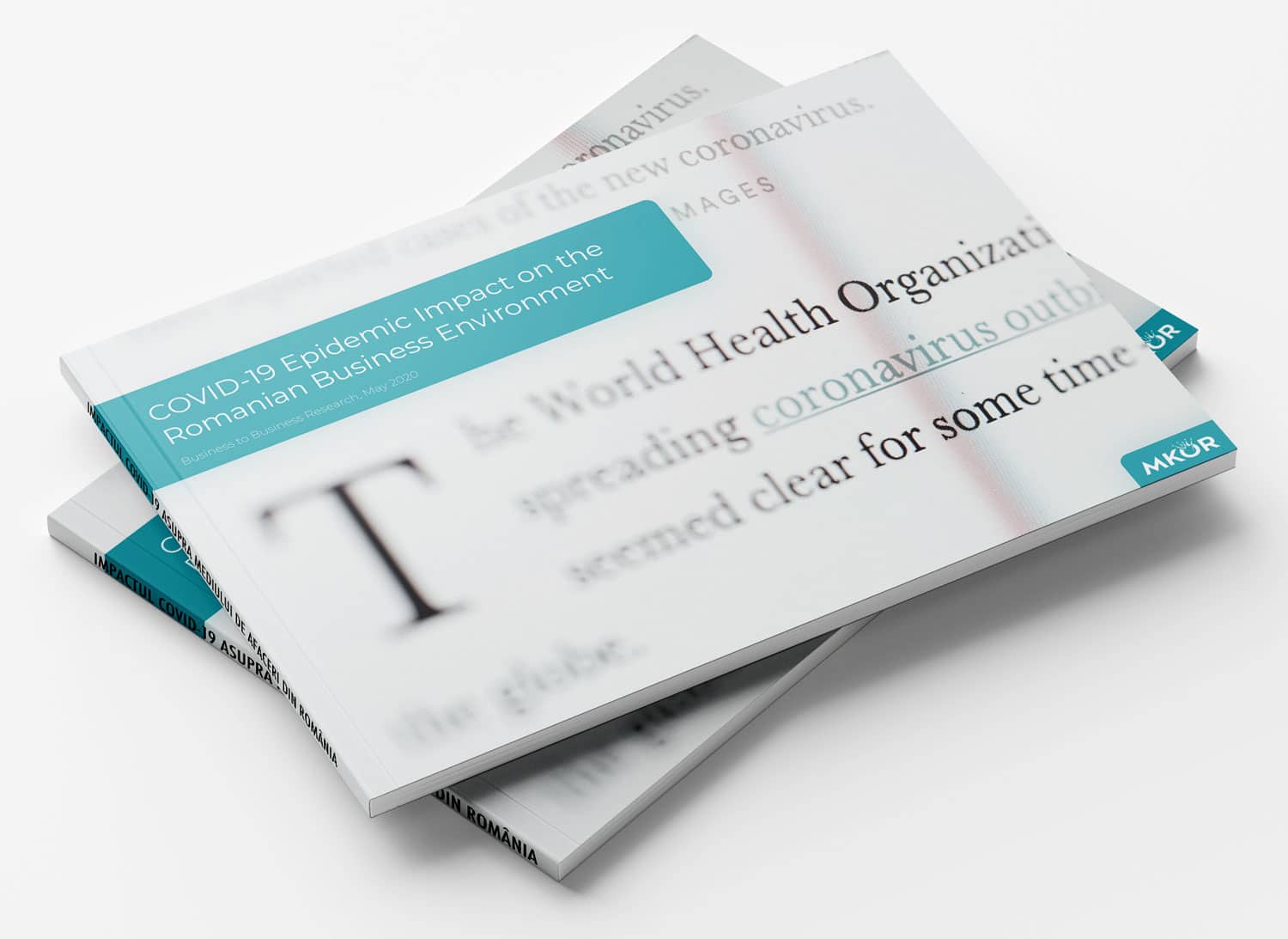
These figures didn’t stay confined to business reports. They entered academic literature through MKOR’s most-cited market study: The Impact of the COVID-19 Epidemic on the Business Environment in Romania.
Article: Management types and styles adapted to remote management, Emiliana Ștefania Dovan, Larisa Florina Macovei, Eugen Teodor Sfârlos, Research Focus, An International Open-Access Scientific Journal for Students and Graduates Research, ISSN: 2668-4675, Special Issue SCSS, 1, 2021
The authors used the MKOR study on the pandemic’s impact on the business environment to analyze the scale of the crisis’s effects on local companies. According to our study, the most visible consequences were declining turnover and suspended operations.
At the same time, 95% of companies took action to cope with the crisis, most reacting quickly as early as March 2020, through financial measures, employee protection, and business model adaptation.
Companies already in decline anticipated further drops, and trust in state institutions proved to be low (2.7 out of 7).
Article: Effects of the COVID-19 Pandemic on the European Business Environment – Romania Case Study, Gabriela Gheorghiu, Elena Cerasela Spătariu — Ovidius University Annals, Economic Sciences Series, Vol. XX, nr. 2/2020, pp. 113-118
The authors chose a methodology based exclusively on secondary data analysis — desk research — from academic sources and specialty reports.
The MKOR study was one of the primary sources, cited both for its data on the impact on companies and for the broader context of the first weeks of the pandemic in Romania. The authors reproduced 3 charts from the MKOR report covering remote work, behavioral changes during the pandemic, and the pandemic’s effects on the population.
Article: The Economic and Social Impact of COVID-19 Pandemic: Evidence from Romania, Ștefan Catană, Sorin-George Toma, Cătălin Grădinaru, Ovidius University Annals, Economic Sciences Series, Vol. XX, nr. 2/2020, pp. 273-277
Researchers from “Ovidius” University of Constanța used MKOR data to document the economic and social impact of the pandemic in Romania. The study directly cites MKOR figures on the pandemic’s effects: 91% of companies declared themselves affected by the coronavirus pandemic. The average impact estimated by a typical organization was €100,000, potentially reaching up to 100% of turnover.
Article: Digital marketing and online consumer behavior in Romania during the COVID-19 pandemic: a case study, Elena Polearus, Mihai Timuș, Acta Marisiensis, Seria Oeconomica, ISSN 2668-3989, University Press Târgu Mureș, under the auspices of the George Emil Palade University of Medicine, Pharmacy, Science and Technology of Târgu Mureș, Romania, pp. 29-40
The article references the MKOR study on COVID’s impact on the business environment and cites that 91% of Romanian companies declared themselves affected by the COVID-19 epidemic, with an average total impact of -10.2% on sales in 2020. It also reports that 95% of companies took measures to survive the crisis.
Marketing and consumer behavior: from crisis to long-term trends
If the first academic citations appeared in the pandemic context, MKOR data continued to be relevant after the crisis faded — this time to track long-term transformations in Romanian consumers.
Article: Emerging trends in food consumer behavior in Romania: A PLS-SEM approach, Simona-Beatrice Manolache, Daniela Nechita, Cristina Gabriela Zamfir, Silvius Stanciu, E&M Economics and Management, 28(2), 229–241.
The authors referenced the MKOR study The Ethical Consumer in Romania 2022 vs. 2021 to show that interest in sustainable and ethical products is rising, particularly among younger consumers.
According to our data, consumers are becoming increasingly concerned about the environmental impact of food products, and brands adopting sustainable practices are gaining popularity.
Article: What Links Retail to Modernity? The Future of Retail – Romanian Case Study A combined Analysis of Consumer Perceptions and AI Insights, Andreea Strătilă (Irimia), The Romanian Economic Journal, Year XXVII no. 87 March 2023, pp. 81-99
The author drew on the MKOR study What Romanians Think in 2023 About the Store of the Future for insights on the store of the future and trends at the national level, including:
- Demand for digital and tech-enabled experiences has grown significantly (up 30% vs. 2021).
- Consumers prioritize efficiency, accessibility, and product variety.
- Low interest in lower prices (8%) and sustainability (3%).
- 63% of consumers want a pleasant, relaxing shopping experience.
- Online channels and digital platforms are used more and more.
- Logistics and delivery services are becoming more important for ensuring quality.
Based on MKOR data, the authors concluded that the store of the future will integrate online and offline experiences, technology will streamline access to products and services, and personalization and sustainability will gain importance.
Ethics and responsible consumption: from stated attitudes to real behavior
The most recent academic citations reflect an emerging concern in Romanian research: the gap between consumers’ stated values and their actual choices.
Article: Romanian consumers and ethical choices: exploring attitudes, actions, barriers and demographic disparities, Anca Ioana Martin, Georgiana Elena Constantin, Alina Andrea Miron, Gabriela Iuliana Munteanu, Sciendo.
Authors from the Academy of Economic Studies at the University of Bucharest used data from the Ethical Consumer in Romania 2024 report to analyze Romanian consumer behavior. The data was collected in August 2024 via CAWI (Computer-Assisted Web Interviewing — online questionnaire) on a nationally representative sample aged 18 to 55, selected by gender, age, and geographic distribution through the MKOR panel.
Within the article, the data was used to analyze attitudes and behaviors around ethical and sustainable consumption, perceived barriers (particularly price), and differences across socio-demographic segments.
Based on MKOR data and other sources, the academic study tested two hypotheses:
- positive attitudes toward green products lead to more responsible behavior;
- the perception of price as a barrier varies by income.
The academic study showed that in Romania, although interest in environmental protection is rising, there is a gap between what consumers declare and how they actually behave. It also confirmed that price is a barrier to ethical behavior.
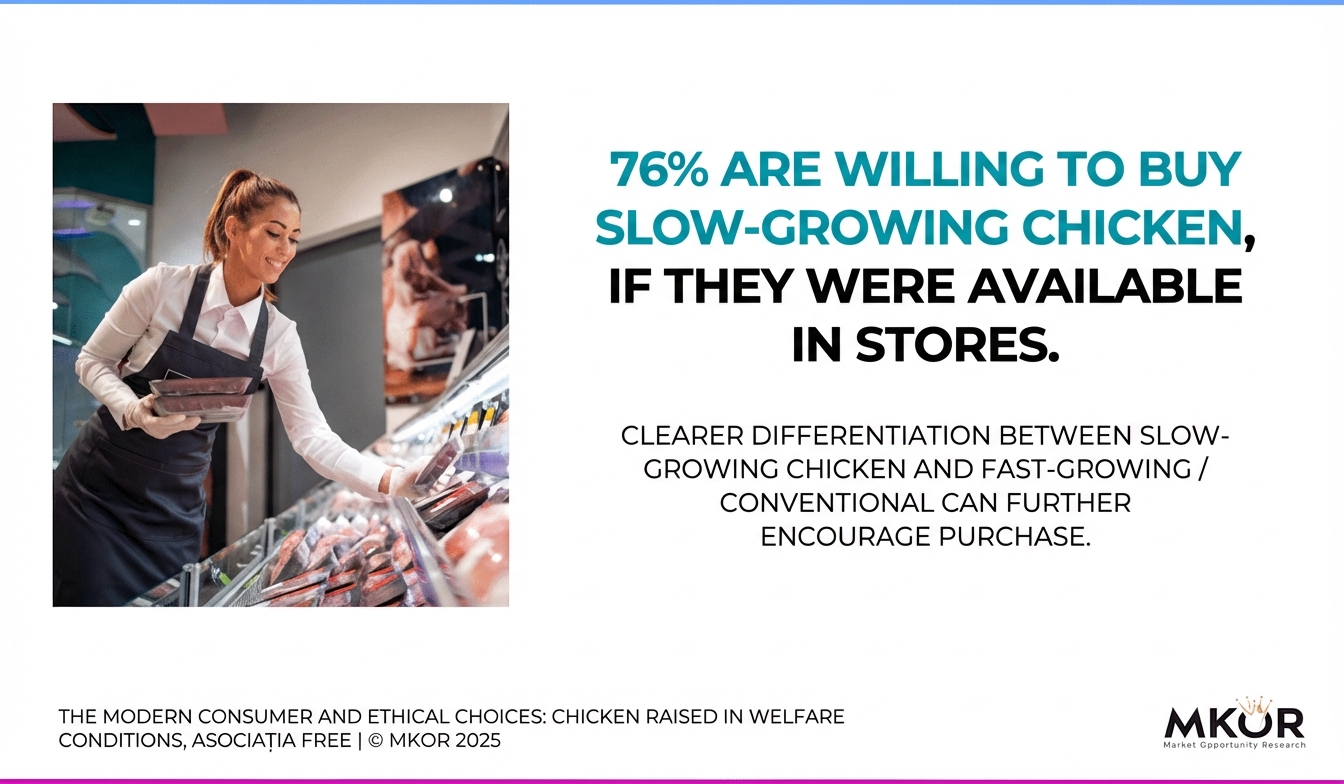
Article: The Modern Consumer and Ethical Choices: Chickens Raised in Higher Welfare Conditions, Alexandra Ștefan, Corina Cimpoca, Social Science Research Network (SSRN)
The authors used data from the market study Romanians’ Perceptions on Chicken Meat and Animal Welfare on chicken meat consumption, conducted for the Freedom and Respect for Every Earthling Association. The study’s data revealed a rise in chicken meat consumption in Romania: 51% of consumers said they eat more than a year ago.
At the same time, 59% consider it important that chickens be raised naturally, without growth accelerators, and 76% would choose such products if they were available in stores.
Although 95% of consumers check labels at purchase, only half feel the information is sufficient, and 1 in 5 express concern about the impact of production methods on health.
Based on the MKOR study, the article showed that consumption habits are shifting, with growing interest in quality, health, and ethical sources. Consumers want more transparency and information, which puts pressure on producers to adapt through higher standards and clearer communication.
Taken together, these citations map out a picture of relevance: MKOR data has reached social psychology, management, economics, marketing, and applied ethics.
Why this matters for your business
There is one question every manager or entrepreneur asks themselves, consciously or not, before making an important decision:
What am I basing this on?
On intuition? On accumulated experience? On a report commissioned three years ago?
Or on data collected rigorously, verified methodologically, capable of standing up to the scrutiny of an international academic journal?
This difference matters more than it seems at first glance.
Academic data and business data speak the same language — when they’re collected correctly, honestly, and rigorously.
Right now, we have 6 studies cited in 9 scientific articles across diverse topics: consumer behavior during the pandemic, food and sustainability, retail, mental health, and ethical consumption.
None of them chose MKOR data because it was free or easy to access — they chose it because it was clear that the data was collected responsibly, on a representative sample, with a rigorous methodology.
Our methodology is built on representative sampling and at least seven data validation criteria. This full transparency delivers the rigor required by academic standards to guarantee the validity of any analysis.
The studies that have appeared in high-impact-factor journals are built with exactly the same tools we offer to our business clients.

Cori Cimpoca – MKOR Founder
That is exactly what a CEO, a marketing director, or an investment board should be looking for when making a decision with real stakes: high-quality data that can withstand any critical analysis.
Our data passes the test of science. Let it pass the test of your profitability too.
Academic standards are, in many ways, more demanding than those in business. By clearing that filter, our data has proven that it can withstand the most rigorous test of credibility.
Want to better understand how your consumers make decisions? Want data that will support a long-term strategy? Book a strategic session with the MKOR team.
Free database access for researchers
We believe a better-informed society makes better decisions — in business, in public policy, and in academic research. That’s why we make our data available to researchers, free of charge, for scientific articles.
9 specialty papers have already used MKOR studies. If you’re working on one too, send us a message here.
* The accuracy of the information contained in this article has been validated by Dr. Mădălina Iorga, Senior Researcher & MKOR Associate, and Mihaela Nicolae, Senior Researcher.
Have you read everything? Comment / join our newsletter / read our other research posts!