



Most entrepreneurs don’t fear the cost of market research; they fear the time it adds before a launch. The idea that testing delays a product or campaign feels like a real, measurable cost. Teams also frequently skip external studies because they believe internal data is enough.
The biggest cost is actually a strategic direction chosen without validation. Concept Testing is a controlled investment with clear timelines and budgets from day one. Skipping it creates unpredictable costs that only surface after you’ve spent resources on production or logistics.
You rarely notice the price of an unvalidated idea until you have to pay it. You face two costs: the visible price of testing, and the hidden, much larger cost of relying on unverified intuition.
At MKOR, concept testing is a core part of our strategy. The results provide a reality check that refines or completely changes your direction. We gathered 4 examples from various markets where data recalibrated the initial business plan, which you can read about in this article.
Contents
What the cost of an untested idea actually means
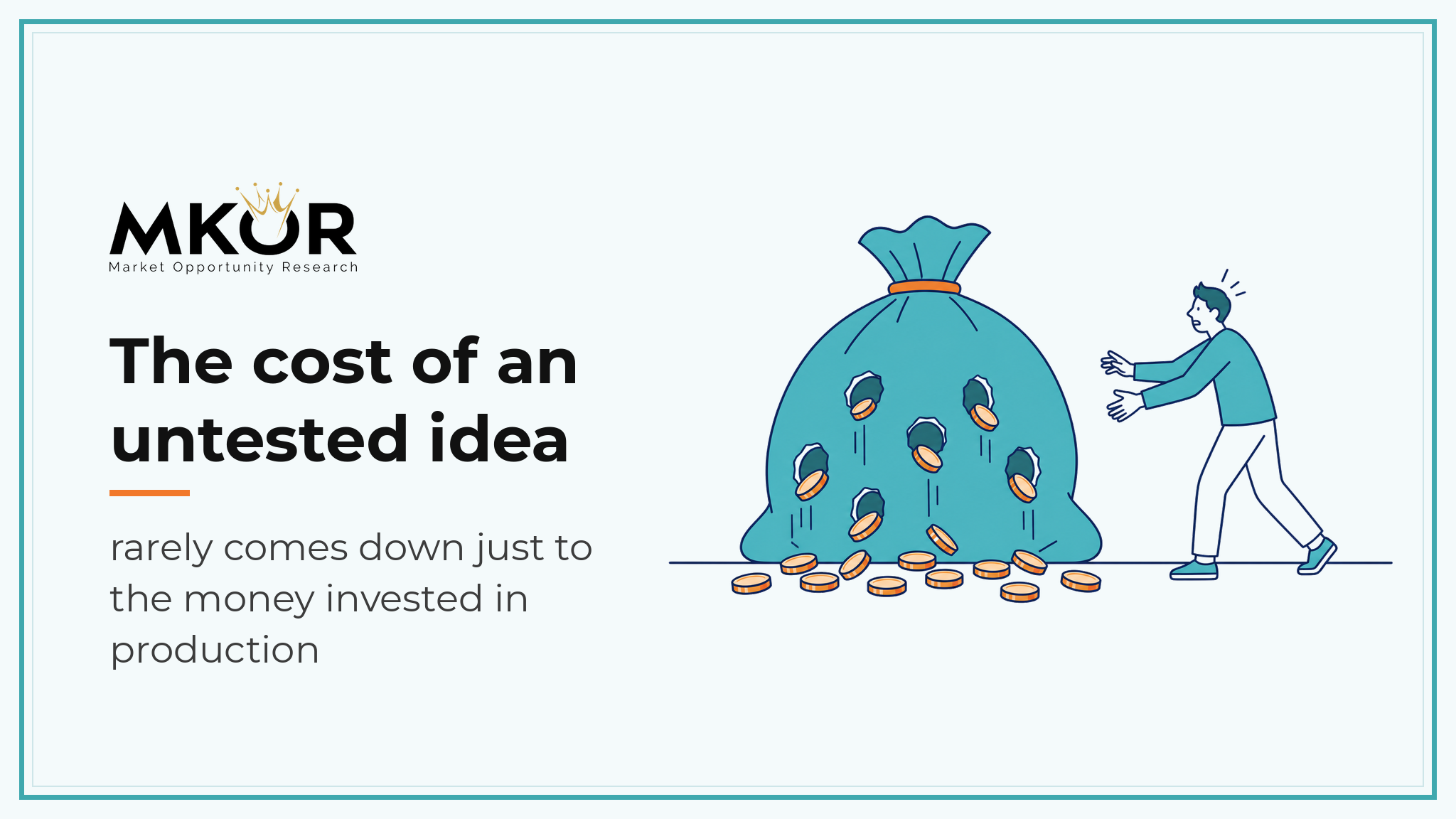
The cost of an untested idea rarely comes down just to the money invested in production. It consists of several types of costs that often go unnoticed.
- Direct financial cost. Money invested in production or physical spaces for a concept with no market demand. You only find out the true size of the loss after consuming resources.
- Opportunity cost. Budget and team allocated to the wrong direction. Every month spent developing a flawed concept is a month lost building the right one.
- Reputational cost. A campaign that misses the mark or impractical packaging erodes brand trust. Once consumers associate you with an irrelevant experience, they view future initiatives with skepticism.
- Decision-making gridlock cost. The pressure to continue an investment you no longer believe in. This happens when money is partially spent and stopping feels like a bigger loss than continuing, but inertia does not fix a wrong decision.
This is the sunk cost fallacy. It pushes you to save an investment by committing new resources on top of those already lost.
How do you stop a bad investment in time? Establish what Annie Duke calls a kill criterion in her book Quit. Set a maximum budget, a deadline, and a concrete stopping rule, like “If I don’t see result Y by date X, I stop”.
At every major milestone, ask yourself: “Knowing what I know now, would I make this investment again?” If the answer is no, the spent money is already lost.
You can also conduct a market study to verify your project’s potential. The market tells the truth, even when it’s hard to hear.
- The cost of the wrong timing. A poor testing result doesn’t always mean the idea is bad. It might indicate the wrong audience or an unsuitable launch time. You can only spot this difference through testing, not intuition.
If the tested audience can be wrong, why invest in a study at all?
A well-designed test goes beyond “buy or do not buy”. It establishes the right audience from the start and tests across multiple segments if the customer profile is unclear.
A “no” accompanied by explanations shows you exactly where the problem lies. Without this detail, you only know something isn’t working, not why.
How much does it actually cost to test?
Concept testing helps you invest in a controlled manner before making a decision that becomes costly to correct later.
A concept testing project takes two to six weeks, depending on the complexity, sample size, and required response. Sometimes you need quick validation. Other times you need depth, segment comparisons, or multiple testing stages.
The method depends on the stakes and available resources. An online questionnaire offers quick validation on a relevant sample to gauge broad market reactions. Focus groups or in-depth interviews bring more detail when testing mock-ups, packaging, or slogans.
Testing is a form of investment protection, not a separate cost. The larger your budget, the more you need to check if your direction makes sense for the audience.
The major difference is between a known and an unknown cost. You know the cost of testing in advance through its budget, deadline, and methodology. The cost of not testing appears later, when corrections become expensive and slow.
Concept testing doesn’t eliminate all risk. It simply reduces the chance of investing time and money in a direction you could have adjusted before launch.
5 reasons why concept testing fails, even when you do it
Many companies test a concept and still make the wrong decision because the research was poorly designed. The reasons repeat across industries, usually stemming from one root cause. The team that created the concept is often the same team organizing the test.
It is hard to objectively test an idea you are emotionally attached to. The more time you invest in a concept, the greater the temptation to look for evidence that confirms it and downplay contradicting signals (confirmation bias).
1. Testing an overly polished concept
Testing fails when respondents evaluate a nearly finished mock-up or final logo instead of the core idea. The reaction measures the visual execution, not whether the product is actually needed.
Internally, this mistake is hard to avoid. The team has already invested time into an attractive mock-up. The greater the creative effort, the harder it becomes to separate enthusiasm from the underlying question: does the market need this?
An external partner like MKOR helps you distinguish between testing and creative execution. We start testing from a simple description of the concept. This measures realistic demand before visual impressions influence the answers.
2. Testing on the wrong audience
Testing fails when you use the general public instead of the segment that actually experiences the problem. Mediocre data from the wrong audience produces useless conclusions, regardless of the methodology.
Teams are frequently tempted to test ideas on readily available resources like current clients or social media followers. These groups are often subjective or already loyal to the brand.
MKOR builds sample selection criteria based on behavior and real needs. We use an independent panel of over 110,000 respondents, reaching beyond your own clients. This avoids sampling mistakes that usually only become visible after launch, when corrections are expensive.
3. Confusing “I like it” with “I would buy it”
Testing fails when it confuses sympathy for an idea with real purchase intent. Respondents might express polite enthusiasm without ever translating it into a purchasing decision.
Internal teams naturally want their hard work validated. This emotional involvement often affects the research’s objectivity. Instead of a real market stress test, internal tests risk becoming simple exercises in reconfirming existing hypotheses.
MKOR places the respondent in front of a concrete choice: the proposed concept or their current solution. This forced choice reveals real purchase intent beyond simple sympathy.
4. Subjectivity in questionnaire design
Testing also fails when question phrasing guides the respondent towards a positive answer. Asking “how much would you pay for this useful tool” already suggests a value judgment. A neutral phrasing like “what price would you expect such a product to be” avoids this bias.
The person writing the questionnaire usually already believes in the product. Maintaining completely neutral phrasing about your own idea requires an exercise in objectivity that is hard to sustain internally.
MKOR phrases questions neutrally, with no personal stake in the result. This reduces the risk of obtaining distorted answers through biased formatting.
5. Lack of a clear research objective
Testing fails when it starts from a vague desire to find out “what people think”. Without a clearly formulated objective, results can be interpreted in multiple directions depending on who reads them.
The pressure to advance quickly often pushes internal teams to skip defining rigorous objectives. This happens especially when testing is viewed as a mere formality before launch.
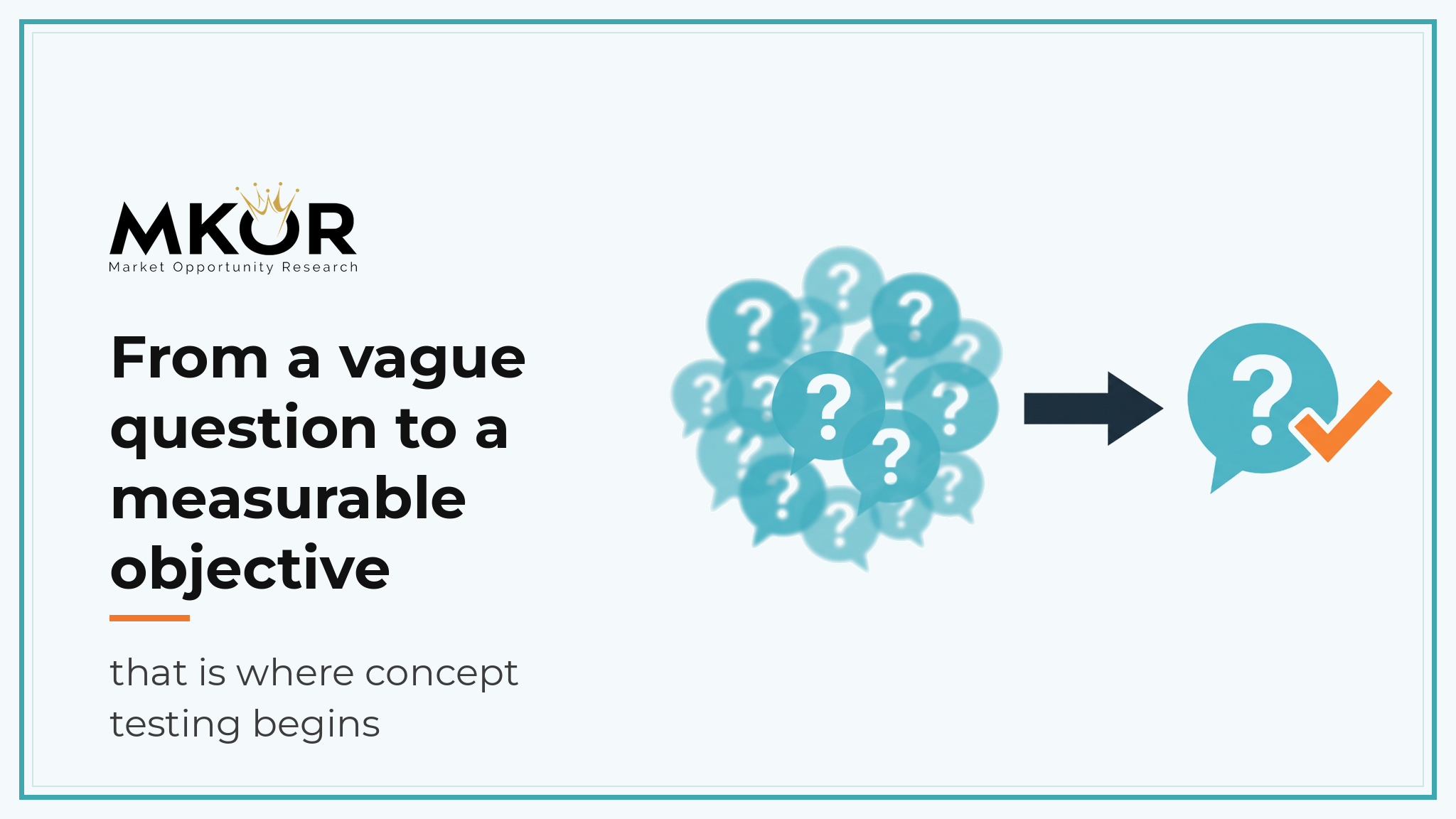
MKOR helps you transform a vague business question into a measurable research objective. We determine if respondents perceive the concept as clear and whether it solves a real problem. We also identify perceived purchasing barriers and the price they are willing to pay.
What you lose if you do not work with us
The cost-benefit calculation is simple:
| What you risk if you decide without data | What you gain if you test rigorously |
|---|---|
| Blind investment: Capital tied up in a product/service the market does not demand. | Demand validation: The certainty that the chosen direction has a real audience ready to buy. |
| Ineffective messaging: Communication effort that fails to convince the consumer. | Identifying triggers: You know exactly which sales arguments make an impact. |
| Distancing from the audience: Unsuccessful launches can affect brand relevance and perception among your own audience. | Alignment with values: You guarantee that the new concept resonates with the audience’s expectations and needs. |
| Decision-making gridlock: The difficulty of stopping an underperforming project due to a lack of evidence. | Strategic objectivity: Clear data that allows you to recalibrate or stop a project in time. |
The most relevant question
Ask yourself how much it costs not to know what the market will do with your idea before spending your budget. The cost of a market research study is easy to find out in advance through a strategic consultancy meeting with MKOR.
The cost of a business decision made without prior testing is rarely visible from the start. But you pay it eventually, from a few thousand euros to millions, depending on the project’s complexity.
MKOR offers an objective perspective that separates your team’s enthusiasm from the consumer’s reality. We transform internal hypotheses into validated strategies so you can take the next step with certainty. Book a strategic meeting today to access our preferential offer, valid until 1 September 2026.