


MKOR & Uniprest Instal Study: The Construction & Installation Market in Romania 2026
The construction and installation market enters 2026 in a phase of heightened caution. Against this backdrop, industry professionals are shifting away from a purely commercial, transactional model towards an increasingly acute need for strategic partnership and genuine technical support.
Together with Uniprest Instal, MKOR has launched the second wave of the study that takes the pulse of Romania’s construction and installation industry. The “Construction & Installation Market in Romania, 2026” study surveyed 100 decision-makers at companies with a turnover of over €1.5 million. The sample was split evenly between builders and installers, to give a full picture of the challenges facing both segments.
The aim of this study was to understand how perceptions have shifted since 2025, and what matters most to the people building Romania, day by day.
Contents
Download the free report “Construction & Installation Market in Romania, 2026” and access the study data.
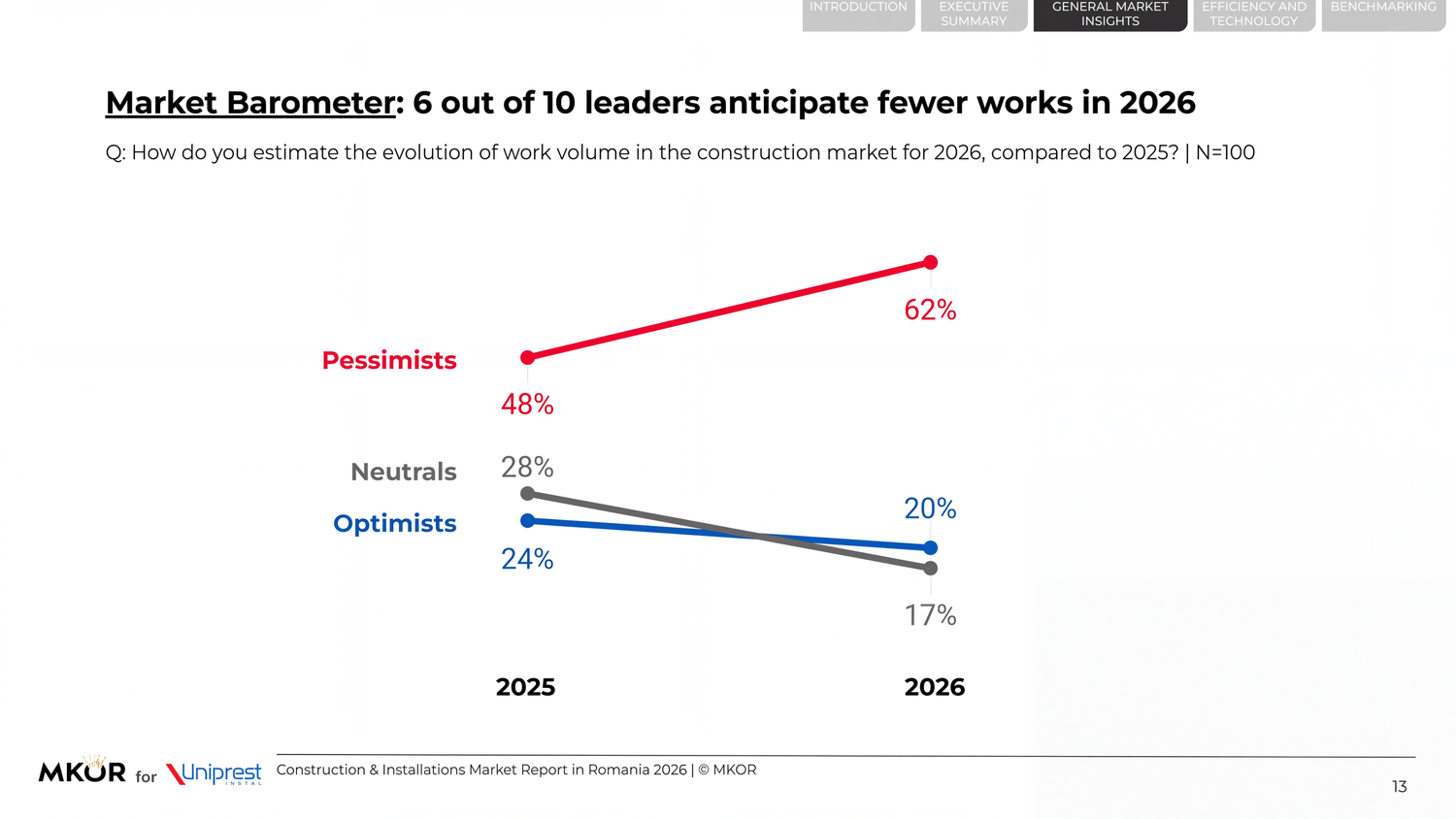
6 in 10 leaders expect less work
Compared with 2025, when 48% of respondents described themselves as pessimistic and 24% as optimistic, the picture in 2026 is different: 62% are pessimistic (a 14-percentage-point rise on 2025), while optimists have fallen to 20%. The neutral group has also shrunk, from 28% to 17%.
67% of firms with a turnover of €1.5-5 million and 67% of those in installations and technical systems fall into the pessimistic camp. Builders, by contrast, are more balanced, with optimists in this segment coming mainly from the mixed and private-project space.
Regionally, pessimism is concentrated above all in the Centre & North-West Macro-region (77% pessimists), while the South-West & West Macro-region has the most optimists (37%).
Challenge #1 is no longer the economic downturn, but people: the skilled-labour shortage has overtaken macroeconomic uncertainty
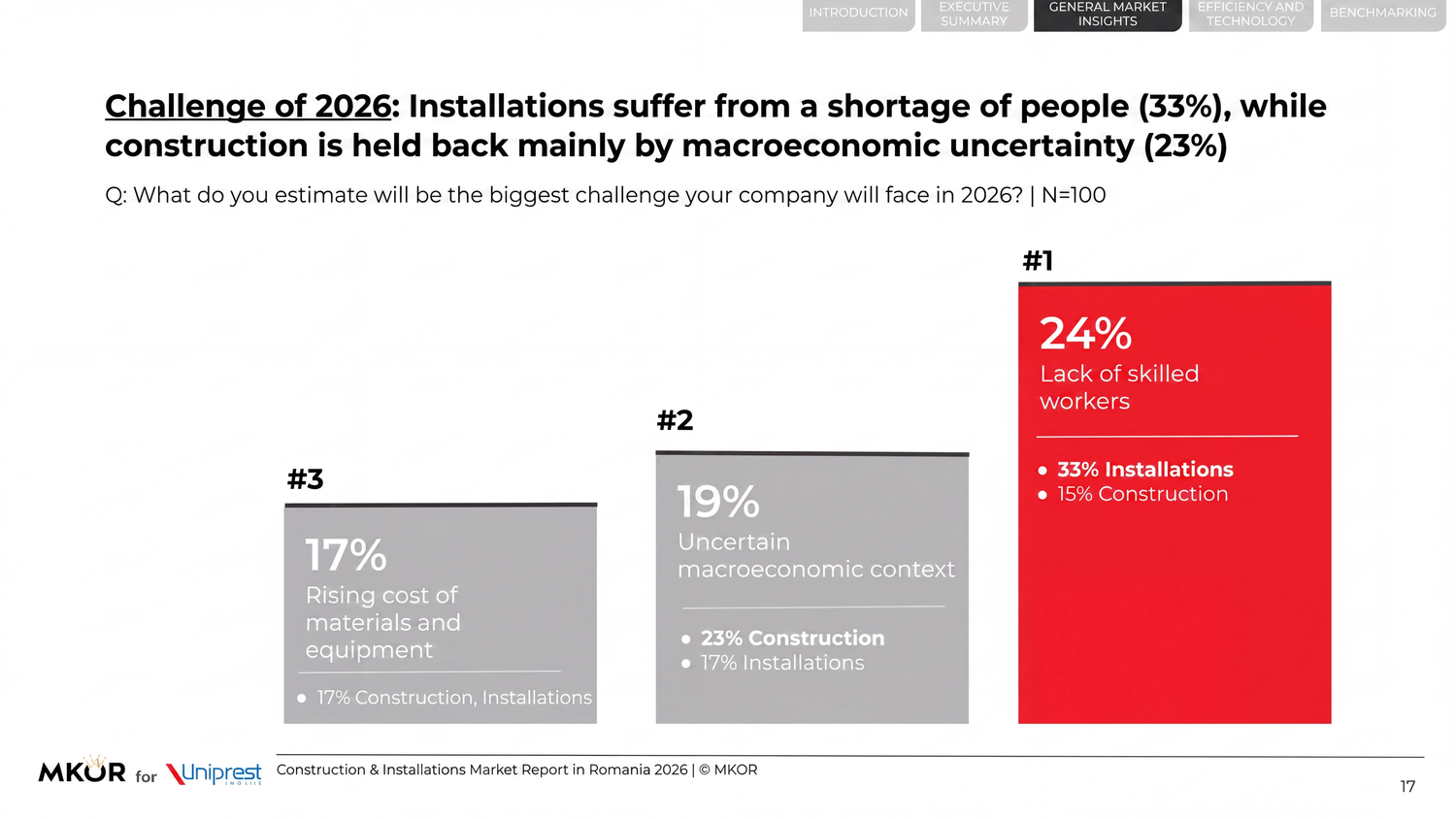
Asked what they see as the biggest challenge for 2026, decision-makers gave an answer that signals a shift in focus: the shortage of skilled staff (24%) has, for the first time, overtaken macroeconomic uncertainty.
However, the analysis by business segment (N=100) reveals two different types of “bottleneck”:
- Installers (33%) run into an internal limitation: for them, staffing isn’t just a challenge, it’s the main obstacle to delivering projects.
- Builders (23%) fear external limitations: they remain more sensitive to economic volatility and the uncertain macroeconomic backdrop.
- Cost pressure (17%) remains a common denominator, affecting both segments equally in budget planning.
MKOR’s strategic insight:
For suppliers, these shifts mean that the strongest sales argument in 2026 is no longer just price, but efficiency: any product or service that cuts installation time or the need for specialised labour becomes a valuable solution for the client.
85% of firms are investing, but priorities have recalibrated: compliance and infrastructure replace expansion
Although the market is cautious, investment intent remains robust: 85% of companies are planning investment in 2026. However, where the capital goes is changing: firms are no longer investing for aggressive expansion, but to secure their delivery capacity and align with regulations.
The recalibration of investment priorities (2026 vs 2025) points to three clear directions:
- Staffing remains priority zero (64%): although slightly down on 2025, staying in first place confirms that the biggest battle is still over attracting and retaining specialists.
- Investment in in-house infrastructure has grown (56%, +9%): firms are investing in their own storage, logistics and equipment capacity to guarantee project delivery.
- Compliance and certification are gaining ground (46%, +10%): this rise is a direct response to the pressure of European regulations on energy efficiency and building sustainability.
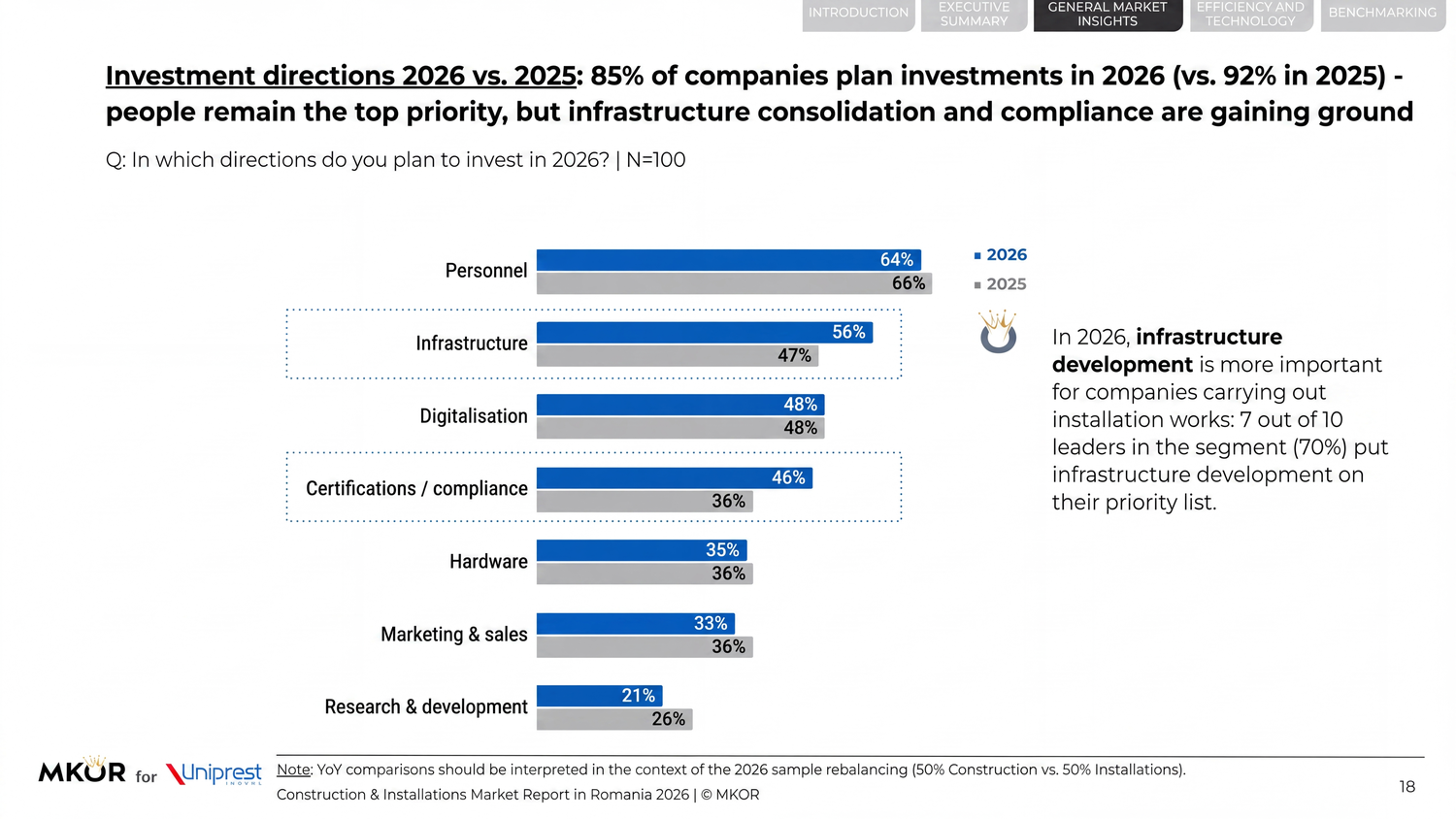
The installations segment brings a distinctly pragmatic note: 7 in 10 installers (70%) put developing their own infrastructure on the priority list. In effect, the industry is “professionalising internally”. Companies are investing in their own resilience (people, tools, certifications). For a supplier, this represents a huge opportunity to offer not just products, but systems that help clients gain certifications, or solutions that streamline their internal logistics.
Download the free report “Construction & Installation Market in Romania, 2026” and access the study data.
The future belongs to mixed and public projects, and to the automation that supports them
Compared with 2025, when mixed projects (34%) dominated future estimates too, their share dips slightly in 2026, but public projects are gaining ground – a shift in perception possibly driven by expectations around the absorption of European funds.
Industrial projects dominate today with 36% of work. Over the next 3-5 years, the market will reshuffle: complex and mixed projects are set to reach 27% and become the fastest-growing segment. It’s the only project type where builders and installers anticipate the same direction.
Builders see the greatest potential in public projects (38%). Installers, by contrast, see the greatest potential in the industrial sector (31%).
Automation and integrated control have moved from premium extras to baseline requirements:
- BMS (Building Management Systems) have the highest anticipated uptake, with an adoption rate above 80%.
- Automation is already built into 1 in 2 private projects and 57% of mixed projects.
- In the public sector, priorities are dictated by efficiency standards: heat-recovery ventilation systems and thermal solutions feature in 69% of projects, backed by energy-renovation programmes.
The market is moving towards “smart buildings by design”. For suppliers, the opportunity no longer lies in selling individual pieces of equipment, but in integrated control and efficiency solutions. End clients have taken the initiative: 87% of installers confirm they receive direct requests for energy-efficient solutions.
The efficiency paradox in 2026: half the market is operationally solid, but monitoring isn’t translating into real efficiency
MKOR’s analysis uncovered an interesting phenomenon: although 93% of companies monitor team productivity, this doesn’t automatically translate into real efficiency.
- 52% of firms are still absorbing substantial losses caused by changes of solution during execution.
- 47% of firms lose valuable resources to design errors or incorrect specifications.
Insight-ul strategic MKOR:
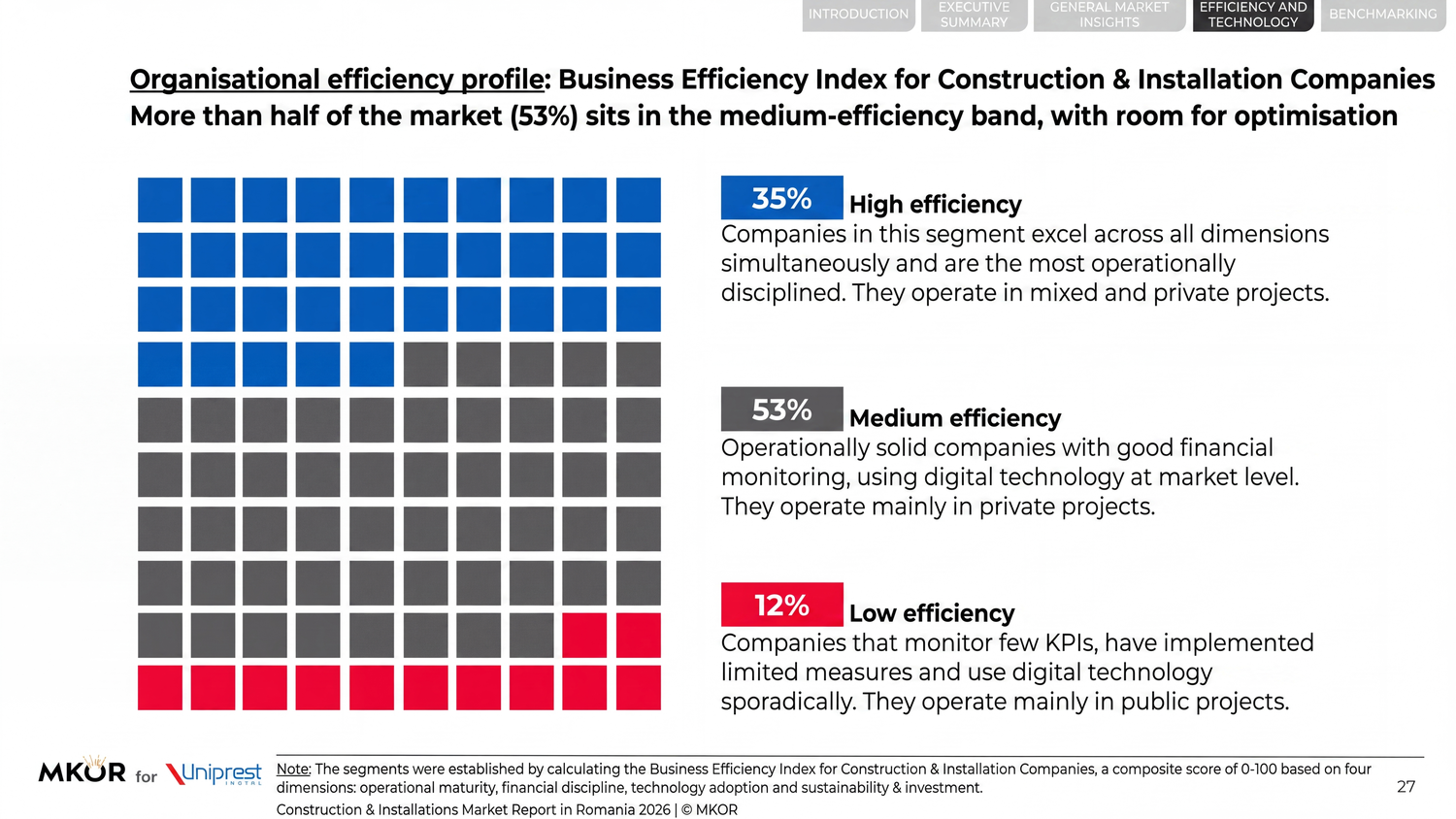
There’s a gap between monitoring infrastructure and the capacity to act on it. The industry has the measurement tools, but lacks operational agility. For suppliers, the opportunity lies in the 53% segment (Medium efficiency): these are the clients who need partners to help them turn monitoring data into real profit, through technical solutions that eliminate design errors.
The industry wants partners, not suppliers: guaranteed stock, fair commercial terms and genuine technical consultancy
Price and quality have become hygiene factors – mandatory conditions for entering the market, but no longer enough to earn loyalty. In an increasingly competitive environment, real differentiation comes from stock availability (38%) and meeting deadlines (40%).
But genuine partnership starts with understanding specific needs, because builders and installers don’t define efficiency the same way:
- Builders prioritise safety and compliance (46%).
- Installers put comfort and lower costs first (42%).
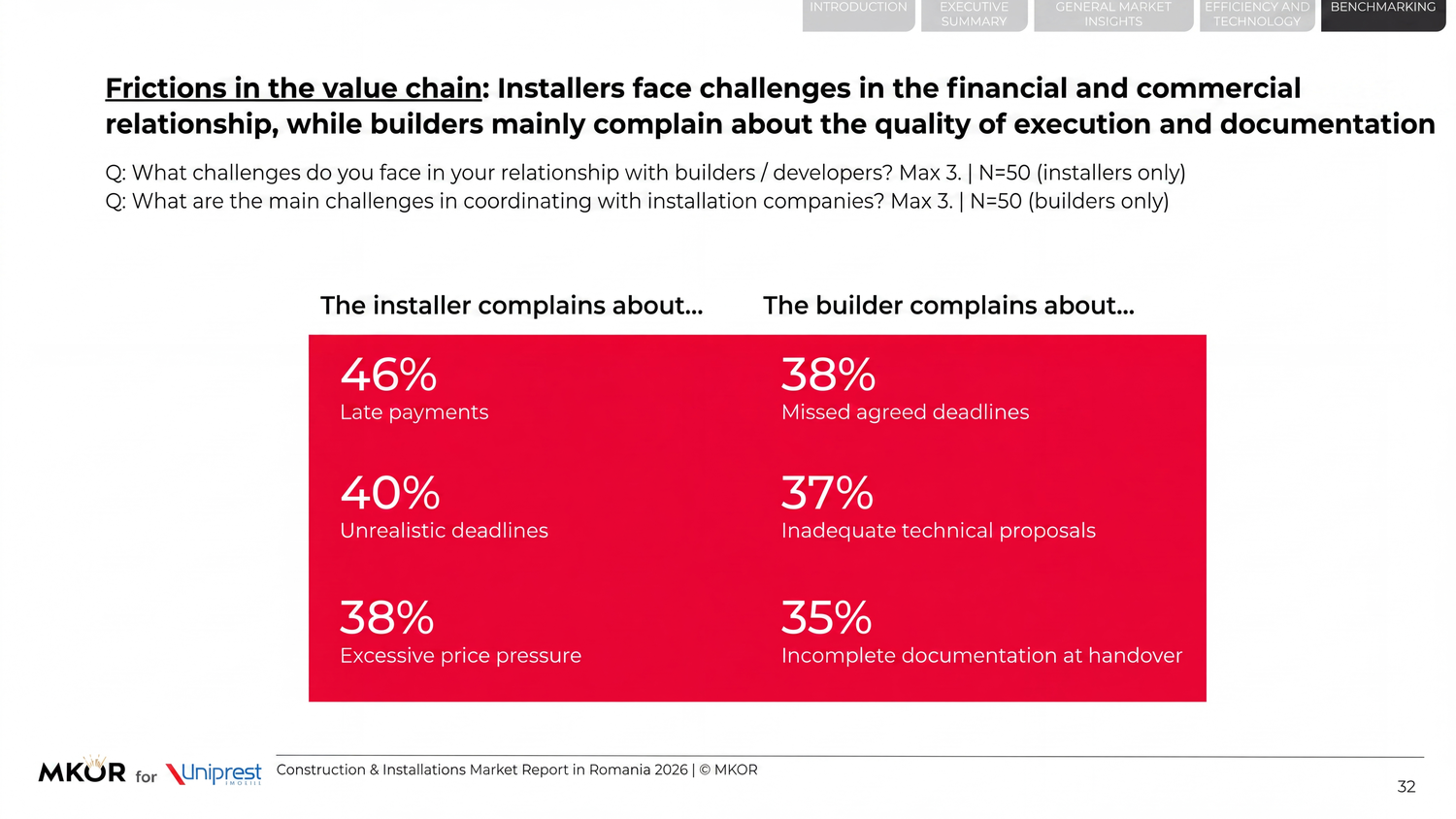
This gap in outlook, fuelled by tensions such as late payments (46% for installers) or missed deadlines (38% for builders), explains why the market is no longer looking for volume alone. What’s wanted are partners offering better commercial terms (48%) and, above all, genuine technical support (35%).
Here’s the voice of specialists on the ground:
Be real partners – meaning we go into a tender together, we supply the materials, and we all wait to get paid, without asking for money upfront.
Owner / Managing Director | Civil & Industrial Construction | €5-10 million turnover
The consultancy side generally doesn’t exist – suppliers just sell and that’s it, without checking what happens next or whether the equipment is correctly installed or used.
Owner / Managing Director | Thermal & HVAC Installation Works | €5-10 million turnover
Conclusions: a more cautious, more demanding market
Romania’s construction and installation market is going through a phase of structural recalibration in 2026. The 14-percentage-point rise in pessimism versus 2025 and the staffing crisis climbing to the top of the list of challenges signal a paradigm shift: investment has moved from aggressive expansion towards strengthening in-house delivery capacity.
Real performance remains sustainable, however, even against this cautious backdrop. The 35% of companies operating at high efficiency standards (the high-performing BEICI segment) show that success is directly tied to digitalisation and operational maturity.
In 2026, a purely transactional role is no longer enough. Competitive advantage belongs to those who can go beyond simple product delivery to offer certainty: guaranteed stock, active technical support and commercial flexibility. 48% of installation and construction market representatives explicitly demand better commercial terms, and 35% demand genuine technical support.
Download the free report “Construction & Installation Market in Romania, 2026” and access the study data.
Good data is the foundation of any resilient strategy. MKOR can help.
At MKOR, we collect data and turn it into decision-making clarity. Our mission is to give companies the strategic foundation they need to act with greater confidence in complex, unpredictable markets.
Whether it’s consumer studies, niche analyses, brand tracking or advanced segmentation (such as the BEICI index), our approach stays the same: we look for the “why” behind the numbers, so you can decide with confidence.
Discover the clients and industries we’ve researched in our project portfolio.
As AI might put it: the question isn’t whether you can afford a market study. It’s whether you can afford to move forward without one.
Get in touch and let’s build the research that supports your business goals together.
Have you read everything? Comment / join our newsletter / read our other research posts!